

WASHINGTON, D.C. — Six companies gathered at an ISS National Laboratory technical session at ASCEND 2026 to describe their progress in in-space manufacturing, commercial space station development, and the computing and logistics infrastructure that will underpin a low Earth orbit (LEO) economy. Taken together, their presentations reflected an ecosystem still being built — but one with real hardware, real data, and real customers. AIAA explores these efforts in a three-part series.
Axiom Space Builds a Biomanufacturing Pipeline in Orbit
Axiom Space holds one of three active development contracts under NASA’s Commercial Low Earth Orbit Destinations program, making it one of the agency’s designated successors to the International Space Station. Its first station module will berth to the ISS no earlier than 2028 and later detach before the ISS deorbits and rendezvous with a second module in orbit to form the first habitable configuration of Axiom Station. These two modules will be ready for crew and enable microgravity research and development to preserve uninterrupted access to LEO. Axiom Station aims to ensure a smooth transition from a government to a commercial platform with continuous crewed operations in LEO.
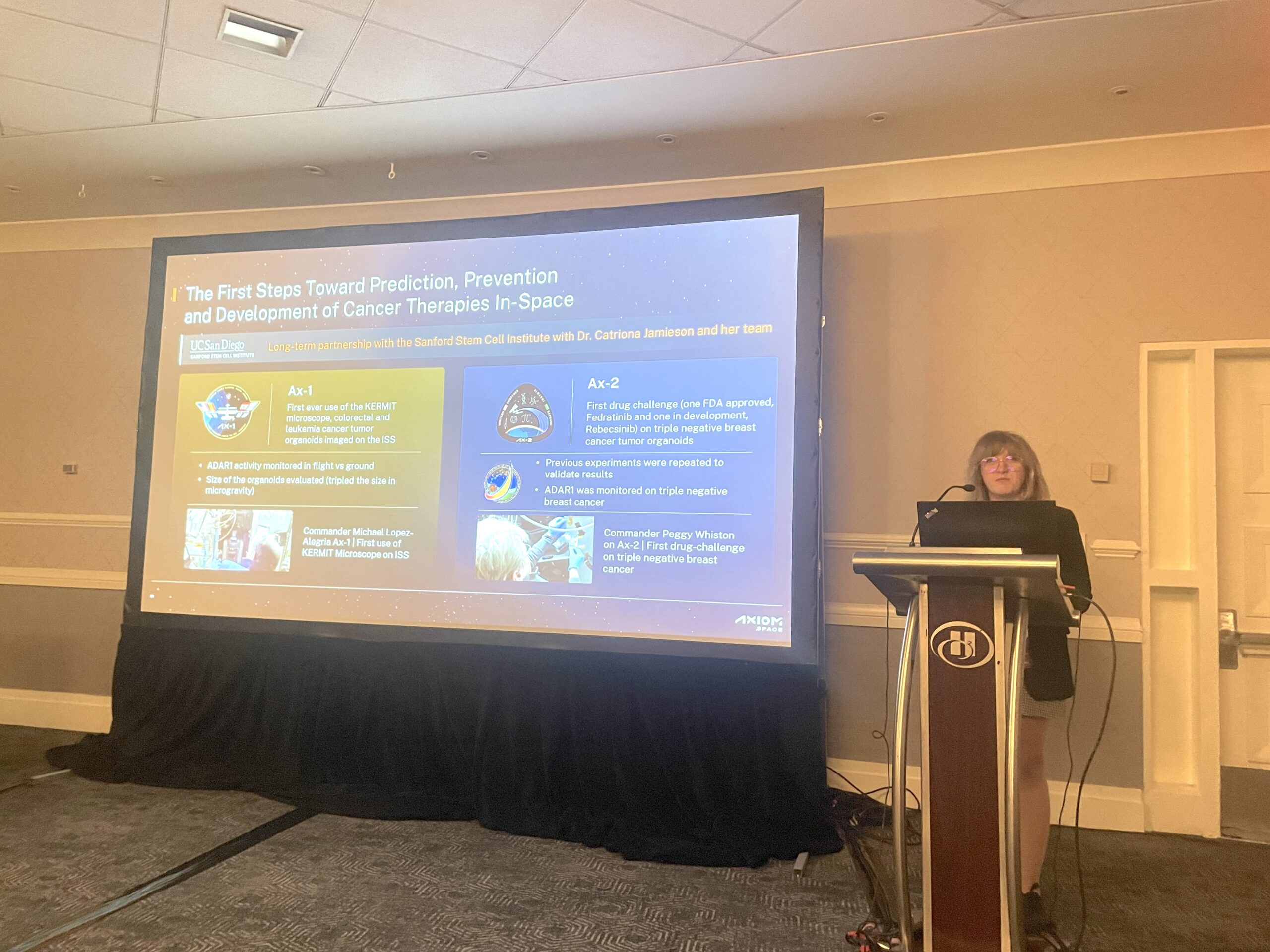
Pinar Mesci, Axiom Space’s global head of Biomanufacturing and Biotechnology, described how the company is using its private astronaut missions to build the research foundation for that station. Microgravity research has historically been constrained by limited flight opportunities and sample sizes too small for publication.
“The problem is because it’s so hard to get to space, you usually get to do your experiments only once,” Mesci explained.
Since its first private astronaut mission in 2022, Axiom Space has flown over 200 payloads with more than 30 countries and 50 organizations, building the flight cadence needed to identify which therapeutic categories benefit most from orbit.
According to Mesci, results span several biomedical areas. Tumor organoids grown in microgravity develop two to three times faster than ground controls, enabling in-orbit drug challenges — including one investigational therapy that has since advanced to IND (Investigational New Drug) status and early clinical trials.
Blood stem cells of Axiom Space crew were assessed to understand the impact of spaceflight and has revealed reversible microgravity-driven changes in immune function; these results were published in Cell Stem Cell. Brain organoid experiments with the National Stem Cell Foundation showed that microgravity can accelerate organoid maturation toward more adult-like states, with potential implications for modeling age-related neurological disease.
“If microgravity can help us make better models with an accelerated maturation that mimics better the adult human brain, rather than a fetal human brain,” Mesci said, “now guess what — you have better chances of finding biomarkers or doing drug screenings for diseases where age is the main risk factor such as Alzheimer’s disease.”
Axiom Space’s University Alliance aims to identify gaps in microgravity research and regional research strengths to connect domestic and international institutions into a translational network, to accelerate scientific discovery — moving results generated on orbit into products and treatments on Earth.
Vast Space Lays Out a Stepping-Stone Path to Its Own Station
Founded in 2021, Vast Space has taken a different path into the commercial station market than the NASA-backed competitors. Rather than waiting for government development contracts, the company chose to build first.
Meghan Everett, principal scientist at Vast Space, described Haven-1, Vast’s first orbital platform, which will fly uncrewed in roughly a year before hosting four 14-day crewed missions. With 45 cubic meters of habitable volume and eight payload facilities, and five commercial partners already committed, Haven-1 is the foundation of a broader bid for NASA’s Phase 2 Commercial LEO Destinations contracts — the awards that will formally designate which private stations replace the ISS.
Haven-1 is a precursor to Haven-2, the multi-module station Vast is pitching for Phase 2. That concept ultimately comprises nine modules, each with international standard payload racks capable of hosting larger experiments.
“Haven-1 is a tech demo flight,” Everett said, while Haven-2 is designed to “bring the lab on Earth to the lab in space.” The company, backed by more than $1 billion in private capital and a recent $500M, now employs more than 1,000 people across offices in Long Beach, Mojave, Tokyo, Houston, Paris, and Washington, D.C.
Related Reading: From the Lab to Low Earth Orbit (Part 2) and From the Lab to Low Earth Orbit (Part 3)