

WASHINGTON, D.C. — Six companies gathered at an ISS National Laboratory technical session at ASCEND 2026 to describe their progress in in-space manufacturing, commercial space station development, and the computing and logistics infrastructure that will underpin a low Earth orbit economy. Taken together, their presentations reflected an ecosystem still being built — but one with real hardware, real data, and real customers. AIAA explores these efforts in a three-part series.
Microgravity Boosts Performance of Cartilage Repair Scaffold
Ian Sands, a research scientist at Eascra Biotech, a nanomedicine company that provides precision therapeutic delivery for hard-to-penetrate tissues, described how the company is using microgravity to improve a regenerative scaffold for damaged cartilage (In microgravity, cartilage degeneration happens more quickly than on Earth.).
He explained that cartilage is difficult to repair: it is avascular, roughly 95 percent extracellular matrix, and current treatments largely address symptoms rather than the underlying tissue. Eascra’s JBNm™ is the company’s injectable 3D nanomaterial designed to repair and regenerate cartilage. It uses proprietary nanotubes mixed with matrilin-1, a protein found naturally in cartilage that both adheres cells and signals them to grow new tissue.
The company describes it as a “scaffold,” because much like a construction scaffold, “the nano-matrix acts as a supportive, porous foundation that attracts the body’s native cartilage cells,” states a story on the material in Upward Magazine.
On Earth, gravity-driven sedimentation disrupts scaffold assembly and limits protein loading. In orbit, the absence of those forces allows each nano-matrix component to align more uniformly, producing bundles three times wider than ground-manufactured equivalents. After three flights, space-manufactured scaffolds bound ten times more stem cells than ground controls, tripled glycosaminoglycan production, and boosted chondrogenic gene expression up to 50-fold in certain biomarkers.
Eascra is now moving toward GMP-quality, clinical-scale production using a continuous-flow microfluidic platform. “The next few years are going to be really exciting,” Sands said.
Varda Space Scales Pharmaceutical Manufacturing on Uncrewed Platforms
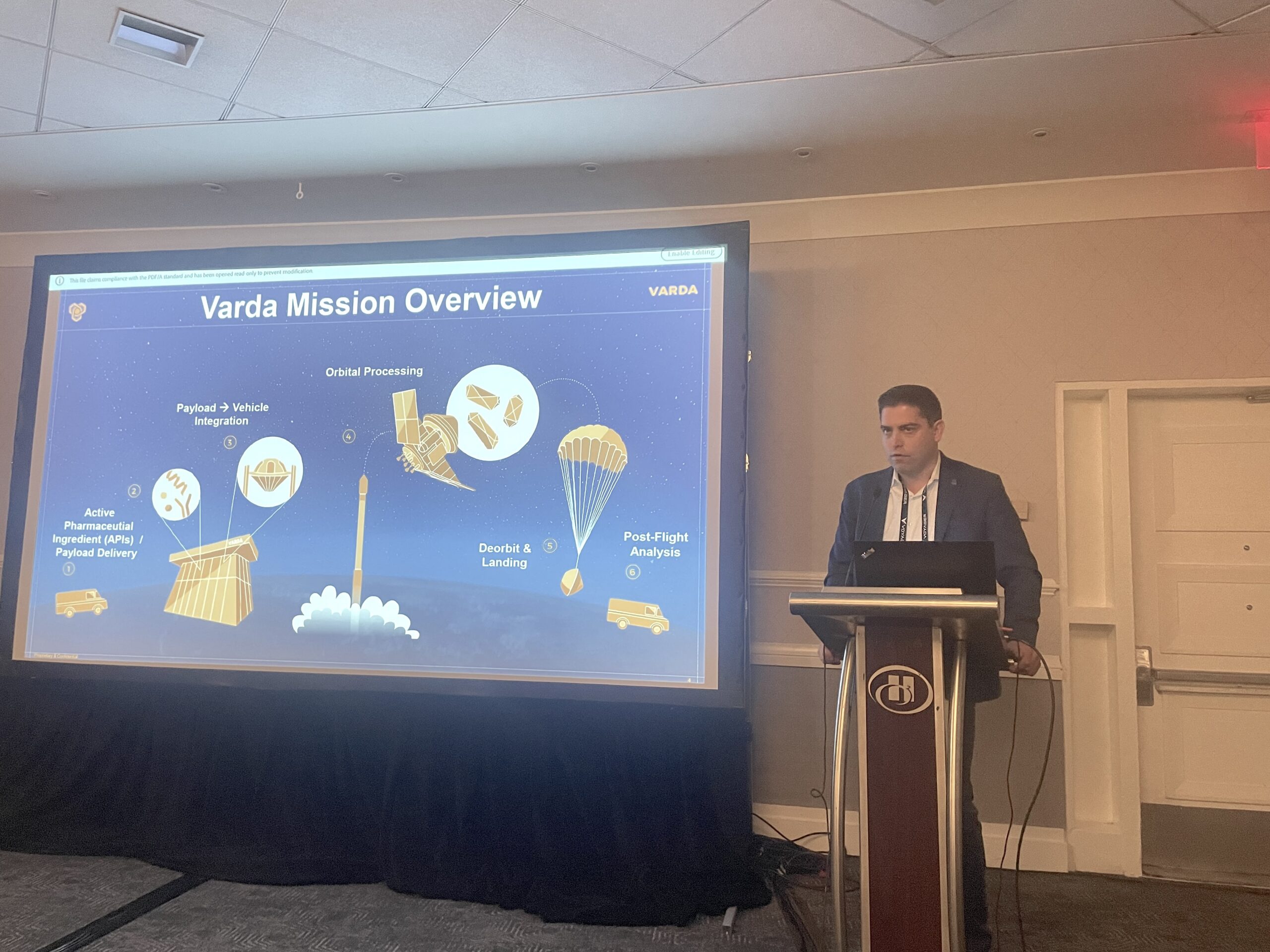
Marchel Holle, director of Civil Space at Varda Space Industries, outlined how the company is building a commercial platform for pharmaceutical manufacturing in microgravity using autonomous, reentry-capable free flyers. Varda targets a subset of high-value biologics and small molecules whose crystal forms can be controlled in microgravity, with the goal of producing drug formulations not achievable on the ground.
The company has flown six missions, returned five capsules, and booked rideshare launches into 2029. One key result was the formation of a new metastable form of ritonavir that remained stable through atmospheric reentry — showing that microgravity-induced crystal structures can survive the full mission lifecycle.
Holle positioned Varda’s uncrewed platforms as complements to crewed stations: crewed destinations serve fundamental science while Varda’s capsules scale proven processes and handle high-potency payloads better suited to uncrewed environments.
“We see a future mixed LEO ecosystem where the collection of this activity makes us much stronger than the sum of our parts,” he explained.
Varda’s lighter capsule allows pharma companies to achieve a high cadence of tests with a platform that has “fewer restrictions to fly,” he said.
Related Reading: From the Lab to Low Earth Orbit (Part 1) and From the Lab to Low Earth Orbit (Part 2)