

1925
Aug. 7-9 — French pilots Drouhin and Landry remain aloft in their Farman F.62 Goliath biplane for 45 hours, 11 minutes and 59 seconds without refueling — a new world duration record. They fly dozens of loops along a 100-kilometer circuit over Étampes, France, the equivalent of roughly 4,400 km. Aircraft Year Book, 1926, p. 120.
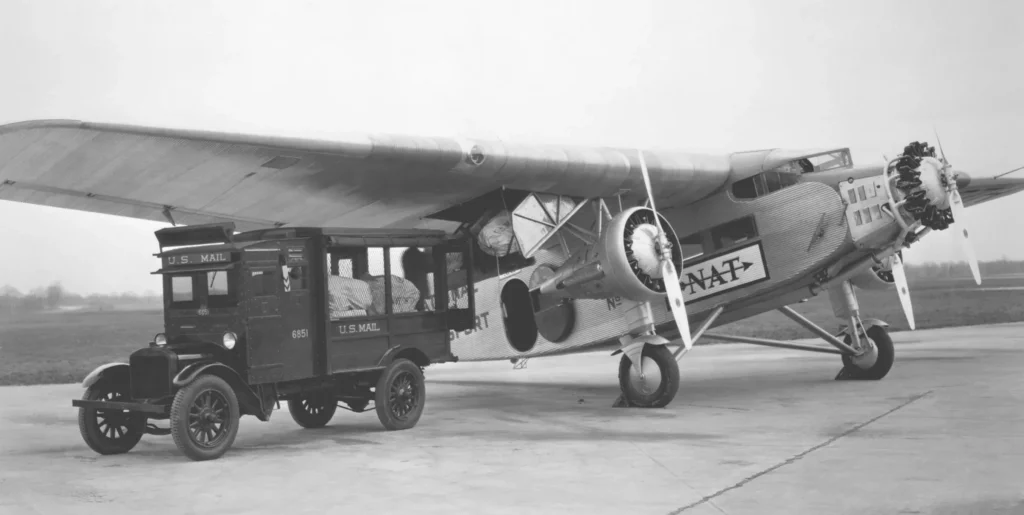
Aug. 15 — Ford Motor Co. purchases the assets of the Stout All-Metal Airplane Co., marking its entry into aviation. This acquisition will soon lead to the development of the classic Ford Tri-Motor series of rugged commercial transports that will help revolutionize air travel in the United States. Aircraft Year Book, 1926, p. 120.
Aug. 25 — As part of the MacMillan Polar Expedition, a fleet of three Loening amphibious planes complete an aerial survey of Ellesmere Island. They fly from the base in Etah, Greenland, under the command of U.S. Navy Lt. Cmdr. Richard Byrd. Aircraft Year Book, 1926, p. 120.
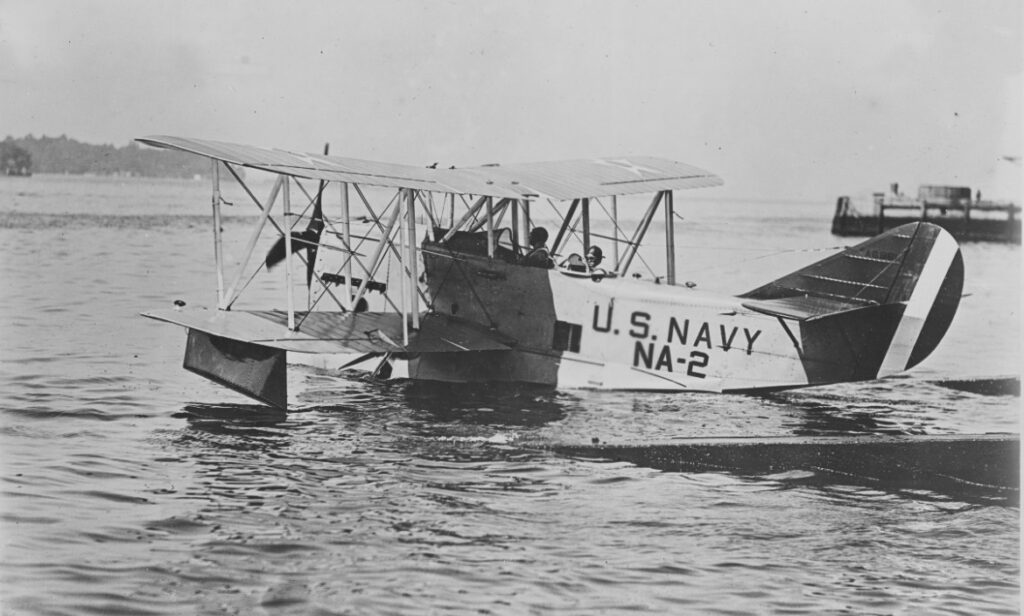
Aug. 31 — U.S. Navy Cmdr. John Rodgers and his crew set a nonstop distance record in their PN-9 flying boat. They depart San Pablo Bay, California, traveling some 3,205 kilometers toward Hawaii before running out of fuel. They are forced to land in the sea several hundred kilometers short of their destination. Presumed lost, the crew repurposes the plane’s components to steer the craft toward land. They are spotted off the island of Kauai nine days later. Aircraft Year Book, 1926, pp. 122-124.
1950
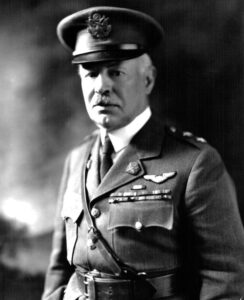
Aug. 1 — The U.S. Air Force renames its Long Range Proving Ground Base in Florida to Patrick Air Force Base. Maj. Gen. Mason Patrick served as the first chief of the U.S. Army Air Service, from 1921-1927. L.G.S. Payne, Air Dates, p. 419.
Aug. 11 — The Fairchild XC-120 Packplane makes its first test flight in Hagerstown, Maryland. This experimental transport, fitted with two Pratt & Whitney R-4360 piston engines, resembles the earlier C¬82 and C-119 but is heavier with a maximum takeoff weight of 29,000 kilograms (64,000 pounds). Its most distinct features are a detachable cargo pod and nacelle-mounted landing gear. Aviation Week, Aug. 21, 1959, p. 13.
Aug. 24 — A RIM-2 Terrier surface-to-air missile intercepts a Grumman F6F Hellcat during a test at the Naval Ordnance Test Station in Inyokern, California. This two-stage solid-fuel missile, design to reach altitudes above 15,000 meters, begins service in 1956 aboard the USS Canberra. U.S. Naval Aviation, 1910-1970, p. 183.
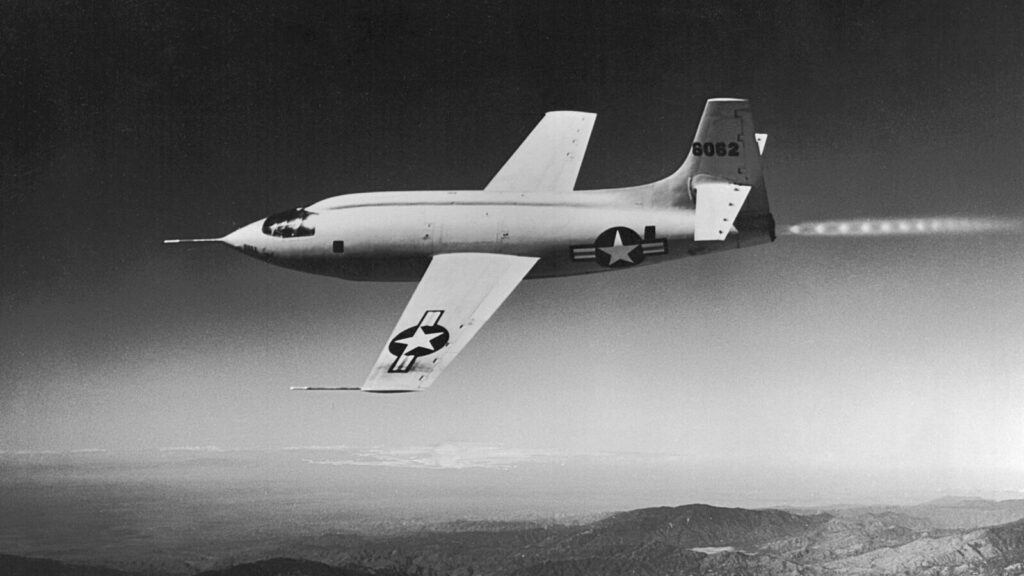
Aug. 26 — During a ceremony at Boston’s Logan International Airport, Air Force Chief of Staff Gen. Hoyt Vandenberg presents the first Bell X-1 rocket plane to Alexander Wetmore, secretary of the Smithsonian Institution. This is the aircraft in which Air Force Capt. Chuck Yeager made his historic 1947 supersonic flight. Gen. Vandenberg says the X-1 “marked the end of the first great period of the air age, and the beginning of the second. In a few moments, the subsonic period became history, and the supersonic period was born.” Remarks by Hoyt Vandenberg, Aug. 26, 1950, in Smithsonian (NASM) X-1 curatorial files; Richard P. Hallion, Supersonic Flight, p. 120.
Aug. 31 — The first mouse is sent to space in a V-2 rocket launched from White Sands Proving Ground in New Mexico. During the flight, which reaches an altitude of 137 kilometers, an on-board camera photographs the mouse to add to the growing body of research centering on the biological effects of high-altitude travel. Willy Ley, Rockets, Missiles, and Space Travel, p. 459.
Also during August — A New York firm acquires Roosevelt Field, Long Island, for real estate development. The field was the takeoff and landing site of various famous flights and aviation milestones, including Charles Lindbergh’s 1927 transatlantic flight, the 1929 “blind flight” by U.S. Army Air Corps Lt. James Doolittle, and the 1929 Guggenheim International Safe Aircraft Competition. Welman Shrader, Fifty Years of Flight.
1975
Aug. 1 — NASA and the Indian Space Research Organization begin transmitting educational instructional programs to some 2,400 isolated villages throughout India. This one-year Satellite Instructional Television Experiment is carried out with NASA’s ATS 6 satellite, with the programming including courses on improved agricultural techniques, family planning and hygiene. New York Times, Aug. 3, 1975, p. 10.
Aug. 4 — Intelsat signs an agreement to transfer three of its pioneering communications satellites to the Smithsonian Institution’s National Air and Space Museum. The artifacts — a backup model of Early Bird 1, the first commercial communications satellite; a backup model of Intelsat II; and an engineering model of Intelsat III — are to be featured in the museum’s inaugural exhibition. Led by Apollo 11 astronaut Michael Collins, the museum is to open in July 1976 to coincide with the bicentennial of the United States. Intelsat Release, 75-224.
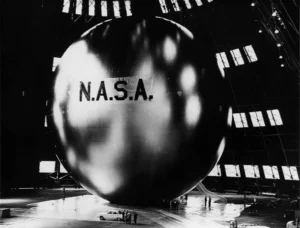
Aug. 12 — NASA commemorates the 15th anniversary of the launch of Echo 1, the world’s first communications satellite. Visible to millions, the 30-meter plastic balloon inflated with gas and coated in Mylar aluminum serves as a passive radio-reflector in space by bouncing signals from one point to another. In its first recoded radio transmission, Echo 1 sends the voice of U.S. President Dwight Eisenhower from Goldstone, California, to Holmdel, New Jersey. NASA Release 61-177.
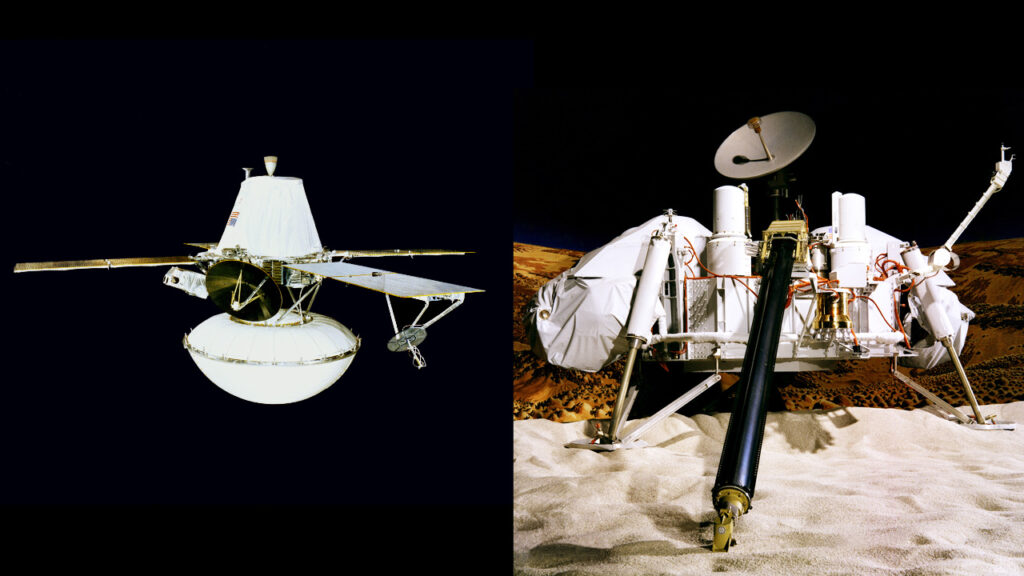
Aug. 20 — NASA launches Viking 1, the first of two identical spacecraft that will become the first U.S. spacecraft to land on Mars. Each Viking consists of a 2,360-kg orbiter and a 1,180-kg lander. The landing is targeted for July 4, 1976, to coincide with the U.S. bicentennial. The Viking orbiters are to make observations from orbit while the landers take direct measurements of the atmosphere and on the surface. Chief among the scientific goals is to examine the Martian soil in search of organic materials. New York Times, Aug. 18-22, 1975.
2000
Aug. 6 — A Russian Cargo spacecraft is launched toward the International Space Station, carrying fuel, scientific instruments and other supplies to prepare the station for the arrival of the four-person Expedition 1 crew in November. These two NASA astronauts and two Russian cosmonauts are to be the first long-duration visitors to the station. NASA, Astronautics and Aeronautics: A Chronology, 1996-2000, p. 276.
Aug. 9 — The European Space Agency’s final pair of Cluster II satellites are launched into orbit by a Starsem Soyuz-Fregat booster from the Baikonur Cosmodrome in Kazakhstan. Named Rumba and Tango, these satellites are to gather data on the physical interaction of the solar wind with Earth’s magnetosphere. NASA, Astronautics and Aeronautics: A Chronology, 1996-2000, pp. 276-277.
Aug. 23 — Boeing launches its third and final Delta III rocket, sending a test article for the U.S. Air Force to geostationary transfer orbit. The company changed the design’s control software after the inaugural flight in 1998, in which the rocket veered off course shortly after liftoff, prompting an automatic self-destruct. Though short-lived, many of the rocket’s components are later repurposed for use on different Delta variants. Spaceflight Now, Aug. 24, 2000.