The next step for cislunar navigation


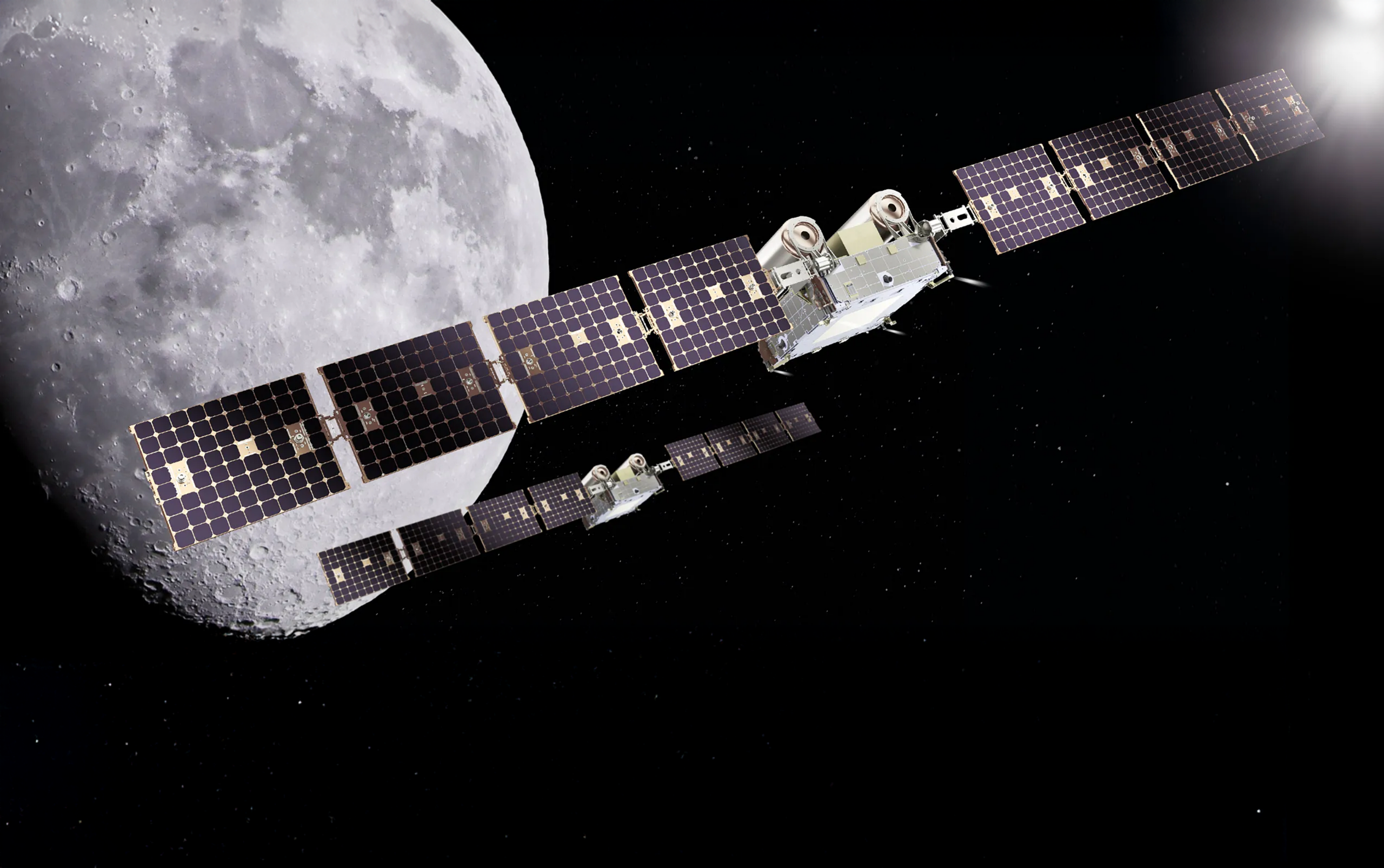
The twin spacecraft slated to be launched next year for NASA’s CAPSTONE 02 mission will attempt a few firsts for space navigation, including the first rendezvous in a highly elliptical lunar orbit.
During the Apollo program, NASA became well-versed in joining up two spacecraft in a low lunar orbit. For each of the six crewed landings, the ascent stage of the lander had to blast off the lunar surface to join the Command and Service Module that had remained in orbit. But those maneuvers occurred roughly 100 kilometers above the surface, where the lunar gravity is stronger. The agency expects the upcoming Artemis lunar missions to use different orbits and rendezvous techniques, and views missions like CAPSTONE 02 as a chance to study those operations.
The mission, led by Advanced Space of Colorado, will attempt to rendezvous two spacecraft in a near-rectilinear halo orbit, or NRHO, in cislunar space where lunar and Earth gravity are balanced. Such an orbit encounters what is known in physics as the three-body problem — the bodies in this case being the spacecraft and the gravity of Earth and moon.
“We have not done that; it’s never been demonstrated,” says Bradley Cheetham, co-founder and CEO of Advanced Space. “The same control laws that you would use in a two-body orbit don’t necessarily extend to a three-body orbit. A lot of the analysis we are doing is breaking new ground, to figure out rendezvous and proximity operations safely, so we don’t have two spacecraft just crash into each other.”
NASA said in an emailed statement that CAPSTONE 02 will “provide first-hand knowledge on the complexities associated with three-body orbits and will inform future crewed and robotic missions that require rendezvous and proximity operations.”
The agency is targeting 2028 for the first Artemis crewed lunar landings, after which it plans to conduct yearly landings to establish a Moon Base near the south pole. NASA has also contracted a handful of companies to land over a dozen uncrewed landers in the coming years.
Although NASA earlier this year halted development of the lunar Gateway that was to be stationed in NRHO, it still considers the orbit a valuable testbed for future lunar operations. Specifically, the “characteristics that will be tested in NRHO are directly applicable to many other lunar orbits,” NASA said in the statement. “The mission is designed to ensure that lessons learned through a demonstration in NRHO would be transferable to other cislunar orbits.”
Whereas spacecraft in low lunar orbit must expend more fuel to stay on course, the gravitational stability of NRHO requires fewer thruster firings. NRHO also affords views of the lunar poles, as well as relatively easy transitions between high-Earth orbits, low lunar orbits and deep-space trajectories. Additionally, spacecraft in NRHO have a consistent line of sight to Earth, ensuring uninterrupted radio communications.
For the first CAPSTONE (Cislunar Autonomous Positioning System Technology Operations and Navigation Experiment) mission, launched in 2022, Advanced Space demonstrated a successful spacecraft insertion into a cislunar NRHO and tested navigation and communication software. CAPSTONE 02 is to build on those learnings by having the twin spacecraft demonstrate rendezvous, flying in formation, and communications with each other and Earth — all in the cislunar environment, Cheetham says.
For example, NASA told me, the spacecraft “will evaluate their relative navigation to one another using both visual imaging from cameras and range measurements from radio signals. The spacecraft will use stars, lunar features, and a variety of ground stations on Earth to determine” their positions autonomously.
Advanced Space is to initially control the satellites from its operations center in Colorado, Cheetham says, but plans call for also testing their ability to function autonomously using NASA software. Demonstrating such operations is essential to ensuring safe lunar exploration, he adds, given the high volume of missions planned.
In the future, “we see dozens of satellites operating at the moon, with landers, rovers, orbiters,” he says. “Most of it will likely be uncrewed, and there’s just not enough ground tracking stations on Earth to manage all that.”
NASA said it “has funded Advanced Space’s work on CAPSTONE 02 at a value of $45 million. We expect that the total value of the Advanced Space contract for the mission with both spacecraft will be approximately $99 million.”
Under the terms of the contract, Advanced Space will own and operate the spacecraft while delivering data to NASA about the agency’s navigation and communications software, thermal performance and deep space radiation, Cheetham says.
“At first, our ground crew will be very involved, but then we want to move to ground observing and confirming and making sure that the autonomous systems on board are working,” he says. “Eventually, we want robotic missions to happen without the ground issuing every single command.”
The two 400-kilogram satellites are to be built by Lockheed Martin company Terran Orbital, with thrusters provided by California-based Stellar Exploration. Terran is modifying its Ambassador spacecraft bus, the same satellite bus it produces for the U.S. Space Development Agency’s Proliferated Warfighter Space Architecture Transport Layer.
“The Ambassador platform has flight-proven avionics and high-rate production architecture,” says Keith Thompson, Terran’s vice president of business development for civil space.
“But I would not call it a bespoke bus, like a snowflake of a bus that can only be used to support this mission,” he adds. “It’s not your one-off spacecraft design.”
Instead, it “demonstrates that we can take our production architecture and tailor its propulsion and [guidance, navigation and control] system for a demanding cislunar deep-space mission.”