Railroad drone sentries
 By Paul Marks
 By Paul Marks
At railroad stations in three major British cities — London, Glasgow and Cardiff — a 50-person startup called SkyBound is now fielding a responsive drone service designed to pinpoint trespassers on the tracks, among other issues.
The idea is that by quickly dispatching quadcopters from secure, automated pods placed near regular railroad troublespots, SkyBound’s pilots can quickly get a visual of any unauthorized personnel to determine what kind of threat they present. This in turn allows British Transport Police to more rapidly intercept and remove them.
Southampton-based SkyBound is among the handful of companies approved to operate drones at designated stations or sections of line by Network Rail, the government-owned entity that owns and run the U.K.’s railroad track infrastructure. The goal is to sharply curtail trespassing and the resulting time and money lost. Network Rail last year estimated there are 19,000 track trespassing incidents annually, amounting to 750,000 minutes in service delays and a cost of £75 million ($101 million) to taxpayers.
“Between April 2025 and June 2026, trespass and fatalities caused almost 14% of cancellations and over 200,000 minutes of delay to SWR and NR Wessex services, making it one of the leading causes of disruption,” South Western Railway, one of the train operators using SkyBound’s service, said in July.
In the view of SkyBound’s CEO and founder, Gemma Alcock, the key to success is more quickly getting information to railroad security teams, who currently “rely on helicopters, which are expensive and scarce, or foot patrol teams who can’t cover the ground fast enough,” she told me in a July interview.
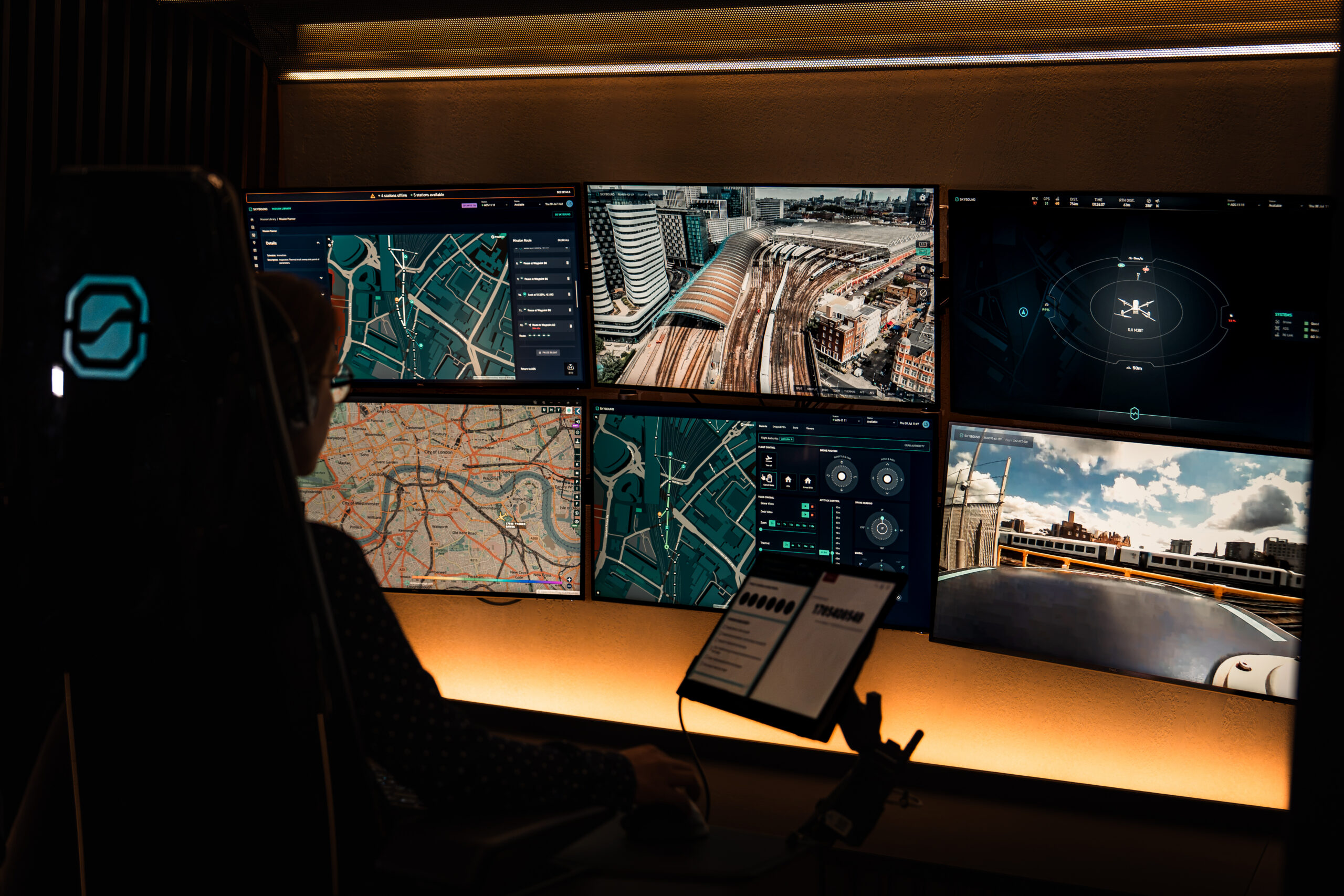
SkyBound’s solution is low-altitude drones that are deployed autonomously from enclosures outside a rail station, on a command from the company’s Southampton control center, to the coordinates of the suspected trespass site.
SkyBound began rolling out this Automated Drone Station (ADS) in late 2025 in the Welsh capital, Cardiff. That was followed by an ADS installation at the English capital’s largest station, London Waterloo, in January, and Scotland’s largest city, Glasgow, in May. Additional stations are slated to be installed later this year at Clapham Junction, Europe’s busiest station; and eventually at the South West Main Line, an express route out of London; and at Walton-On-Thames, Surrey.
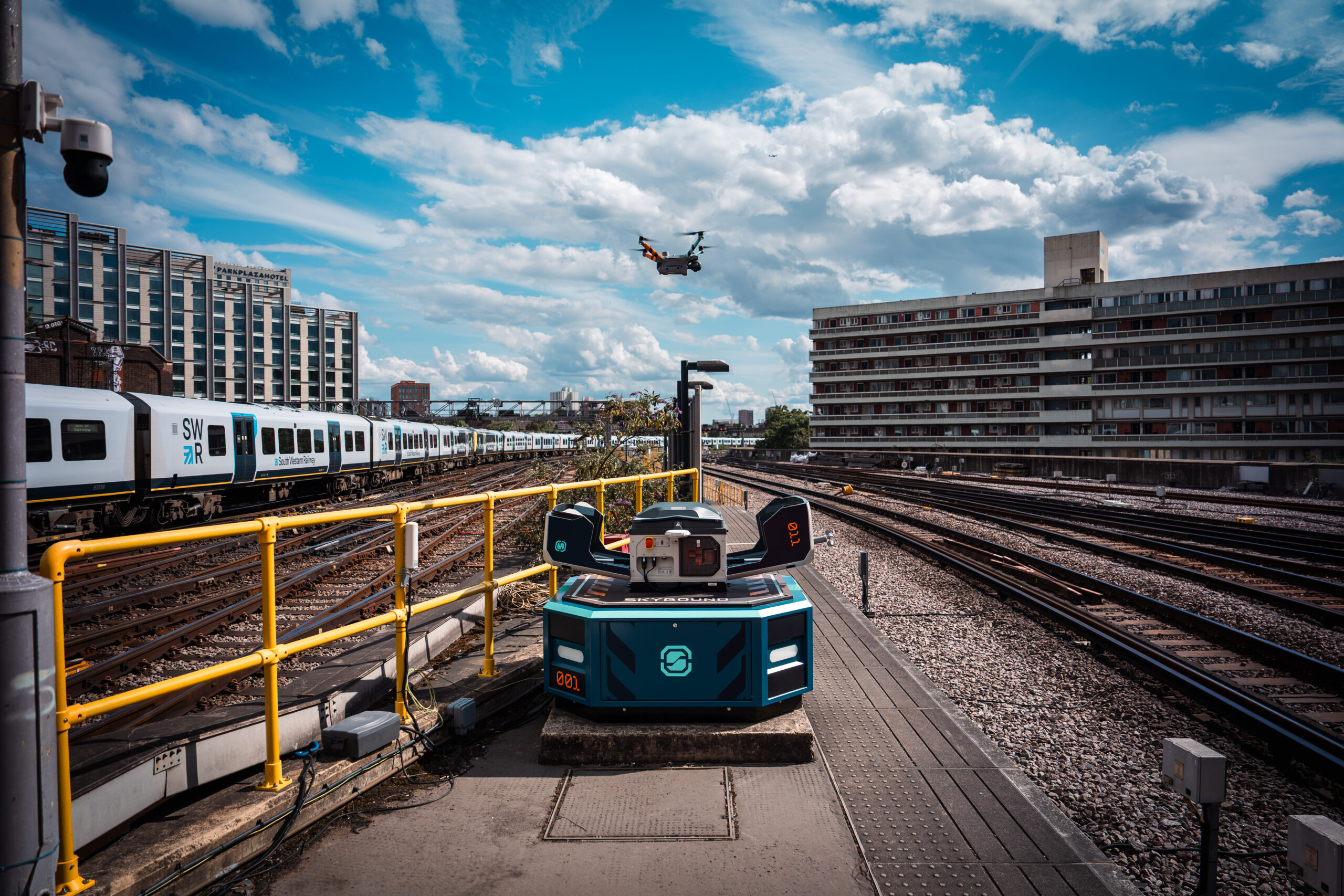
“At Waterloo, our Automated Drone Station is situated just where it’s needed for rapid response to trespassers — at the far end of a platform,” Alcock says. “It’s also used for continuous site awareness and infrastructure monitoring, for which we’re flying patrols every day, spotting faults on the tracks before they have an impact.”
Earlier this year, a drone detected smoke under the tracks, she says. “Waterloo has raised track and a yard underneath it was on fire — and our early detection of that meant firefighters responded and no trains were delayed.”
To see the ADS and SkyBound’s other drone technology firsthand, I took a train to Waterloo on a sunny afternoon in August. On a skinny stretch of platform with clanking trains passing either side, Alcock and James Watt, a SkyBound drone pilot, talked me through their technology.
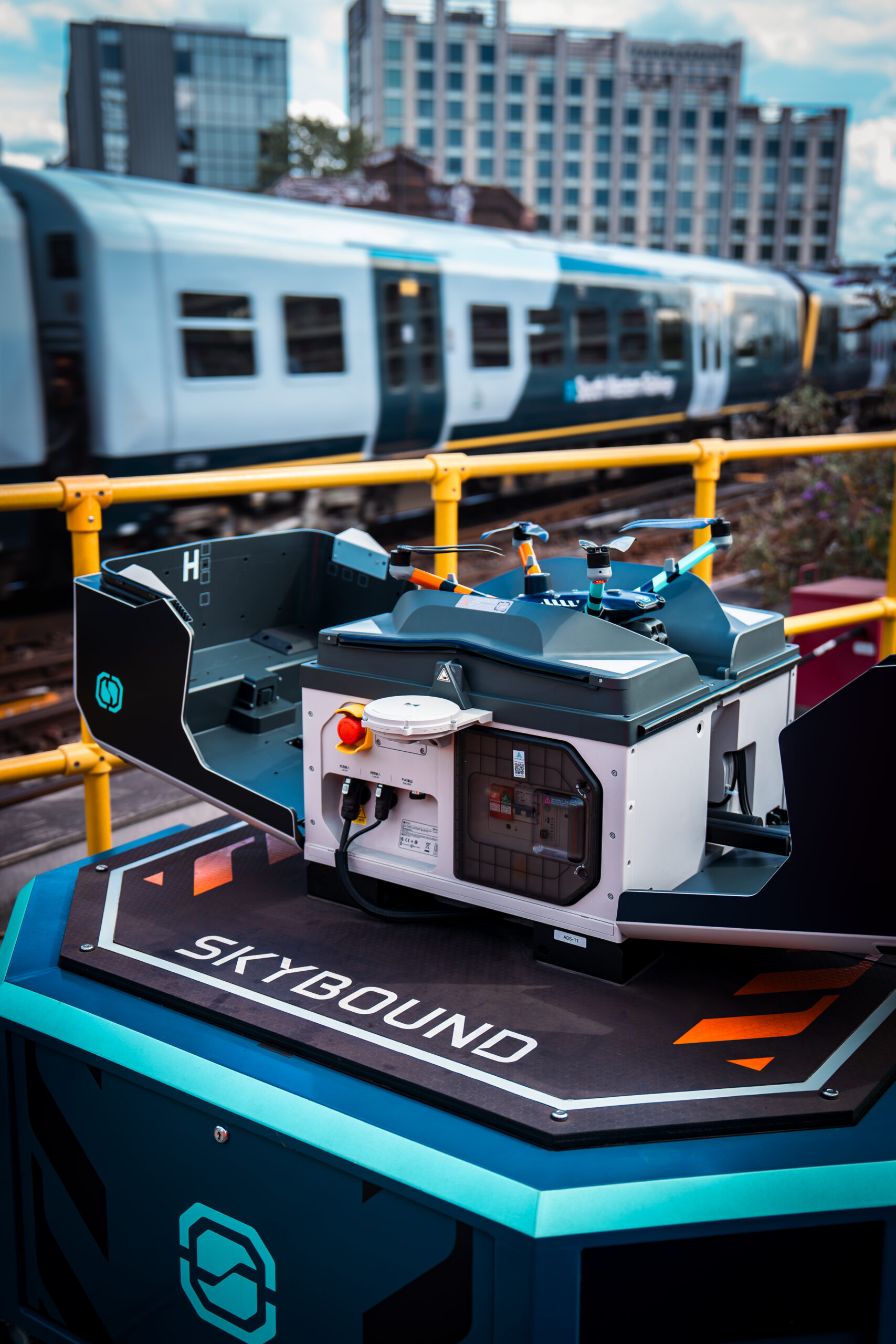
The ADS has two parts: First is a commercially available dock from Chinese drone manufacturer DJI. This cubic box, about 80 centimeters per side, contains the drone — a DJI Matrice 4-series quadcopter — and its charger. That dock, in turn, is bolted to a large plinth that’s about 1.2 meters long and 80 cm high.
SkyBound’s addition to the setup is what it calls the SkyBound Core, a proprietary power, processing, storage and communications unit.
“The ADS automates the takeoff, landing, and recharging of the drone,” Alcock says. The Skybound Core “makes the docking station more resilient and self-sufficient in the field, and it provides, for instance, backup communications, backup power, edge computing and encrypted data storage.”
Depending on local connectivity, the core’s backup communications can include the Starlink satellite service, additional cellular channels or — if the local railroad infrastructure allows — fast Ethernet cabling.
The company needs the core’s deep pool of data storage, Chief Technology Officer Piotr Pladzyk told me in an earlier video call, because the drone’s video cameras, infrared thermal and lidar sensors generate 10 gigabytes of data in every 30-minute flight.
“The video is crazy high resolution, at 4K HD, and at a very high frame rate too, at 60 frames per second,” he says.
SkyBound collects such a high volume, says Pladzyk, so its engineers can generate synthetic data to build ever-more-accurate simulations of the flight environments they operate in. This in turn allows them to research, in simulation, a variety of AI techniques — large and video language models (LLMs and VLMs, respectively) and advanced computer vision algorithms — to iterate and improve how their drones lock onto trespassers and track them automatically.
Tracking uncooperative people is a tough ask, notes Alcock, who earlier in her career participated in drone-based search-and-rescue operations. “A missing person wants to be found,” she says. “A trespasser does not.”
There’s something else SkyBound’s drones must locate: conflicting air traffic.
My visit to Waterloo included a demonstration of how this is done. When it came time to launch the drone, SkyBound coordinators at the Southampton control center checked ADS-B traffic on FlightRadar24 and contacted other nearby airborne services to check for any conflicting flight plans.
London Waterloo is near two medical centers, St. Thomas’ Hospital and Guy’s Hospital, that fly pathology samples between their labs on Matternet M2 drones operated by Apian Health — a 35-minute road trip reduced to a 3-minute flight.
Strict altitude separation is enforced: Apian drones fly at an altitude of around 300 feet, while SkyBound’s fly at 150 ft. London’s helicopter air ambulance services often fly low and fast over central London too. And Waterloo is near the River Thames, which is heavily overflown by helicopters heading for the London Heliport, near Battersea Power Station, and airliners headed east over the river to London City Airport and west to London Heathrow.
Apian has been running its medical drone service since late 2024, and it has achieved full beyond visual line of sight (BVLOS) flight certification from the U.K. Civil Aviation Authority. SkyBound, however, is still flying on visual line of sight (VLOS) rules.
“For BVLOS drone operations such as the Guy’s and St. Thomas’s and police operations in London, we typically use a Temporary Reserved Area or Temporary Danger Area, which only the drone should operate in without prior notification,” says Sophie O’Sullivan, the CAA’s director of Future Safety & Innovation.
She continues: “VLOS, such as the SkyBound operation at Waterloo, requires a remote pilot or visual observer to identify any conflicting traffic and ensure that the drone remains well clear of it. This is much in the same way that crewed aviation avoids other air traffic over shorter distances.”
Separate from the controllers at Southampton, SkyBound has a visual observer at Waterloo with a drone controller handset, who can override Southampton’s point-and-click automation — but they have never needed to use it, says Alcock, so she hopes that role will lapse late this year, when she expects the company to receive BVLOS approval.
“Apian and Matternet work collaboratively with those drone operators who need to fly in close proximity to our operations,” says Louisa Smith, chief aviation officer at Apian. “Much like traditional aviation, we agree how to deconflict in advance, wherever possible.”
This agreement-based uncrewed traffic management (UTM) is likely more loosely coupled than the systems being crafted by the U.K.’s National Air Traffic Services, Alcock notes, “but we can’t wait for those solutions to be rolled out. So we’re kind of having to do UTM ourselves until there’s a supplier that does it.”
All goes as planned for my demo: The SkyBound drone reaches 150 ft, loiters, and captures ultra-sharp footage of the Big Ben clock half a mile away, before switching to thermal imaging mode, which reveals the clock face to be at 16 degrees Celsius. The drone then drops to hover a few feet above the DJI dock, and the clamshell opens to receive it, closing once the drone sits on its charger.
SkyBound is also pursuing additional use cases. Its Southampton control center is colocated with that of the global control room of marine exploration company Ocean Infinity, SkyBound’s major investor. Until January, it was Ocean Infinity whose deep ocean ships hosted multiple underwater drone searches in the Indian Ocean for the wreckage of MH370, the Malaysia Airlines Boeing 777 that went missing in 2014.
SkyBound is fielding its technology on Ocean Infinity’s ships in a number of roles, Alcock says. “In ISR [intelligence, surveillance and reconnaissance] missions in and around ports and maritime environments, in places like Kuwait, we can pair a drone with one of their vessels. It can then fly ahead and find a potentially uncooperative vessel, rather than using the ship to do the search.”
Another potential use case is scanning the water around Ocean Infinity’s vessels that deploy autonomous underwater vehicles, to ensure the area is free of sea creatures when a vehicle is launched or recovered.
“At the moment, they’re using people and cameras” for that task, Alcock says. “A drone can see much further, making sure there are no marine mammals in the area, and that they’re not disrupting their habitat.”