

After a fly-off earlier this year that challenged competitors to build drones capable of lifting four times their weight, DARPA is readying for a second event in 2028.
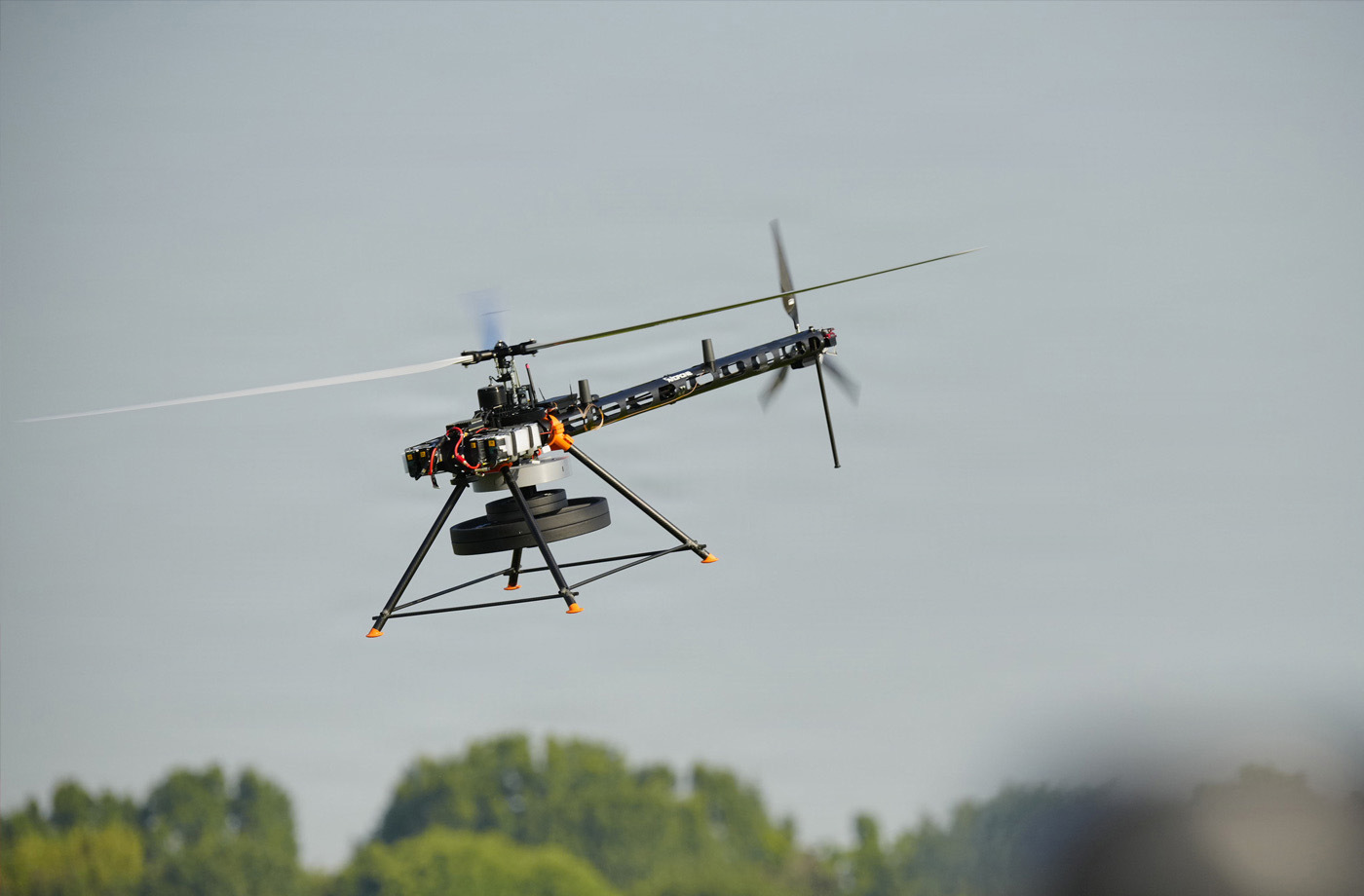
The first DARPA Lift Challenge, dubbed DLC-1, asked participants to move beyond the typical drone payload-to-weight ratio of 1:1 and create drones capable of a 4:1 ratio. It culminated in August with a live-flight competition in Dayton, Ohio, where drones from dozens of teams attempted to complete a 5-nautical-mile course while carrying weightlifting plates.
“We consider that we proved that 4:1 is possible, even though no one actually completed the 5 miles” at that ratio, said Lt. Col. Phillip Smith, the DARPA Lift Challenge program manager.
The first-place team, AVIDrone Inc., achieved a 3.84:1 ratio and won the $1.25 million prize. Another team, DefendTex, won the “Most Promising Technology” category with a “string-based” drone that achieved a 9.63:1 lift ratio — the event’s highest — but did not complete the course.
For DLC-1, a 4:1 ratio was the ceiling. For the next competition, DLC-2, it will be the floor.
DARPA is doubling the lift requirements and preparation timelines for this second challenge, Smith said. Drones must carry at least four times their weight and complete a 10-nm course to qualify. The agency plans to release high-level information on the course in the next few weeks, but details will not be finalized until a venue is selected. Applications are expected to open in early 2027 with the fly-off slated for 2028.
While analyzing technology trends after the event, Smith said the team realized the winning drones were “basic designs. It was helicopters and a quadcopter or a multi-copter — and those designs have been around for a long time.”
There was no shortage of creative drones, he said, but ultimately, “we didn’t see a lot of innovation complete that course because of that short design” timeline.
On average, DLC-1 competitors had nine months to prepare, Smith said. “There were a number of teams who were, up to the last day, trying to get these breakthrough engine, powertrain or aerodynamic function or feature [to work], and they just couldn’t quite figure it out.”
Between these not-quite-realized technologies and other incremental design improvements, DARPA sees the maximum payload-to-weight ratio for heavy-lift drones as “much higher” than experts previously thought, Smith said. “We don’t know what that [limit] is.”
For DLC-2, “we’re excited for more innovative designs to get out there,” he added.
Smith highlighted some of the technologies in DLC-1 he’d like to see further developed: propeller-driven rotors, in which the main drone rotor blades have smaller propellers attached to the ends; engines with the gearbox integrated, a design meant to minimize components to increase efficiency; and multi-unit drone systems, in which two or more drones are tethered together and to a payload, then fly in coordinated circles to carry the weight.
“If all of these different groups and ideas and subcomponents can get together and form the next generation [of drones], I think that’s going to be even better and more impactful to the aviation world than DLC-1 was,” he said.
“In two years, I’m hoping that 4:1 [lift ratio] is not looked at as a one-off novelty,” Smith said. “Maybe the novelty is 20x or 10x.”