

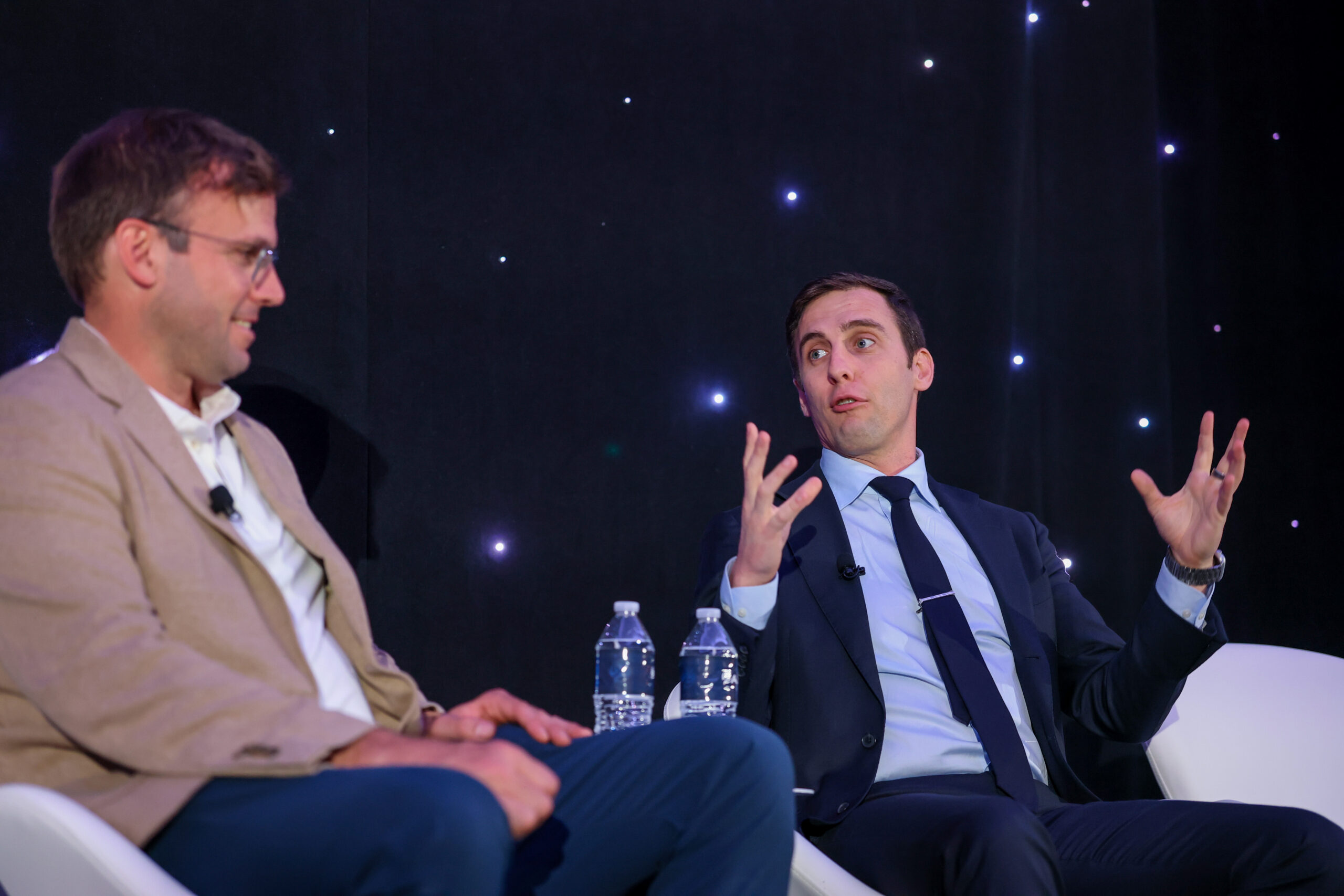
During ASCEND fireside chat, Bruey discusses strategy, a partnership, and running ‘two startups in one’
WASHINGTON, D.C. — Fresh off the reentry of its sixth vehicle over Australia and a newly announced commercial partnership with United Therapeutics, Varda Space Industries is positioning itself as a bridge between orbital research and real-world medicine, CEO and Co-founder Will Bruey said in a fireside chat Wednesday at ASCEND 2026.
In a candid and often entertaining exchange with author and SpaceNews contributor David Ariosto, Bruey said the United deal shows that pharmaceutical companies are starting to treat microgravity as a practical manufacturing tool rather than a research novelty.
“It shows that space drugs have gone from research for science’s sake to research and development for patients’ sake,” he said.
The United Therapeutics agreement is Varda’s first large, publicly disclosed pharma contract. Under the collaboration, Varda and United are reviewing the company’s drug portfolio to identify candidates whose formulations might benefit from microgravity, such as moving from an IV infusion to an injectable.
Bruey told the ASCEND audience that Varda hopes to fly the first drug with United Therapeutics next year and begin manufacturing the drug in microgravity the following year, if results are favorable. He doesn’t expect to inject the first patient with a microgravity-enabled pharmaceutical before 2030 at the soonest, depending on clinical progress.
From the pharma industry’s point of view, “we’re not really a space company for them; we’re a drug company,” he said.
Proving Ground of Space
Varda’s approach builds on work aboard the International Space Station (ISS), where Merck used microgravity to improve Keytruda, its blockbuster cancer therapy. ISS research showed that crystallizing Keytruda in microgravity opened a path to reformulating it from a lengthy IV drip into a quick, subcutaneous shot, making it easier for patients to receive and expanding access.
Bruey pointed to that success as proof that microgravity can be dialed in as a predictable production tool.
“What we’re doing is we’re introducing a gravity knob to the pharmaceutical industry in the same way that refrigeration introduced a temperature knob 100 years ago,” he said. “Cold doesn’t make drugs better per se, and neither does microgravity, but by turning that knob during the manufacturing process, you can create new chemical outcomes.”
Two Startups in One
Bruey described Varda as effectively two startups in one sharing a common vehicle platform. On the pharma side, Varda buys access to orbit via rideshare launches such as SpaceX’s Transporter missions. It then conducts microgravity manufacturing steps using processes co-developed with customers and returns payloads to Earth in compact capsules. On the defense and hypersonics side, that same capsule serves as a low-cost Mach 25 testbed. Varda flies as a secondary payload on a large rocket, then sells access to the high-speed reentry environment to customers who previously needed dedicated launch vehicles—a model Bruey referred to as “delta-v arbitrage.”
“Before Varda, the cheapest way to go Mach 25 was to buy a rocket,” he said. “Now the cheapest way to go Mach 25 is [a] Varda capsule… If you have something smaller than a meter in diameter and you want it to go Mach 25, the cheapest way to do that is taking the Varda capsule.”
Varda is the third corporate entity to bring a commercial vehicle back from orbit, following SpaceX and Boeing, but with a much smaller, non-crewed spacecraft.
Investing and Risk-Sharing
To support both lines of business, Varda channels about 80% of its capital into an assembly line of dual-use reentry vehicles that can fly either pharmaceutical or defense missions. The remaining 20% funds the pharma lab, which develops microgravity formulations and pursues patents and downstream royalties with partners.
Because the same vehicles support government-funded hypersonics and test missions as well as commercial pharma payloads, Bruey said Varda can shoulder more upfront risk for drugmakers, with government work helping underwrite the hardware and operations that pharma customers later use.
Asked about regulatory roadblocks—from the FCC and NOAA to the FAA, FDA, and international treaties—Bruey acknowledged that working through regulation is inherent to pioneering new capabilities but said U.S. agencies have generally been supportive. He pointed to Varda’s work with the FAA between 2021 and 2023, when the company secured its first reentry license.
He expressed a similar view of the FDA, noting that regulators recognize the potential benefits if space-enabled drugs can improve outcomes for patients on Earth.
“If you’re building something that’s never existed before, you are going to, by definition, have to work with regulators, and there will…be friction,” Bruey said.
How Future Generations May View Space
Looking ahead, Bruey said he expects low Earth orbit to feel more like everyday infrastructure as more commercial activity moves into space. He noted that for a child in Kansas, the ISS flying overhead is actually closer than the ocean, yet the ocean feels more real because of visible commercial activity such as oil rigs and shipping.
That could change as spaceflight and applications like in-space manufacturing and drug discovery take off. And for Bruey, the real measure of success will be when a kid in a hospital receives a life-saving drug from space without giving it a second thought.
“That’s actually the goal — in the same way they just take refrigerators for granted.”