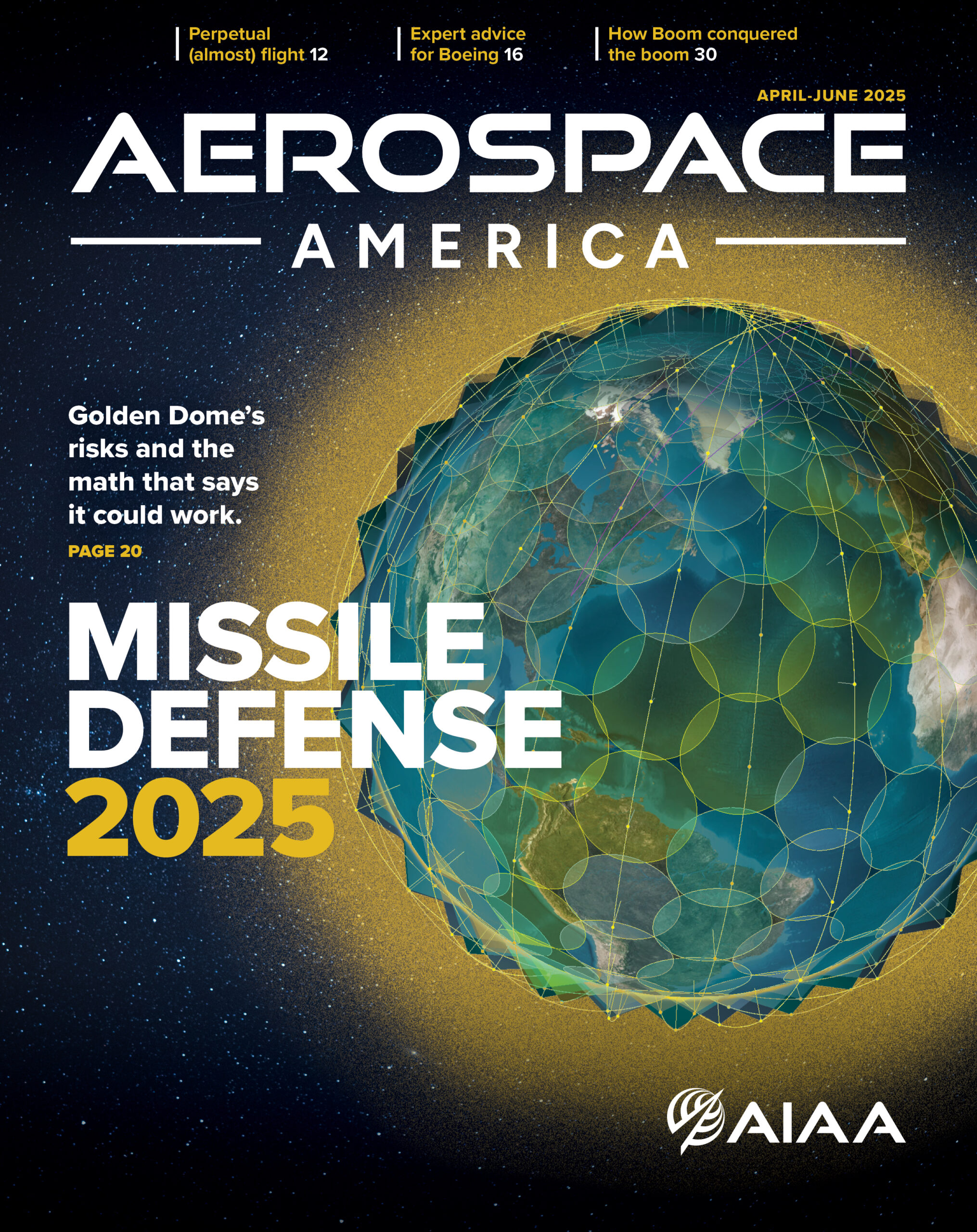



Technical Realities, Industrial-Base Bottlenecks, and the Role of AIAA in Strengthening U.S. Defense Capabilities
Golden Dome for America (GDA) represents the most ambitious U.S. homeland missile defense concept in decades. By integrating terrestrial interceptors, space-based sensors, and potentially space-based interceptors, which are now under early prototype consideration by the U.S. Space Force, it promises a multilayered shield against evolving missile threats and near-space hypersonic systems.[1]
However, recent conflicts in Ukraine, Israel, Yemen, and the Red Sea, combined with outcomes from U.S. war-gaming scenarios of a Taiwan invasion by China, have highlighted the industrial fragility at the heart of this effort. These events revealed that U.S. missile production and supply logistics cannot yet sustain prolonged high-tempo operations, especially when considering operations in multiple theaters.
As the world’s largest aerospace professional society, AIAA is uniquely positioned to help policymakers and industry address these barriers. Through its technical expertise, independent analysis, and standards development, AIAA can help Congress and the Pentagon integrate traditional primes, non-traditional suppliers, start-ups, and academic and research infrastructure into a cohesive defense ecosystem.
Gen. Michael Guetlein, USSF, Director of Golden Dome, and other senior defense leaders have emphasized that GDA’s success will depend on synchronizing these disparate entities into an operational, supportable, and rapidly responsive system, a task as complex as any technological hurdle. While the technology is challenging, ensuring that every link of the kill chain is connected, responsive, and sustainable will be the true test of success.
Introduction to Golden Dome for America
GDA is the latest expression of the U.S. ambition to build a truly comprehensive missile defense shield. Unlike the Strategic Defense Initiative of the 1980s, GDA benefits from mature technologies in composites, additive manufacturing, digital design, and space launch. Yet feasibility will be determined not only by engineering ingenuity and industrial readiness, but also by production capacity, a key area where the United States faces growing strategic disadvantages and challenges.
Simulations by the Center for Strategic and International Studies (CSIS) found that U.S. forces could expend over 5,000 long-range missiles in just three weeks of a Taiwan conflict, well beyond current replenishment capacity.[2] During Israel’s 2025 Twelve-Day War, the United States reportedly expended roughly 100–150 THAAD interceptors, representing about 25% of total stockpile across all combatant commands, alongside Aegis and Patriot interceptors. Combined with Israel’s Arrow and David’s Sling air defense systems, roughly 250 intercepts were conducted, meaning the United States supplied more than half of all intercepts during that brief conflict.[3] To defend an ally for 12 days, the U.S. depleted a quarter of its own stockpile, an alarming indicator of industrial vulnerability.
Ukraine’s reliance on Patriot interceptors further underscored production and operational challenges as Russia adapted its missile tactics to exploit Patriot limitations faster than the systems could be upgraded.[4] Future GDA architecture must therefore be far more agile and adaptable than any system conceived to date, an attribute that must be designed into the program from the outset.
Beneath these operational lessons lies a broader challenge: the U.S. industrial capacity and manufacturing throughput have not kept pace with demand. American defense manufacturing faces workforce attrition, aging facilities, and supply-chain fragility, while China’s vertically integrated manufacturing base allows far faster scale-up and lower-cost production. Structural dependencies on foreign suppliers, particularly for critical minerals and microelectronics, further constrain U.S. capacity.
The Golden Dome Concept
The Congressional Budget Office estimates the total cost of GDA between $161 and $175 billion over 10 years, with $25 billion allocated for foundational space and ground elements.[5] As Lloyd Nelson of Toray Advanced Composites has noted, “the technical means exist,” but the true challenges lie in “power, discipline, and funding.”
In this context, power refers not only to electrical generation capacity for energy-intensive production, but also to computational power and industrial throughput; discipline reflects the rigor of acquisition, testing, and systems integration; and funding, subject to political uncertainty and government shutdown risk, remains the most immediate constraint.
Meeting GDA requirements will require suppliers to increase manufacturing capacity by five to six times, expand domestic supply chains and capabilities, and accelerate material qualification. This statement remains the most consequential reality for policymakers: without a surge in domestic production capability and capacity, no architectural vision can be realized. Estimates suggest a need to increase the skilled labor pool by 30–40%, requiring partnerships with community colleges, trade programs, and universities. We can support this by aligning curricula and certification standards with GDA component manufacturing needs, similar to efforts during the Artemis and Commercial Crew programs. Thus, workforce readiness is a core enabler of the “five-to-six-times manufacturing surge” cited in the paper.
Industrial-Base Bottlenecks
Solid Rocket Motors (SRMs) – SRM production remains highly consolidated, dominated by two primary suppliers. New entrants such as Anduril, Ursa Major, and X-Bow Systems are all building facilities. While Anduril’s Mississippi plant aims to produce 6,000 tactical motors annually by 2026, certification and testing remain constraining factors that could impact that timeline.[6]
At present, the U.S. Office of the Director of Operational Test & Evaluation (DOT&E), the key policy and oversight body ensuring performance and safety, faces a 50% funding cut under recent reforms.[7] Without sufficient oversight capacity, much less a reduced capability, the pipeline for qualification will narrow even further, delaying new entrants and perpetuating risk. The U.S. government must widen the aperture for testing and qualification, reduce costs and time-to-certification, and incentivize redundant capacity.
Seekers and Guidance Assemblies – Missile seekers require precision manufacturing and depend heavily on rare earth elements (REEs), of which China controls more than 70% of global mineral rights and nearly all refining capacity.[8] The strategic vulnerability is obvious and acute: the United States relies on its principal adversary to supply essential inputs for its own missile defense systems. Securing a reliable, alternative REE supply with adequate domestic refining capacity must therefore be a foundational element of GDA’s industrial policy.
Composites and Radome Materials – Suppliers such as Toray are expanding production of advanced carbon fiber, thermoplastic composites, and low-dielectric radome materials.[9] Yet the U.S. government’s current qualification and certification processes are misaligned to support surge timelines. For GDA to deploy on schedule, sweeping reforms in material qualification are necessary, enabling faster adoption without compromising safety.
Microelectronics and Critical Minerals – The July 2025 General Accounting Office (GAO) report found that the Pentagon lacks visibility into its microelectronics supply chains and remains dependent on Chinese sources for critical materials.[10] This paradox of relying on an adversary to field U.S. defensive technologies is not merely ironic but strategically untenable. A concerted industrial and diplomatic strategy to develop adequate domestic production and diversify sourcing is imperative.
Workforce – Workforce shortages represent the single largest constraint to scaling the defense industrial base. The Aerospace Industries Association (AIA) and McKinsey recently identified a deficit of more than 200,000 skilled technical workers across the sector.[11] Apprenticeship programs, technical education partnerships, and national retraining initiatives are essential to meet GDA labor demands.
Standards, Qualification, and the Innovation Gap – Delays in qualification often do not deter innovation, they delay its operational impact. New technologies remain shelved, not rejected. NASA’s Artemis program proved that accelerated qualification is possible: Lockheed Martin and Toray developed a new high-temperature heat shield material in under nine months.[12]
Scaling this success requires more than inspiration, it demands institutionalization. For a program the size of GDA, AIAA recommends a tiered qualification model: low-risk components fast-tracked through standardized testbeds, while high-risk systems undergo expanded but parallel validation. This approach balances safety with speed and is scalable to GDA’s magnitude.
This recommendation draws on established aerospace qualification practices used in NASA and Pentagon programs where risk-based tiering accelerates certification without compromising safety. For example, NASA’s Rapid IV qualification approach and the Air Force’s Agile Acquisition Framework both apply differentiated testing based on component criticality and prior performance data.
AIAA’s proposed model adapts this logic to GDA’s scale—allowing low-risk, proven components (e.g., heritage avionics or materials) to move rapidly through standardized testbeds, while high-risk or novel systems undergo expanded, parallel validation campaigns.
This structure ensures traceable, scalable qualification across thousands of subsystems while maintaining verification discipline.
The Role of AIAA
AIAA offers a neutral, technically credible bridge between government, industry, and academia. Its value lies not in claiming ownership of the workforce or industrial base, but in supporting their development through standards, analysis, and coordination.
- Technical Authority: AIAA convenes expertise across propulsion, composites, and systems integration relevant to GDA.
- Standards Development: The Institute can lead efforts to codify rapid qualification frameworks for materials and SRMs.
- Independent Analysis: AIAA can produce vulnerability maps identifying performance gaps and industrial dependencies, providing Congress actionable oversight tools.
- Workforce Support: Through partnerships with universities and industry, AIAA can help shape the next generation of aerospace professionals, aligning training programs with GDA-specific needs.
- Policy Engagement: AIAA can provide technical input to Congress and the Pentagon on standards, supply chain, and workforce development. We do not lobby on specific programs, but we can ensure that policymakers have technically grounded data to inform legislation and oversight. This can be done in a variety of ways such as:
- Submitting expert testimony on materials qualification timelines.
- Partnering with the Pentagon and NASA to standardize rapid qualification frameworks.
- Producing independent analysis that identify industrial bottlenecks relevant to GDA implementation.
Policy Pathways for Congress
- Establish a Surge Qualification and Test Program. Fund a one-year pilot to validate faster qualification processes for materials, radomes, and SRMs using standardized AIAA-vetted testbeds.
- Expand DPA Title III and IBAS Investments. Target chokepoints in SRMs, seekers, and REEs; measure progress through throughput and time-to-qualification metrics.
- Stabilize Demand Through Multi-Year Procurement. Predictable contracts will encourage private investment in facilities and workforce expansion, while also generating the industrial performance map Congress needs to target gaps effectively.
- Mandate Semiannual Supplier Risk Reports. DoD should provide visibility into microelectronics, REE access, and key materials.
- Require End-to-End Testing. Each GDA increment should undergo independent, operationally realistic evaluation before procurement scale-up.
Conclusion
Golden Dome for America is both visionary and necessary, but its success will depend on collaboration as much as on innovation. The United States must overcome deep-seated industrial, workforce, and supply-chain weaknesses to realize a truly layered defense.
AIAA stands ready to assist Congress, the Pentagon, and industry partners in this endeavor. By uniting technical expertise, setting standards, and supporting workforce development, AIAA can help ensure that the Golden Dome is not merely conceived, but constructed as a credible, sustainable, and effective shield for the nation.
References
- Aviation Week Network, U.S. Space Force Seeks Space-Based Interceptor Prototypes (2025).
- CSIS, The First Battle of the Next War: Wargaming a Chinese Invasion of Taiwan (2023).
- Wall Street Journal, “Pentagon Presses Missile Makers Amid Middle East Surge,” September 30, 2025.
- Financial Times, “Ukraine’s Air Shield Falters—Russia Shifts Missile Tactics to Confuse Patriot Defenses,” 2025.
- Congressional Budget Office, Estimated Costs of a Homeland Missile Defense Architecture (2025).
- Defense News, “Anduril Expands Solid Rocket Motor Production in Mississippi,” August 2025.
- Politico, “Hegseth Cuts Pentagon Testing Office in Half,” September 2025.
- Econofact, “Can the U.S. Reduce Its Reliance on Imported Rare Earth Elements?” (2025).
- GAO, Defense Supply Chains: Risks in Microelectronics and Rare Earth Elements (July 2025).
- Toray Advanced Composites, Building Missile Defense Readiness through Composites (Sept. 23, 2025).
- AIA/McKinsey, Tackling Talent Gaps in Aerospace and Defense (2024).
- NASA/Lockheed Martin, Orion Heat Shield Material Development (2022).