


“If we weaken academia, we don’t just weaken our research capacity, we lose our workforce and we lose the innovation that fuels our economy.” —Rep. Zoe Lofgren at ASCEND 2026
Congressional leaders with oversight of NASA were bullish on the progress of the Artemis program and plans to return astronauts to the surface of the moon and beyond, but also reinforced the clashes ahead on Capitol Hill over steep proposed cuts to the agency’s budget.
“Through Artemis, we have sent American astronauts back into deep space, laying the foundation for a long-term presence on the moon and future missions onto the Red Planet,” Rep. Brian Babin, the Texas Republican who chairs the House Science, Space, and Technology Committee, told the ASCEND 2026 audience in Washington, D.C.
He called the recent 10-day mission around the moon “a remarkable achievement.”
“But it was not just a NASA success,” Babin said. “It was a testament to what American industry can achieve, from propulsion systems to advanced materials, from software to launch capabilities. Notably, he pointed to how “commercial partners played a critical role in making this mission possible. Artemis II demonstrated what can happen when government leadership and private sector innovation come together with a shared purpose. That is the model for the future of exploration in space.”
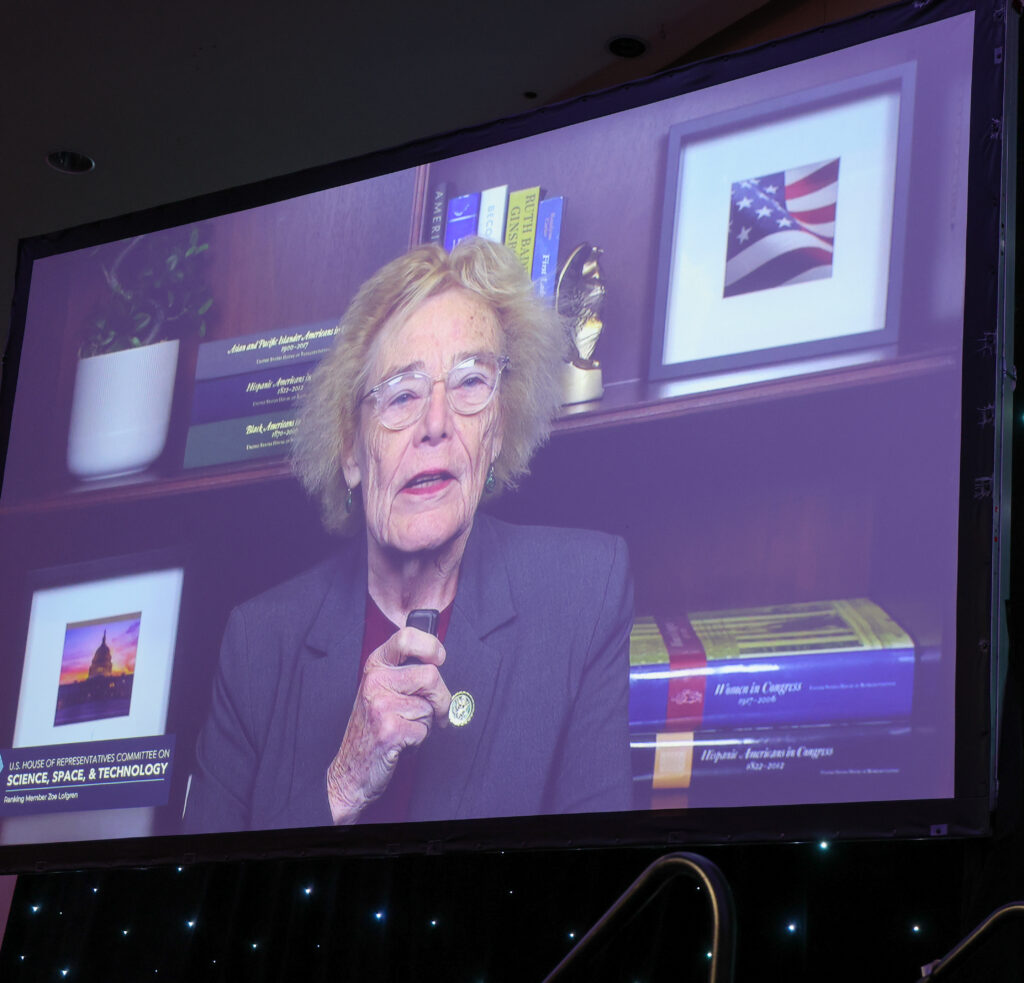
His Democratic counterpart, Rep. Zoe Lofgren of California, echoed those sentiments in separate remarks to ASCEND attendees.
“Artemis II reminded the world what American leadership and space looks like,” she said. “Bold, ambitious, and yes, very technically challenging.”
“These awe-inspiring missions,” she added, “reflect a broader ecosystem at work. Government and industry and academia are all deeply interconnected and in making these achievements possible.”
She said both parties in Congress are committed to the program’s future success. “None of this works without continuous bipartisan support in Congress. We are united in ensuring that NASA and space exploration remains a national priority.”
But it is becoming clearer that they are also united in opposing key elements of the Trump administration’s latest NASA budget proposal. The NASA spending blueprint for Fiscal 2027 came in at $18.8 billion, or nearly 25 percent less than the $24.4 billion that was appropriated for this year. Most of those cuts are in the agency’s science portfolio.
Last month, Babin told NASA Administrator Jared Isaacman in a hearing that “shortchanging NASA is simply not smart,” asserting that “many of the proposed budget cuts were rejected by Congress previously, and I am confident that they’re going to be rejected again.”
Lofgren, in her ASCEND remarks, also previewed the budget clashes to come, particularly proposed cuts to academic, research, and other scientific institutions that support NASA.
“This is where the fundamental science happens, and where the next generations of scientists, engineers, and astronauts are trained,” she said. “And yet at precisely the moment when we should be doubling down on STEM education, we’re seeing proposals that move us in the opposite direction,” she added, specifically citing NASA’s Earth science portfolio.
“If we weaken academia, we don’t just weaken our research capacity, we lose our workforce and we lose the innovation that fuels our economy,” she added. “In a world of intensifying global competition, particularly with China’s sustained investments…this is not a risk we can afford to take.”
“I’m appalled at the president’s proposed budget request for 2027,” she added. “We can’t push the boundaries of what we know, reach the goals we’ve set, and lead in space exploration with this absurd budget.”
“China is on our heels,” she declared. “It is time for the president to get serious about preserving the American science enterprise.”
She predicted that Congress will outright reject the administration’s budget proposal. “And I know many of my colleagues on the opposite side of the aisle agree with me on that.”
Babin said another priority of the committee in the coming months is ensuring that the regulatory framework for space launches continues to be streamlined, noting that he and Lofgren partnered to request a study by the Government Accountability Office on the FAA’s Part 450 commercial space launch licensing process.
“We expect to receive a draft report this summer and a final report this fall,” Babin said. “As commercial launch activity increases in cadence, complexity, and capability, our regulatory framework must remain clear, efficient, and effective. We cannot afford a system where innovation moves at the speed of the private sector, but approvals and permits move at the speed of bureaucracy.”