

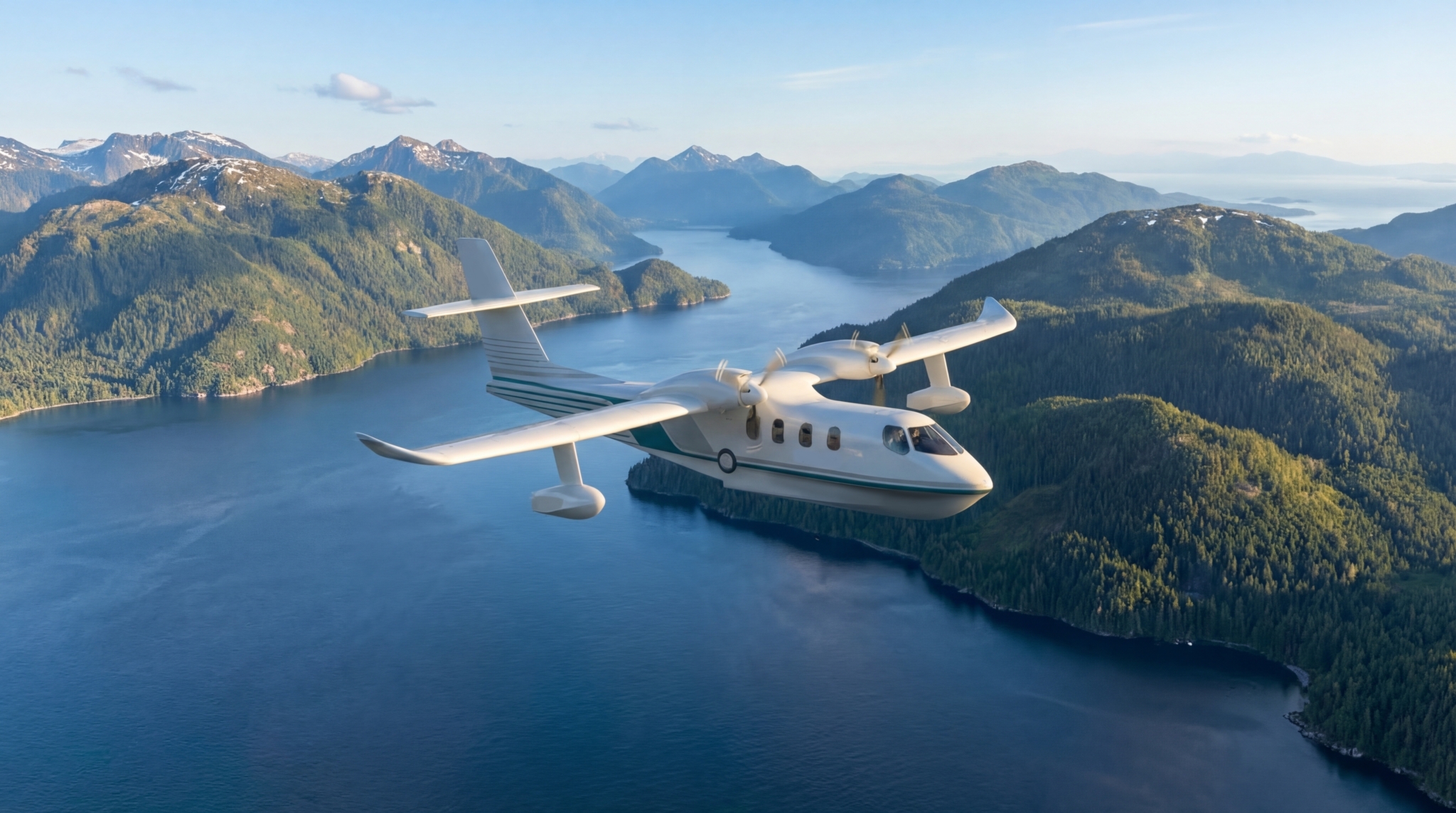
On 12 June, the Seaplane Working Group held a soft-launch event at AIAA AVIATION Forum 2026 to generate attendee and member interest in seaplane and water-flying related aircraft engineering, operations, regulatory, finance, and community engagement. Renewed enthusiasm for seaplanes can be seen in Norway with NOEMI, Canada with De Havilland, and the United States with TIDAL, REGENT, The Flying Ship Company, and Anatra, to name a few, making this an ideal time to convene the group.
While seaplanes have been part of the aircraft conversation since the early 20th century, a few advances in technology, governance, and infrastructure have made them more attractive to inventors and investors alike. The co-chairs of this new initiative, Bruce J. Holmes, D.E., of Holmes Consulting, LLC and Michael Dyment of NEXA Capital, have identified a number of reasons for a renewed interest in water-flying and are recruiting members from industry, academia, and local, state, and federal government with an interest in engaging with the challenges and opportunities of the contemporary seaplane market. They have also invited Yolanka Wulff of the Community Air Mobility Initiative (CAMI), who has previously engaged communities in learning about the value of seaplanes and wishes she could take one from her home island in the Seattle area.
“With roughly 40% of the U.S. population living in a NOAA-designated coastal region, adding the third dimension to coastal travel will provide communities with benefits such as medical and emergency services, natural disaster support, improved mobility access, and more economic opportunities.” stated Yolanka Wulff, Executive Director of CAMI.
Alternative Fuel and Propulsion Systems
Electric, hybrid-electric, and hybrid-hydrogen energy systems provide opportunities for fueling that draw less on current energy sources and infrastructure grids. This could be particularly useful in the Maldives, where waterways outnumber standard runway options. Electrified aircraft may also be quieter and the impact of water degrading the engine may be more limited.
“Electrification changes two things that have always been hard about operating from water: acoustic footprint and corrosion exposure,” noted Holmes, “Quieter aircraft are far easier for waterfront communities to accept, and a sealed motor with distributed propulsors mounted clear of the spray envelope is a fundamentally more durable architecture than what we have flown for the last eighty years. Those are engineering advantages, but they show up as community acceptance and dispatch reliability.”
Certification Pathways
Seaplanes operate at the intersection of aviation and maritime requirements. While aircraft certification and airworthiness remain under FAA authority, operators must also navigate maritime rules and, in many cases, state and local requirements governing water operations. As new aircraft designs and operating concepts emerge, clear and coordinated guidance across these authorities will be important to supporting safe growth in the sector.
Development of Intelligent Multimodal Systems
The German Aerospace Centre (DLR) is leading the COLOSSUS project, which explores connections between aviation and other transportation modes, alongside unique uses for novel aircraft including aerial firefighting and the creation of additional tourist routes to coastal areas. Prajwal Shiva Prakasha, Group Lead at Institute of System Architectures in Aeronautics and coordinator of the COLOSSUS project, presented on its work as part of the Aviation in Multimodal Transportation Workshop at AIAA AVIATION Forum 2026.
“Seaplanes could have a rebirth with revolutionary technologies to foster connectivity and economy in new geographies. A multirole vehicle could also play pivotal role in transporting people, cargo, emergency payload or defense payloads,” explained Prakasha. “A holistic system of systems approach could support evolution of such amphibious flying products.”
The Working Group’s near-term projects include a webinar in fall 2026 featuring leaders from seaplane startups and a white paper on contemporary priorities for the seaplane community, including safety considerations for landing in crowded waterways. “The near-term work is unglamorous and essential: agreeing on what safe operations look like in shared, crowded waterways, and mapping the certification and infrastructure questions that a startup shouldn’t have to answer alone. That is exactly the kind of pre-competitive problem AIAA is built to convene,” declared Holmes.
Volunteers for the Seaplane Working Group are welcome and should reach out to Ashira Beutler-Greene ([email protected]) or Jim Sherman ([email protected]) for more information.
Related Reading
- Are Seaplanes Making a Comeback? It May Be Just Beyond the Horizon – From the Institute (July 2025)
- Norway seaplane startup prepares for propulsion tests – Aerospace America (June 2026)