With Dragonfly mission, NASA faces challenges great and small


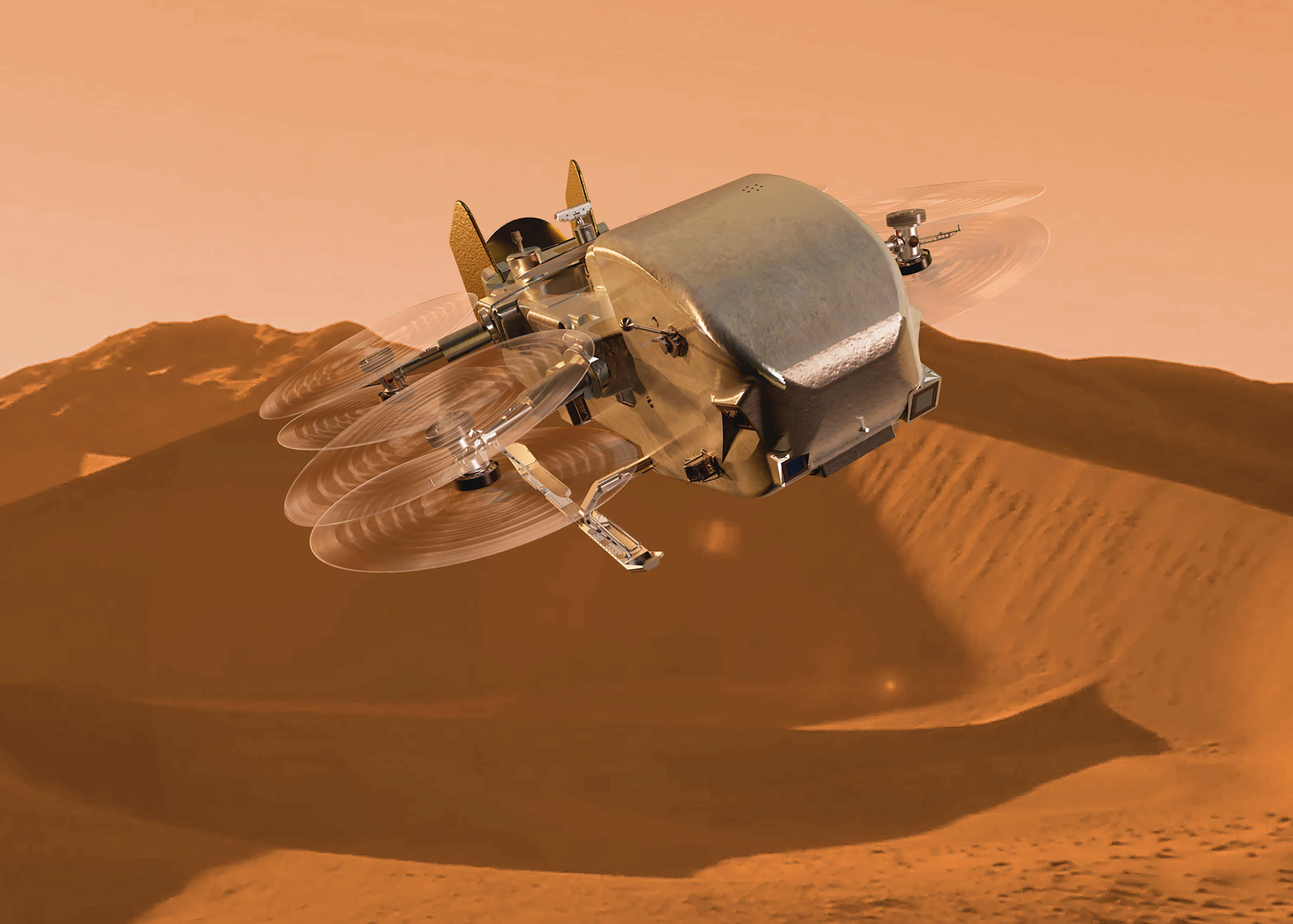
NASA has sent dozens of spacecraft to distant interplanetary bodies over the decades, but none quite like the Saturnian moon that the car-sized Dragonfly octocopter is slated to land on and explore in the 2030s.
To date, the European Space Agency’s Huygens is the only probe to reach Titan’s surface, though it was not intended to function long after landing. Instead, the primary mission was to collect information about the moon’s dense, almost smog-like atmosphere during its slow, 147-minute descent under parachutes. It also sent back tantalizing surface photos of packed icy sand, pebbles and rocks.
The $3.35 billion Dragonfly mission faces a tougher set of challenges, as NASA is aiming for the craft to traverse Titan for at least three years, surveying the surface via a series of short flights resembling leapfrog hops. The agency’s interplanetary rotorcraft experience is limited to the Ingenuity helicopter, which completed 72 flights during its nearly three years on Mars, and Dragonfly will experience vastly different conditions. Titan is about eight times farther away than the red planet, and at their lowest, temperatures drop to about minus 180 Celsius — 100 degrees colder than Mars.
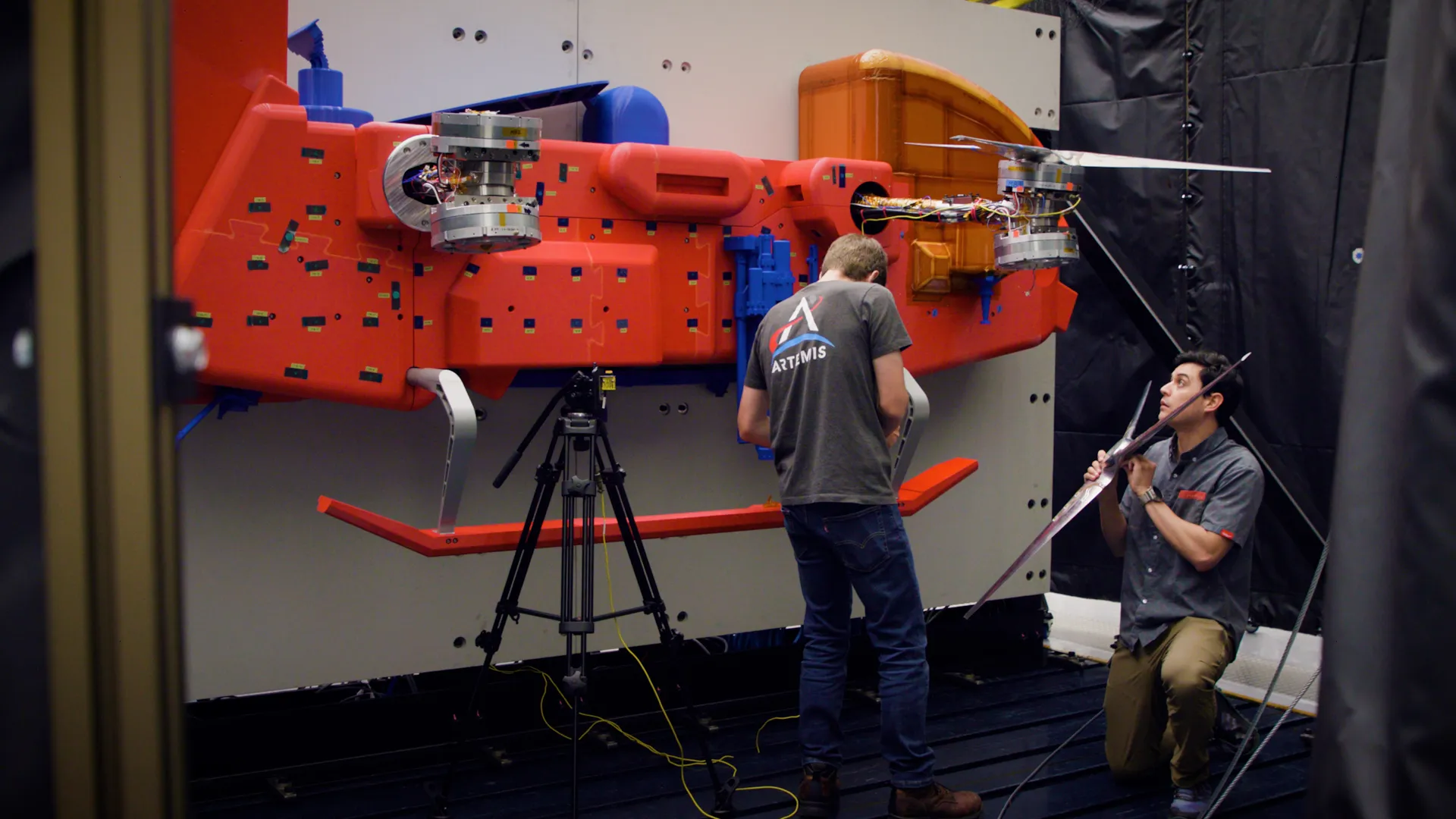
After years of testing rotors, instruments and materials for survival in these harsh conditions, NASA and lead contractor Johns Hopkins University’s Applied Physics Laboratory are now building Dragonfly, in preparation for a launch in 2028. Integration tests began in early February, the first time all of the spacecraft’s components will be tested as a complete system.
It’s impossible to replicate Titan’s atmosphere for testing on Earth, but the Dragonfly team has high confidence in its models, says Michael Wright, NASA’s Dragonfly entry descent and landing lead. Also, past tests have incorporated real data gained from Huygens.
“You’re never getting all the parameters right at the same time,” he says. “It tends to be a bit of a jigsaw puzzle to try to match what you can where you can and then put all the pieces together into an integrated simulation of what will happen when we get there.”
From the onset, NASA knew Dragonfly’s nearly two-hour descent through Titan’s atmosphere to its surface would present different design challenges than those encountered by Mars spacecraft, which must survive the “seven minutes of terror” plunge. These included sizing the drogue parachutes “to provide sufficient stability to overcome” any problematic oscillation during the long duration, Wright says. He compared it to pushing an unoccupied bike to another person: “You can push a bike 3 or 4 feet to your partner, and everything will be fine. If you want to push it 300 feet, you better make sure that bike is very carefully balanced.”
For much of the descent, Dragonfly will be encased inside an aeroshell. Then, closer to the surface, it will spring free and spin up its rotors to search for a landing site in what NASA expects will be a relatively flat, smooth region. Plans call for the initial flights to avoid areas with boulders, mountains or what are thought to be oceans of liquid methane, but mission planners would like Dragonfly to eventually explore more diverse terrain.
Delay in reaching a landing zone and becoming fully operative could also pose a problem, because the octocopter is being designed to only fly for about 30 minutes before it must land to recharge its batteries on its internal nuclear power plant. However, Wright is confident designers have eliminated that risk.
“Once the lander is released, it is only a matter of seconds before it is working to achieve stable flight, and the 100-plus minutes of time spent on the parachute prior to that moment are no longer relevant,” he says.
In parallel, researchers at Embry-Riddle Aeronautical University’s Daytona Beach campus have spent years simulating and studying the possible impacts of debris being kicked up by downwash or outwash from Dragonfly’s rotors, two of which are stacked on each of four short metal booms extending from the body. They identified problems with air pressure interactions between the rotors, which prompted NASA in 2023 to shift the alignment of the dual rotors so they are tilted toward each other on their outer edges farthest from the craft’s body.
NASA also made several alterations to flight control software to account for drafts and unsteadiness during landing and to reposition some sensitive instruments to protect them from debris.
“Whenever the lander approaches the ground, you get not just debris but also unsteady loading on the vehicle,” says Jackson Asiatico, an Embry-Riddle Ph.D. candidate researching Dragonfly interactions. “Helicopter pilots here on Earth are trained for that, but with an autonomous vehicle, you have to build that into your flight controller.”
Staying warm
Given Titan’s frigid temps, NASA’s initial concern was how to ensure Dragonfly didn’t get too cold to operate. However, scientists were surprised to discover in the early design phase that the spacecraft’s nuclear thermo- electric generator — the same power source for the Curiosity and Perseverance Mars rovers — ran the risk of getting too toasty.
“There can be a slight breeze on Titan, and we had to design for that potential to stay warm with a breeze,” says APL’s Elizabeth “Zibi” Turtle, Dragonfly’s principal investigator. “But conversely — surprisingly enough — that means the lander could overheat if you have a completely calm day. In testing, we were able to demonstrate that the system and its thermal management software could react to that.”
If there’s a problem, mission controllers have no way of quickly connecting with Dragonfly. Radio signals will take up to 90 minutes each way to travel between Earth and Saturn. So the rotorcraft and its computers will be in charge most of the time. To account for that, NASA and APL established a series of software decision trees for several common scenarios Dragonfly could encounter, to help the rotorcraft’s flight computer determine when Dragonfly should land immediately, hop to a new location nearby, scout for the next site or return to its last landing site.
For instance, if there’s a problem midflight and “we are halfway or more to our designated safe landing site, we’re just going to continue going to our safe landing site. If we are not that far along our trajectory, though, we can return to the takeoff site,” said Michael Marshall, a Dragonfly guidance and control engineer at APL, during a presentation at AIAA’s SciTech Forum in January.
Marshall said the lander will keep a running list of five suitable nearby landing sites, based on previous aerial reconnaissance, in case of emergency.
Scientists will continue to test and verify Dragonfly’s responses to “in-flight anomalies” or a bad landing, he added.
“There’s a bunch more work going on behind the scenes to actually rigorously test and verify that these [contingencies] are going to behave as we expect across all sorts of known and unknown uncertainties,” Marshall said.