Shape-shifting aircraft wings
 By Paul Marks
 By Paul Marks
To most of us, the word “airplane” conjures a very specific mental picture: a rigid tube-and-wing airframe peppered with familiar components like ailerons, flaps and elevators, whose roles in flight are pretty much set in stone. But talk to Martin Radestock, a senior adaptive systems engineer at the German Aerospace Center (DLR), and you may come away with a different view.
Radestock and his colleagues in DLR’s Institute of Lightweight Systems in Braunschweig, Lower Saxony, believe aircraft could be capable of adopting far more fluid and adaptive structures, ones in which the shape of flight control surfaces can morph into smoother profiles that reduce drag and increase fuel efficiency. Ultimately, Radestock envisions a future in which aircraft fuselage surfaces are capable of morphing too, he told me in a May video call.
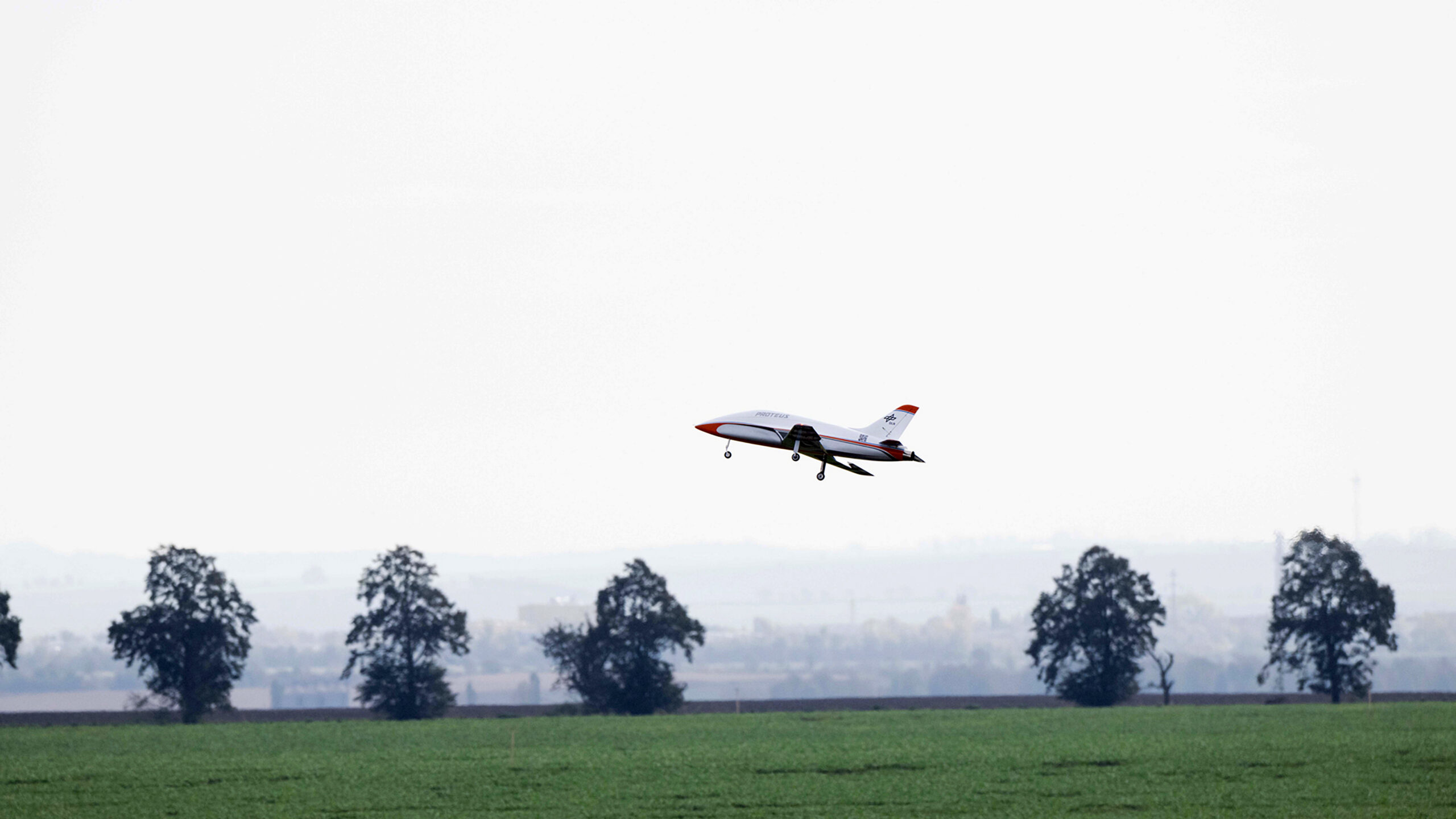
All these ideas stem from a DLR project called Morphing Technologies and Artificial Intelligence Research — morphAIR for short. Under this €1 million ($1.16 million) initiative, engineers fitted a 70-kilogram drone with a morphing trailing edge that spans the full length of its 3-meter wings. That drone, called Proteus, in April finished a series of seven remotely piloted flight tests at DLR’s National Experimental Test Center for Unmanned Aircraft Systems in Cochstedt, Saxony-Anhalt.
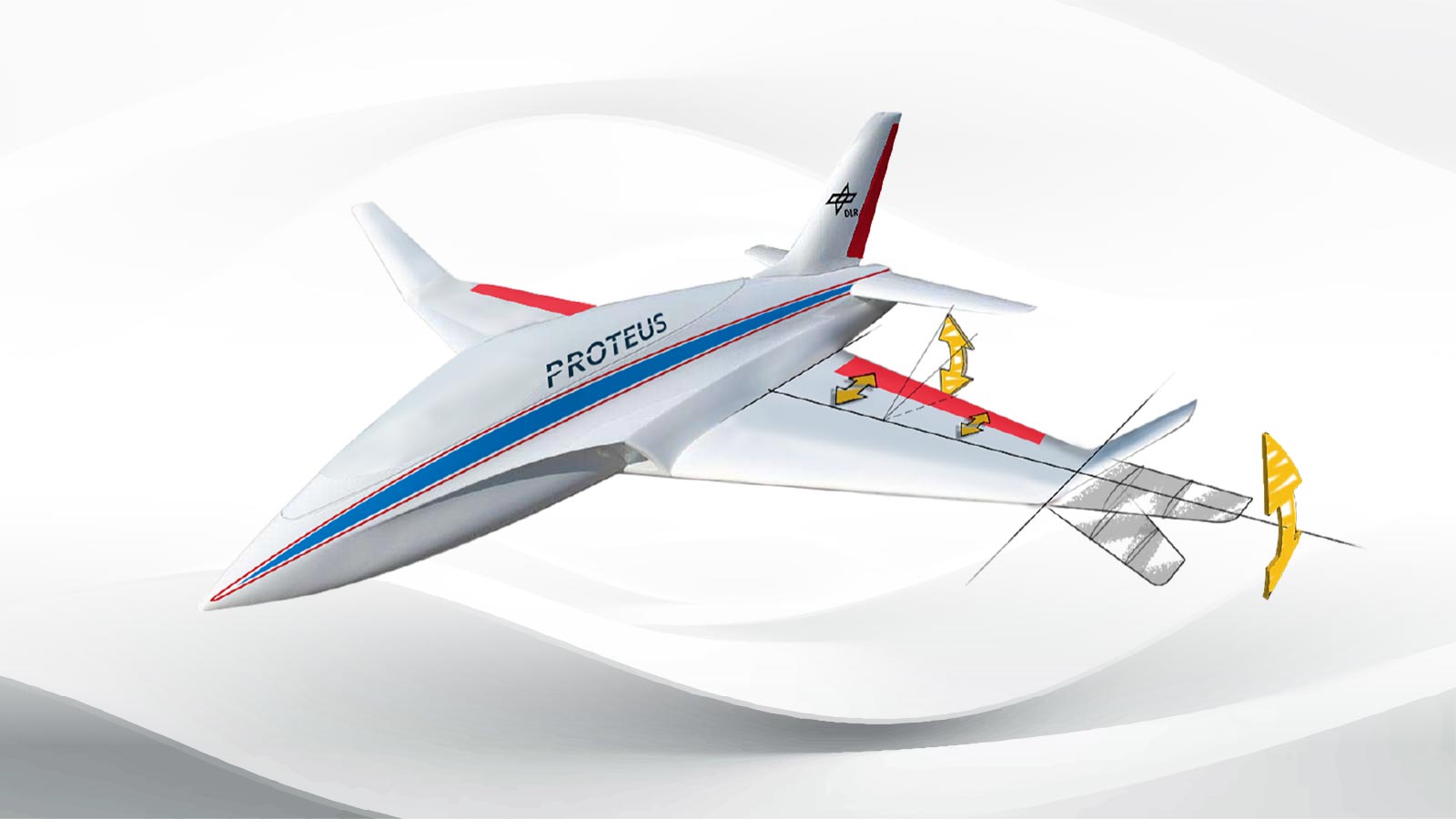
Based on those initial flights, Radestock and colleagues believe the concept shows promise for a range of novel capabilities, such as combining and replacing some of today’s aircraft control surfaces. For instance, because the morphable trailing edge spans the full length of the wing, an inboard section of the edge can provide a flap function, and an outboard section the aileron. And by ganging the flap and aileron together into an adaptive elevator of sorts, this morphing wing could take on major tailplane functions like elevator pitch control, allowing the tailplane and tailfin structures of drones and light aircraft to be shrunk — reducing drag. Also, that smaller tail could have a morphing rudder, says Radestock.
Underlying this morphing technology are some innovations by DLR at the wing level — harnessing novel, flexible, actuated materials —and in the computerized control of the morphing profile.
Engineers created a reinforcement learning algorithm to operate the trailing edge’s shape-shifting motorized actuators in an efficient way for a given flight, says Radestock. Both the morphing surface and AI-based control algorithm were completed between 2022 to 2025, with the April flight tests marking the official conclusion of morphAIR.
Now, DLR’s three-person morphing team is moving into a two-year follow-up phase, UAdapt, short for Unmanned Aircraft Wing Adaption. They will investigate how the morphing trailing edge “can transfer some functionalities of the tail’s horizontal and vertical stabilizer, like the rudder or elevator, to the wing to make the tail structure smaller, to reduce the drag and fuel consumption of the overall aircraft,” says Radestock.
But why morph the wing in the first place? “Currently, aircraft are flying with turbulent flow over their wings, because they have steps and gaps between their control surfaces,” says Radestock.
By “steps,” he means areas where an aileron or flap, for instance, is not perfectly flush with the wing, leaving gaps behind and between these hinged surfaces and the wing.
“They also have screws on top of the slats and the flaps, and with these generous steps and gaps, normal airflow produces turbulence,” he says — and with it, increased fuel burn.
By contrast, a surface that smoothly changes shape while leaving no gaps or steps, no screws or rivets interfering with the airflow, could reduce wing friction by 95%, Radestock estimates. “So morphing aircraft aim to fly with natural laminar flow that’s completely attached to the wing and not creating any turbulence.
It’s not a new concept. In 2015, FlexSys of Michigan flew a Grumman Gulfstream II business jet fitted with morphing flaps for NASA and the U.S. Air Force Research Laboratory. Since then, FlexSys has been supplying retrofit and other morphing structures in applications such as defense and drones, CEO Sridhar Kota told me by email. He gave an update on the company’s progress in February on an Emerging Technologies Institute podcast.
In the FlexSys tests, the flap spanned only a portion of the wing, Radestock notes, so he and his colleagues wondered what advantages could be gained from having an entirely morphable trailing edge.
“What we wanted to try was not to have a single flap, but have multiple flaps at certain stations on the wing that can smoothly transition on that continuously variable, gapless surface,” he says.
This is what they set out to flight test on a drone, specifically looking for one with wing loading strong enough to make their results applicable to future morphing research on general aviation light aircraft like a Cessna 172 or Beechcraft G58. They bought a 3-m-long radio-controlled sports jet from Tomahawk Aviation, called a Futura Jet 2, and built two sets of wings: one a conventional two-flap-and-one-aileron per wing version, using carbon-fiber reinforced plastic; the other with the morphing trailing edges.
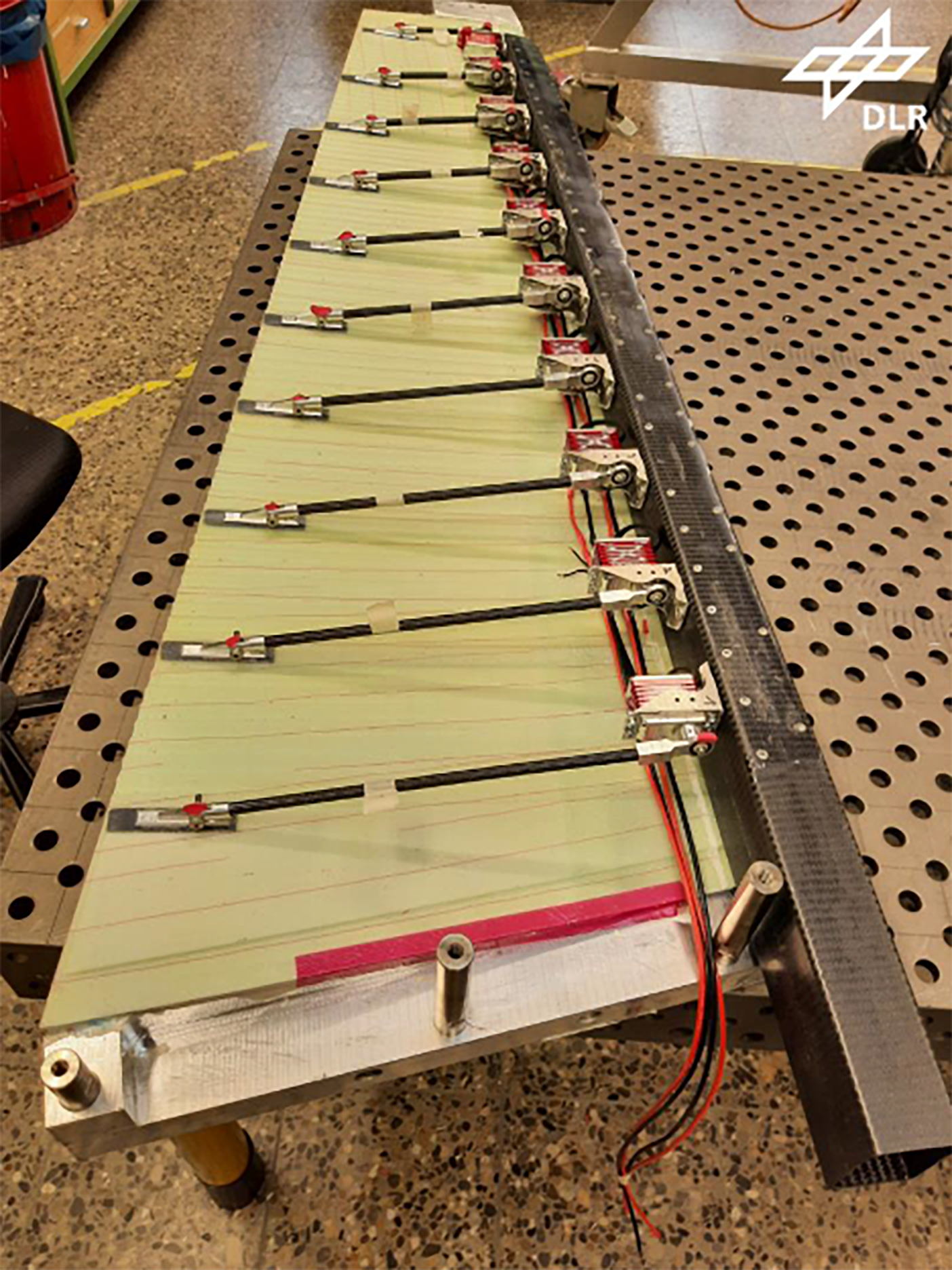
The conventional wing contains just three rotary actuators — motorized aluminum rods that raise and lower the two flaps and the aileron — but the morphing version contains 10 identical actuators across each wing, spaced 15 centimeters apart. The morphing trailing edge’s flexible skin is made from glass-fiber reinforced plastic because it’s “slightly more flexible than carbon fiber,” says Radestock.
The surface is also corrugated, to allow it to stretch if a situation demands it — perhaps when an aileron section abuts a length used as a flap, for instance.
The key here, says Radestock, is how the top and bottom corrugated skins are bonded: “Our inventive step is to join the glass fiber skin shells with a hyperelastic polyurethane adhesive,” he says.
Altogether, the stretchier, corrugated material, held together by hyperelastic glue, allows the morphing surface its high degree of flexibility — rippling in a sine pattern almost like the pectoral fins of a swimming stingray.
The wing design is just one piece of the equation. For the concept to work in flight, commands from the safety pilot’s remote control station must produce the right motions from the 10 actuators inside each morphing wing. So DLR turned to AI in general, and reinforcement learning in particular, to train the drone’s flight control system.
“What we are not doing is saying: ‘OK, AI, here are all the actuators, learn to fly this.’ That would be brutal,” says Radestock. “What we are doing is getting the AI to tune the parameters controlling the actuators, to decide what are the best actuator deflections for a rolling motion, say.”
The engineers are training the algorithm on a simulation model of the wing and actuators, but as more and more flight tests are completed, they plan to incorporate real-world data, Radestock adds.
The flight tests, limited to 20 minutes by Proteus’ 12-liter fuel capacity, were all conducted in visual line of sight of the safety pilots, but DLR has a beyond visual line of sight station for more ambitious sorties later.
Safety pilots already report the morphing trailing edge is providing “quite interesting handling characteristics,” says Radestock, with roll agility boosted by some 50%.
To Kota, the FlexSys CEO, the project amounts to an “an exciting research demonstrator.”
“As with any technology at this stage, real challenges lie ahead,” Kota told me by email, “including the material’s long-term durability, system complexity from distributed actuation, sustaining greater wing loads, and the certification pathway for learning-based flight controls.”
He added: “I’m looking forward to seeing how these challenges get addressed, especially as they move toward larger scales.”
So is Radestock — not least because he wants to see shape-shifting technologies adopted more widely on planes of all sizes, but also on more parts of the airplanes than their wings and tail structures.
“My big hope is that morphing technologies get more and more integrated into aircraft, perhaps beyond the flight surfaces, as the fuselage itself could also benefit,” he says. “Antennas cause turbulence, for instance, so perhaps a morphing surface could move them outside only when they’re needed.”