Predictive physics in the aerodynamic design loop
 By Cat Hofacker
 By Cat Hofacker
2025 marked substantial progress toward demonstrating the Space Access Grand Challenge, proposed by this committee in 2021, to use computational fluid dynamics (CFD) directly for aerodynamic predictions during Monte Carlo flight simulations before the end of the decade. This would eliminate the need for many, if not all, aerodynamic databases currently required to perform a flight simulation, and potentially save countless hours of wind tunnel testing and years of database development required to perform high-fidelity flight simulation on emerging launch vehicle and spacecraft designs.
NASA Langley’s FUN3D team made substantial progress toward demonstrating the challenge. FUN3D runs on the most advanced graphics processing units (GPU) in the industry and on the most powerful leadership-class supercomputers in the world. The team has ensured that the code not only runs on these systems, but that it also takes full advantage of the computational power associated with the processors by tailoring the coding to the processor hardware in use. This has reduced computational time substantially to produce extremely high-fidelity capsule retro-propulsion entry simulations with closed-loop control. In January, the team demonstrated the code’s ability to simulate accelerating flight to aid in the development of flight-relevant buffet and aeroacoustic predictions for launch vehicles by reproducing structural responses from NASA’s Artemis I lunar flight test.
Multiphysics simulations in the form of fully chemically-reacting solid-rocket motor plumes demonstrate the importance of these reactions on accurately predicting vehicle aerodynamic performance, particularly significant for launch abort vehicles with plume-forward configurations. FUN3D was coupled with the industry-standard POST 2 flight simulation software to perform the CFD-in-the-loop flight simulation for Monte Carlo analysis, enabling a fully nonlinear, physics-based transient representation of the vehicle aerodynamics during the flight simulation.
NASA, through partnerships with Syracuse University and MIT, leveraged Engineering Sketch Pad/Engineering Geometry for Analysis and Design System (ESP/EGADS) and an internally developed grid refinement and adaptation capability known as REFINE to develop a sketch-to-solution capability. This requires only a solid model to develop engineering-quality aerodynamic simulations on virtually any complex body. With this capability, the novice user can quickly generate solution-adapted high-fidelity aerodynamic simulations with limited experience. In August, a team from NASA Langley used this capability to construct and adapt the unstructured mesh in a Mach 10 blunt-body wake validation study. This is a huge step forward for CFD technology, and with modest investment, refinement and efficiency improvements could revolutionize how CFD data are acquired in the future.
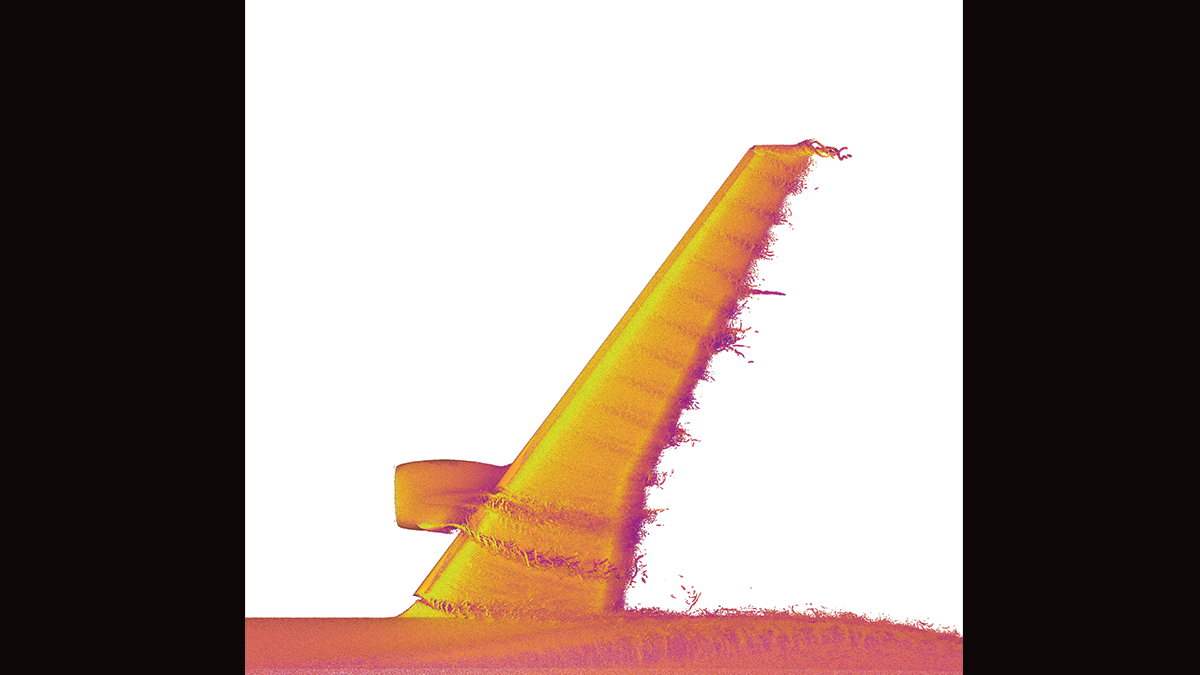
In May, NASA held a high-fidelity CFD workshop in Suffolk, Virginia, to assess progress on the Revolutionary Computational Aerosciences technical challenge, aimed at developing efficient modeling tools that predict maximum-lift coefficient for transport aircraft with the same accuracy as flight tests — a potentially revolutionary aircraft design tool. Participants from government, industry, and academia demonstrated progress in predicting maximum lift for NASA’s high-lift common research model using wall-modeled large-eddy simulation codes: CharLES (Stanford University), FUN3D (NASA), LAVA (NASA), and Volcano ScaLES (Volcano Platforms). GE Aerospace demonstrated use of wall-resolved large-eddy simulation for propulsion applications employing their high-order GENESIS solver. Scale-resolving simulation tools are rapidly evolving and are showing encouraging progress toward a physics-based, predictive capability at the edge-of-the-envelope, and that GPU technology is providing a path for meaningful engineering use of such advanced CFD tools.
In October, the Association for Computing Machinery selected a team from Georgia Tech and the Courant Institute of Mathematical Sciences at NYU as finalists in the 2025 Gordon Bell Prize for outstanding achievement in high-performance computing. They conducted the largest-ever CFD simulation on the Frontier supercomputer, using novel software to study the fluid dynamics phenomena in interacting plumes from rocket engine clusters.
Contributors: David M. Schuster, Mujeeb R. Malik
Opener image: FUN3D wall-modeled large-eddy simulation of NASA’s High-Lift Common Research Model at a Reynolds number of 30 million near maximum-lift condition, performed on the Frontier exascale system at the Department of Energy’s Oak Ridge National Laboratory. Credit: NASA Langley Research Center/Li Wang