Plasma and laser physics experiments push aerospace boundaries
 By Cat Hofacker
 By Cat Hofacker
At Texas A&M University, researchers in May analyzed the magnetic window approach, which applies magnetic fields to help radio signals pass through the plasma sheath surrounding hypersonic vehicles. They found that upper hybrid resonance regions can form when the field strength increases, reducing transmission. In July, researchers from the University of Dayton Research Institute in Ohio simulated high-speed boundary layers with partially catalytic wall conditions, revealing a corridor of Mach and altitude in which this treatment more accurately predicted heat transfer. Researchers from the University of Arizona in June developed a thermodynamically consistent model of vibrational-electron heating that predicted electron temperatures lower than previous simulations and matched historic RAM-C-II flight test data.
Researchers from CentraleSupélec in France validated 3D simulations of turbulent methane-air flames assisted by plasma against experiments and correctly predicted the lean blow-off limits of hydrogen plasma-assisted flames. At ETH Zurich in Switzerland, tests in a sequential combustor with hydrogen and natural gas at up to 350 kilowatts and 5 atmospheres showed that plasma actuation can suppress thermoacoustic instabilities in these conditions. In China, researchers from the Air Force Engineering and Xi’an Jiaotong Universities in April developed an arc plasma actuator matrix that increased velocity fluctuations in a supersonic cavity flow by 55% and, when combined with deep reinforcement learning, enabled adaptive control of shear layers using just 10 seconds of wind tunnel data.
The University of Minnesota and U.S. Army Research Laboratory addressed several challenges with low-ignitability liquid fuels and multiphase non-premixed combustion, using pulsed nanosecond discharges. In January, researchers at the University of Poitiers began testing plasma discharges on homogeneous grids to study multiscale turbulence interactions.
Through a multi-university project led by Stanford University, researchers advanced the use of plasma metamaterials to manipulate electromagnetic waves, demonstrating that plasma arrays can perform logic operations and signal demultiplexing. At Princeton University, magnetized ionization waves that propagate through plasma under crossed electric and magnetic fields were observed experimentally for the first time in January. Working with FAA, the same group in April validated the effectiveness of nanosecond barrier discharges in preventing ice formation on wings with energy requirements more than one order of magnitude lower than for conventional heating.
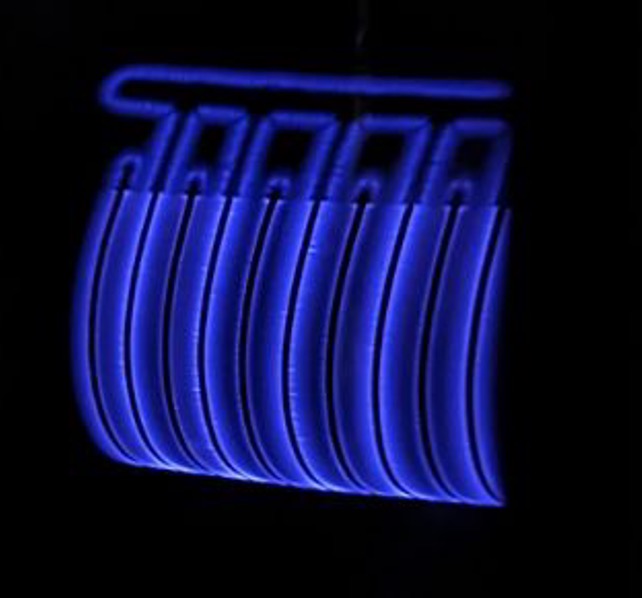
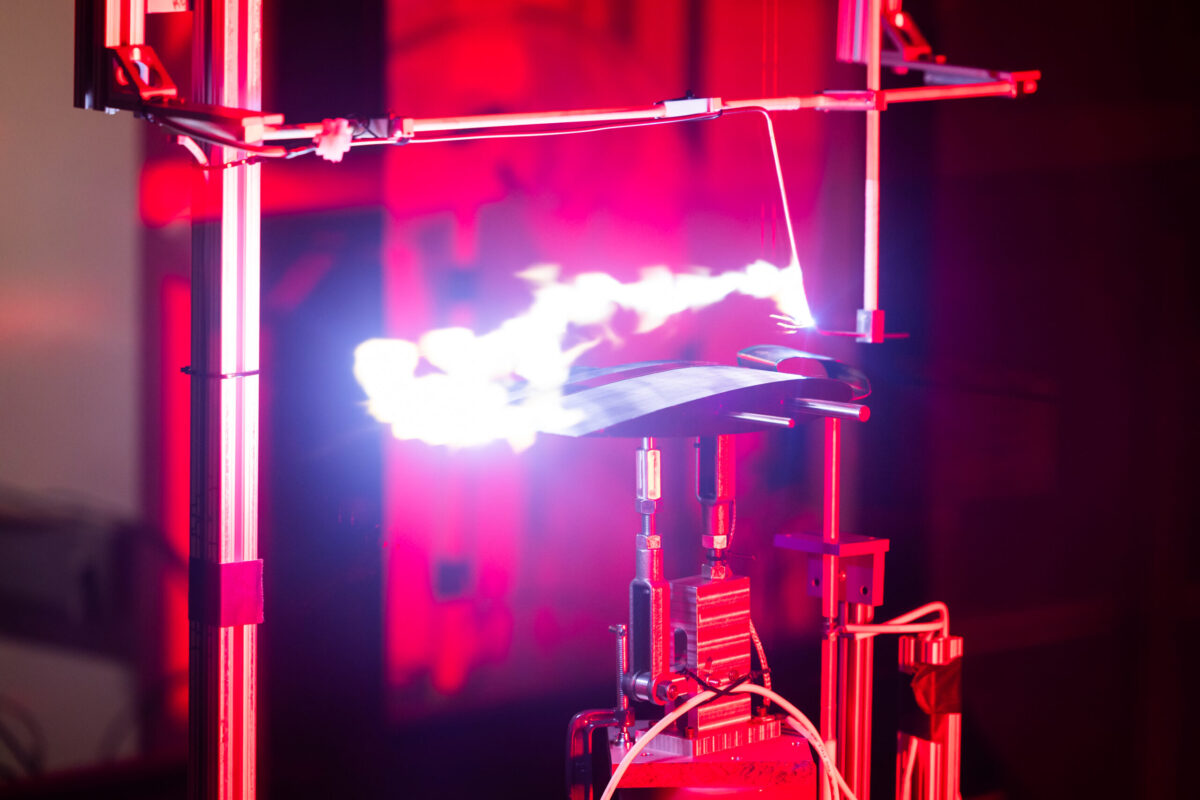
In September, MIT researchers, in collaboration with colleagues from the Universitat Politècnica de Catalunya (UPC) and the French Aerospace Lab (ONERA), generated electrical arcs of around 1 meter inside the MIT Wright Brothers Wind Tunnel in Massachusetts to replicate how lightning attaches to aircraft surfaces during flight. At the University of Tennessee Space Institute, researchers in August applied ultrafast laser microfabrication to create embedded capillary channels in electrospray thrusters, enabling compact emitter-extractor designs that operate at voltages of a few hundred volts.
Texas A&M University researchers in March developed a fluorescent imaging panel (FLIP) that eliminated speckle from reflected surfaces and has since enabled the analysis of images with atmospheric distortions caused by turbulence and weather. In Indiana, University of Notre Dame researchers designed a dual-beam digital holography wavefront sensor that simultaneously captured unsteady optical distortions over two apertures with high spatial resolution. It is used for mitigation studies of latency effects that limit the performance of adaptive optics systems.
In June, University of Texas at Austin researchers demonstrated quantitative single-shot supercontinuum-enhanced terahertz spectroscopy, probing the refractive properties of radio-frequency plasmas at ultrafast timescales. Colorado State University researchers in June developed Coherent anti-Stokes Raman spectroscopy diagnostics as a method that detects trace gases with detection limits of tens of parts per million for hydrogen. Researchers from the University of Minnesota improved the sensitivity of the electric field-induced second harmonic (E-FISH) diagnostic, enabling detection of electric fields as weak as 0.3 volts per centimeter in February. Purdue University researchers in October investigated high-energy nanosecond pulsed discharges, examining streamer propagation before spark formation.
Contributors: Albina Tropina, Ariel Blanco, Bernard Parent, Christophe Laux, Yun Wu, Suo Yang, Nicolas Benard, Mark Cappelli, Trevor Moeller, Richard Miles, Stanislav Gordeyev, Thomas Underwood, Azer Yalin, Marien Simeni Simeni, Alexey Shashurin
Opener image: September 2025 experiments in the MIT Wright Brothers Wind Tunnel simulating lightning attachment to aircraft surfaces during flight. Credit: Jake Belcher (photographer) and Carmen Guerra-Garcia (principal investigator), MIT