This AI prediction model could help shield future lunar habitats against micrometeorites
 By Paul Marks
 By Paul Marks
NASA has just begun to analyze the data collected from the 10-day Artemis II mission, but one standout moment so far is the number of micrometeorite impacts the crew observed during its April 6 lunar flyby. The astronauts saw six impact flashes in half an hour — suggesting these are more frequent occurrences than scientists previously predicted.
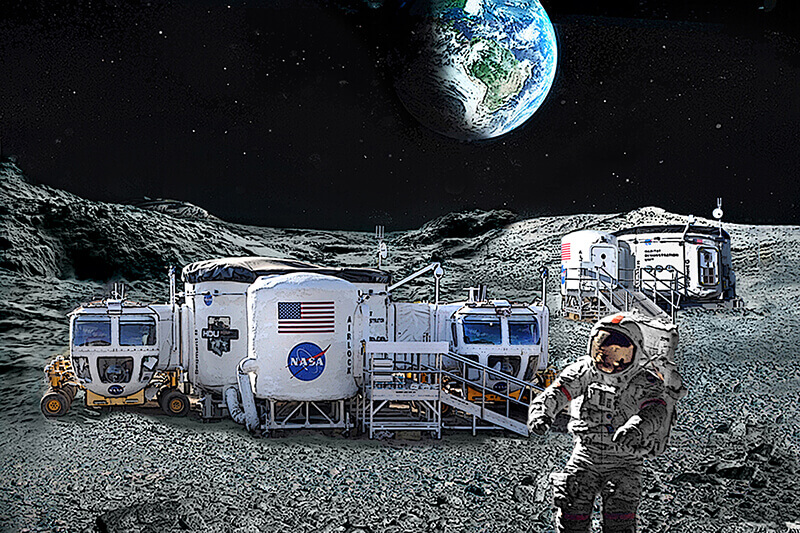
That poses a potential challenge for future lunar surface bases, like the one NASA plans to establish by 2030. As NASA Administrator Jared Isaacman put it in an April 6 post on X: “Gonna have to rethink moon base roofing.”
A team of U.S. researchers might have a solution: an AI-based damage prediction system that will help designers protect future lunar habitats against such impacts.
The proposal, described in a pre-print accepted for publication last week in the space journal Acta Astronautica, is the work of Arturo Montoya, a professor of civil and environmental engineering at the University of Texas in San Antonio; his UTSA colleague, Adnan Shahriar; and Purdue University mechanical engineer Amir Behjat. Funded by a $15 million NASA grant, they developed a deep learning model, known as an artificial neural network (ANN), that aims to save lunar surface architects from having to undertake complicated and expensive high-velocity impact tests for their habitats.
To do this, the ANN’s training dataset includes data on the expected penetration depths of micrometeorites of diameters between 1 and 3 millimeters, moving at velocities of up to 70 kilometers per second (156,586 mph), as they impact lunar habitats built from a variety of combinations of regolith and aluminum-based shielding materials.
“The model is intended to support preliminary trade off studies and the evaluation of early design concepts,” Montoya told me by email.
The idea is that hab designers input the design parameters of their desired structure, and the ANN will estimate the penetration depth of any micrometeorite strikes. This will help designers determine early on if such impacts would threaten the hab’s structural integrity or the lives of astronauts within.
In their paper, the researchers say the ANN method has already improved upon previous computationally-intensive “finite element”-based predictions, but that they still need more training data to improve the ANN’s accuracy at the high end of their impact velocity range.
“Much of what we know today about these impacts comes from years of careful observation and modelling,” Montoya said. “NASA routinely monitors the Moon using video and telescope observations, capturing moments when meteoroids strike its surface. These observations are distilled into technical memoranda that bring together data and models, shaping our ongoing research.”
Kelsey Young, Artemis II lunar science lead, in an April 7 status briefing said “the Lunar Reconnaissance Orbiter team is hard at work trying to identify evidence of those impact flashes that the crew observed.”
She added that the flashes, seen south of the equator on the near side of the moon, are key indicators of the “dynamic lunar environment, which is important when we think about future missions.”
There are various ways habitat designers could guard against impacts, said Mark Burchell, professor emeritus of impact studies at the University of Kent in the U.K., who researches hypervelocity impacts and related solar system phenomena.
“You can build aluminium shells and take them with you, then cover then with lunar regolith,” he told me by email. “Or you can 3D print bricks from regolith and build on site. The real issue is the cost of shipping stuff to the Moon, so you want it lightweight, or made in-situ –
but you also need it strong enough to resist impact damage.”
The in-development ANN network could be a “very convenient tool” for prediction, Burchell said, if it can reveal “underlying trends in the data and extrapolate accurately to different types of impacts.”
He added: “But, as their paper acknowledges, there are large gaps in such datasets, so at some impact speeds, for example, this is a problem – and you do need an accurate flux model.”
The Artemis II data will be a useful addition, Montoya said. “When something unexpected happens, like astronauts spotting more flashes than anticipated, it becomes a powerful moment. Each new observation helps sharpen models.”
However, updating such models isn’t always straightforward, noted astrophysicist and spaceflight historian Jonathan McDowell, who until recently worked on the Chandra X-ray telescope team at the Harvard-Smithsonian Center for Astrophysics.
“The big uncertainty here is, for a given brightness of flash seen by the Artemis II astronauts, what is the mass and energy of the incoming rock?” he said. “Unless you can calibrate that somehow, it’s hard to know if this rate of flashes is something that will be a problem or not.”