Senate Armed Services Committee moves to codify new defense innovation advisory board


The U.S. Senate Armed Services Committee is moving to formalize the Pentagon’s new technology-focused advisory board.
The committee’s fiscal year 2027 defense policy bill includes a provision codifying the new Defense Science, Technology, and Innovation Board, dubbed STIB. This body is to focus on “pressing and complex technology problems” as well as “research, engineering, manufacturing, [and] acquisition process.”
The bill is currently stalled after a failed vote on Tuesday.
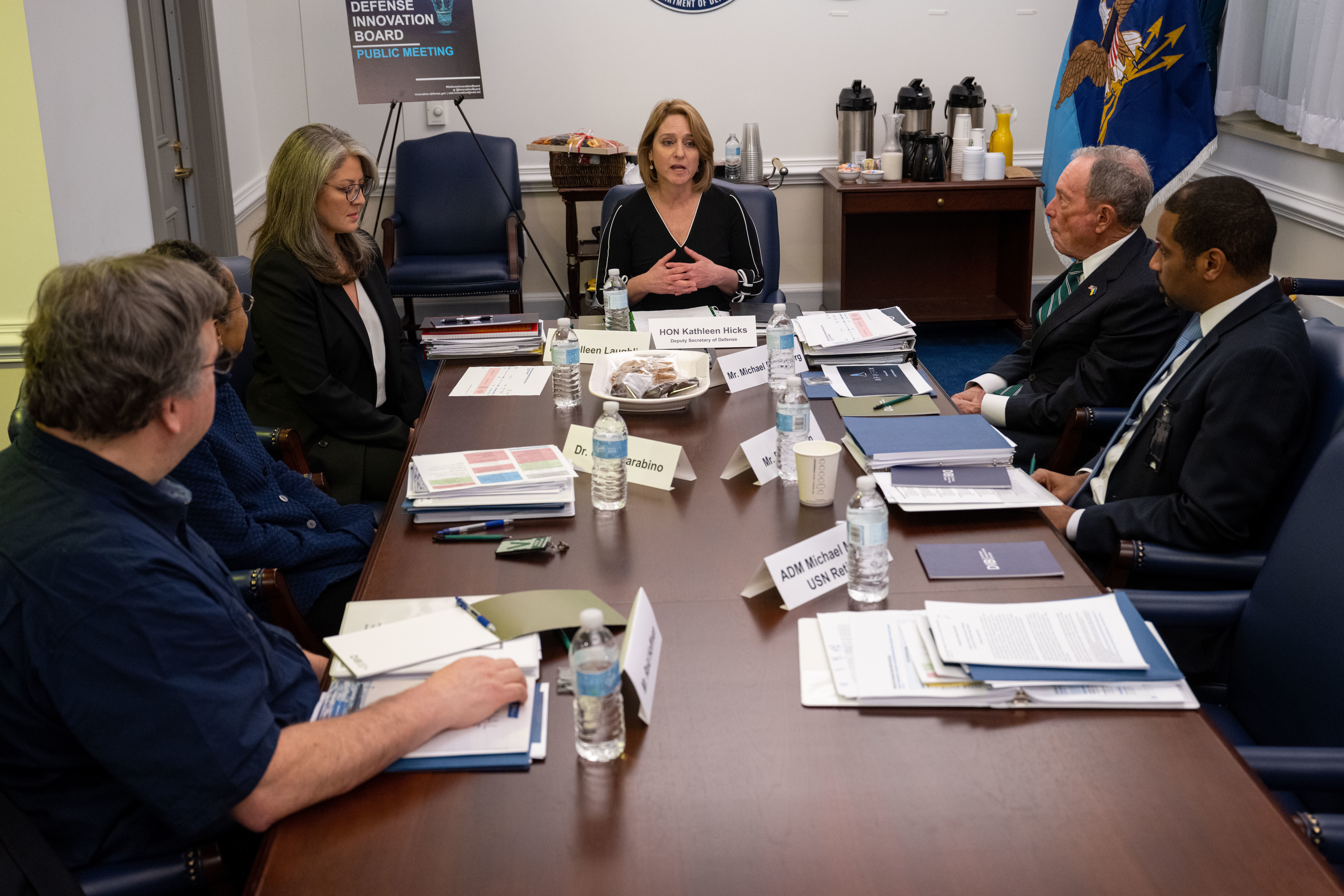
The Pentagon established the STIB in January by merging the Defense Innovation Board and Defense Science Board. In May, the department appointed the first members.
Details on the board’s activities are limited. The office it reports to — the Office of the Under Secretary of Defense for Research and Engineering — did not provide answers to questions about it.
In the January release announcing the new board, Under Secretary of Defense for Research and Engineering Emil Michael said the STIB will unify “our best scientific minds and our most innovative private-sector leaders into a single board built to provide clear answers, not more bureaucracy.”
The merged board has two permanent subcommittees: the Subcommittee on Strategic Options, tasked with “identifying concepts, capabilities, strategies, and courses of action across the S&T [science and technology] enterprise that rebalance cost and benefit, strengthen deterrence, and ensure U.S. operational dominance,” and the Subcommittee on National Security Innovation, focused on “examining and advising on innovation pathways, emerging and disruptive technologies, commercial best practices in strategy and management, organizational design, human capital, decision making, and scaling — while leveraging America’s broader innovation ecosystem for national security.”
The Defense Science Board, established in 1956, had up to 40 members and reported to same level as the STIB. Its membership generally had technical expertise, and its work focused on in-depth studies of specific topics.
“It was a very prestigious board, a very responsible board, did a lot of good work over the years,” said Arnold Punaro, a defense consultant who previously spent over a decade on both the Defense Business Board and the Defense Reserve Forces Policy Board. “In every administration, it’s been one of the most prestigious [Federal Advisory Committee Act] boards” and enjoyed strong support in Congress.
The Defense Innovation Board, established in 2016, had up to 20 members and reported directly to the under secretary of defense. Its members generally had backgrounds working in the private sector, and its work focused on broader recommendations.
“The innovation board was a little bit more sporadic in terms of actual in-depth studies,” said Stan Soloway, a defense consultant who previously served on the Defense Business Board. “Their role was really to, as the names suggest, just to advise.”
According to Will Roper, a former Air Force acquisition chief and member of the Defense Innovation Board from 2022 to 2025, “the thing that made that board effective isn’t just where it reported, but who was sitting in that seat.”
These types of boards “can be hugely impactful; it can be a complete nothing burger,” Roper said. “It all depends on these factors you can’t put in legislation,” such as the effort of individual board members and whether Pentagon leadership welcomes the advice.
Mac Thornberry, a longtime member of Congress, former chairman of the House Armed Services Committee and member of the innovation board for about three years, said in written comments that although the science and innovation boards functioned differently, “at the end of the day, both of them merely give advice.”
“Whatever arrangement does the most to help decision makers to do their job is probably best,” Thornberry added.
The STIB inaugural membership includes 33 people with a mix of military, academic and private-sector backgrounds, according to the board’s website. Its first study topics are to evaluate a test facility on Kwajalein Atoll and optimize the defense secretary’s office structure to better support software advances.
Its first chairman is Milan Nikolich, a senior staff member at the Johns Hopkins University Applied Physics Laboratory and former director of defense research and engineering for research and technology from 2018 to 2020.
The STIB is to meet about eight times a year and first met in May, according to the Federal Advisory Committee Act database.
“I can understand the inclination to want to sort of consolidate things,” Soloway said. “But each of [the boards] has always had a kind of a unique role, and it’s going to be how you marry all those roles up that’s going to make the difference.”
He added: “It comes down to how they do it, and how they use it — and that we don’t know yet.”