
Echodyne expands production of drone-detecting radars
 By Keith Button
 By Keith Button
A Washington state company is preparing to increase production of radar technology it’s been developing over the last decade, which executives say can help address the proliferation of drones.
“This huge mass of cheap lethal drones is going to have to be defended with a mass of cheap counter-drone capabilities,” said Eben Frankenberg, co-founder and chief executive of Echodyne. “Every gun you have on an armored vehicle has to have a chance of taking a drone out to defend itself, so you’ve got to make those gun systems effective.”
New drone-intercepting drones and counter-drone missiles, lasers and microwave pulse systems also need radar guidance, he said. “Our radars are now being used for all of those things.”
To capitalize on the newfound demand, Echodyne plans to begin building its radars at a new factory near its Kirkland, Washington, headquarters this month capable of producing 30,000 radars per year. The company declined to share its current production rate.
Since its founding in 2014, Echodyne has developed four iterations of its phased-array radar technology and is now working on a fifth version that would extend the range of the radar.
With a phased array concept, multiple stationary antennas send out the radar’s electromagnetic signals instead of a mechanically turning antenna. The timing of those multiple signals are controlled so that their combined waves stack up and are steered in the desired direction. So, for example, if the first in a straight line of antennas was to begin transmitting, followed quickly by the antenna to its right, then the next antenna to the right, and so on, their combined stacked-up wavefronts would angle to the right.
By electronically controlling a phased array, a radar can focus its antenna signals into a fine spot beam and steer that beam rapidly around a field of view, switching directions in a fraction of a second. A traditional electronically controlled phased array needs 500 to 1,500 Lego-block-like electronic components plugged together for amplifying and steering the radio signals, and those modules which can both transmit and receive signals cost $100 to $500 each, Frankenberg said.
According to Echodyne, its equivalent radar is much cheaper. Its phased-array technology uses more antennas — 5,000 for some variants — that cost a few dollars apiece, Frankenberg said. Instead of the block-like modules, the antenna array consists of etched shapes on one or more circuit boards, turned on or off by software to combine and steer their electromagnetic waves in a beam.
Where a traditional electronically controlled phased array radar might cost nearly $1 million, the equivalent Echodyne radar costs $40,000 to $160,000, Frankenberg said.
That “fundamentally changes the economics of the antenna arrays,” he said. “That was the whole underlying thesis of the company.”
The company’s technology can pack a radar array into a smaller space because the antennas need to be only one-tenth of a wavelength apart, compared to the one-half wavelength distance for traditional radar arrays, he said. For context, one of Echodyne’s radars operates on the Ku band, which transmits at a wavelength of about 2 centimeters.
A denser phased array will enhance a radar’s angular resolution — its ability to distinguish between equally sized targets — which is an important feature for detecting small drones, said Mohamed Abouzahra, a consultant at MIT Lincoln Laboratory and former head of its Lincoln Space Surveillance Complex radar site, who is not associated with Echodyne.
Packing more antennas into a given space also allows a radar to produce a stronger signal. “You need enhanced detection and tracking performance when you deal with swarms of small drones,” Abouzahra said. These vehicles can be more difficult to track than missiles because they change directions so quickly. Though a ballistic missile is much faster, he said, once it is detected, “you can predict where it’s going to be in five minutes.”
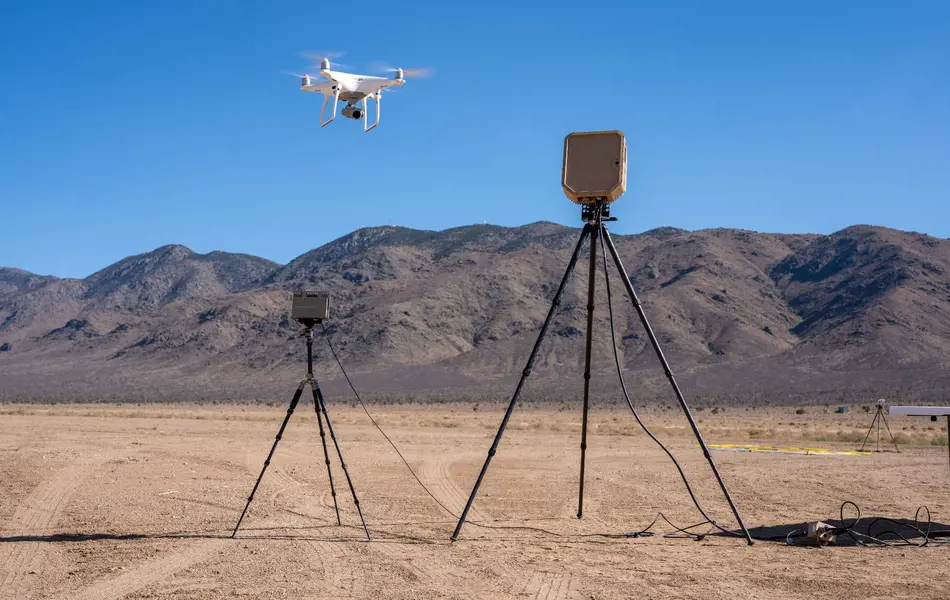
Echodyne now produces versions of the short-range radar that was developed about eight years ago, each of which are the size of a small paperback book and can detect small drones 1.5 kilometers away, and a medium-range radar about the size of a small backpack developed in 2023 capable of picking up small drones at 3 km to 5 km. The company is developing a longer-range radar, but there’s no expected completion date.
Counter-drone customers either want a radar for detecting, tracking and quickly classifying a threat, or just for detecting a drone where it isn’t supposed to be, Frankenberg said. For the former category, software for high-performance radars will send out a spot beam that rapidly scans the field of view according to a statistical distribution, returning more frequently to potential targets.
“I just statistically scan my field of view, sending beams all these different directions, and then if I get a return someplace that’s interesting, I put that in a special queue,” he said. Objects or areas in the queue are revisited at a high rate, 10 times per second or more, to update the object and track it with high fidelity.
Echodyne’s radar software can also classify an object based on its characteristics compared to previous data collected during radar operations, or on AI that learns the signature characteristics of various objects.
To distinguish between a small drone or similarly sized bird, for example, the physics might point to the radar’s Doppler signals: the drone is moving in a certain direction while one tip of a propeller is moving in another direction at an extremely high velocity and the opposite propeller tip is moving in the opposite direction at the same velocity, Frankenberg said.
An AI-trained model might determine that “if I don’t see the propeller but this thing is moving at a certain speed towards me or away from me and it’s above the ground, then it’s either a bird or it’s a drone,” he said, and then use other data to determine that the object is flying more like a drone than a bird.
Today, about 65% of Echodyne’s market is with the defense industry and 35% with commercial and civilian customers. The list includes defense contractors Anduril Industries, AeroVironment subsidiary Blue Halo, Northrop Grumman and Moog, along with the U.S. Department of Defense and Department of Homeland Security.
However, Frankenberg said the company initially believed its main business would come from the commercial drone market.
“We thought the commercial drone industry was going to take off really quickly and there would be hundreds of thousands of drones delivering packages for Amazon and lots of other people,” he said. “That industry is still just beginning to come into some scale.”