
New Frontier Aerospace plans sales of 3D-printed hypersonic rocket engine


Editor’s note: An earlier version of this story misstated the amount of a Defense Innovation Unit contract.
Washington state startup New Frontier Aerospace is moving to install by the end of this year its 3D-printed, hypersonic-capable rocket engine onto a drone to demonstrate and gather data on its performance.
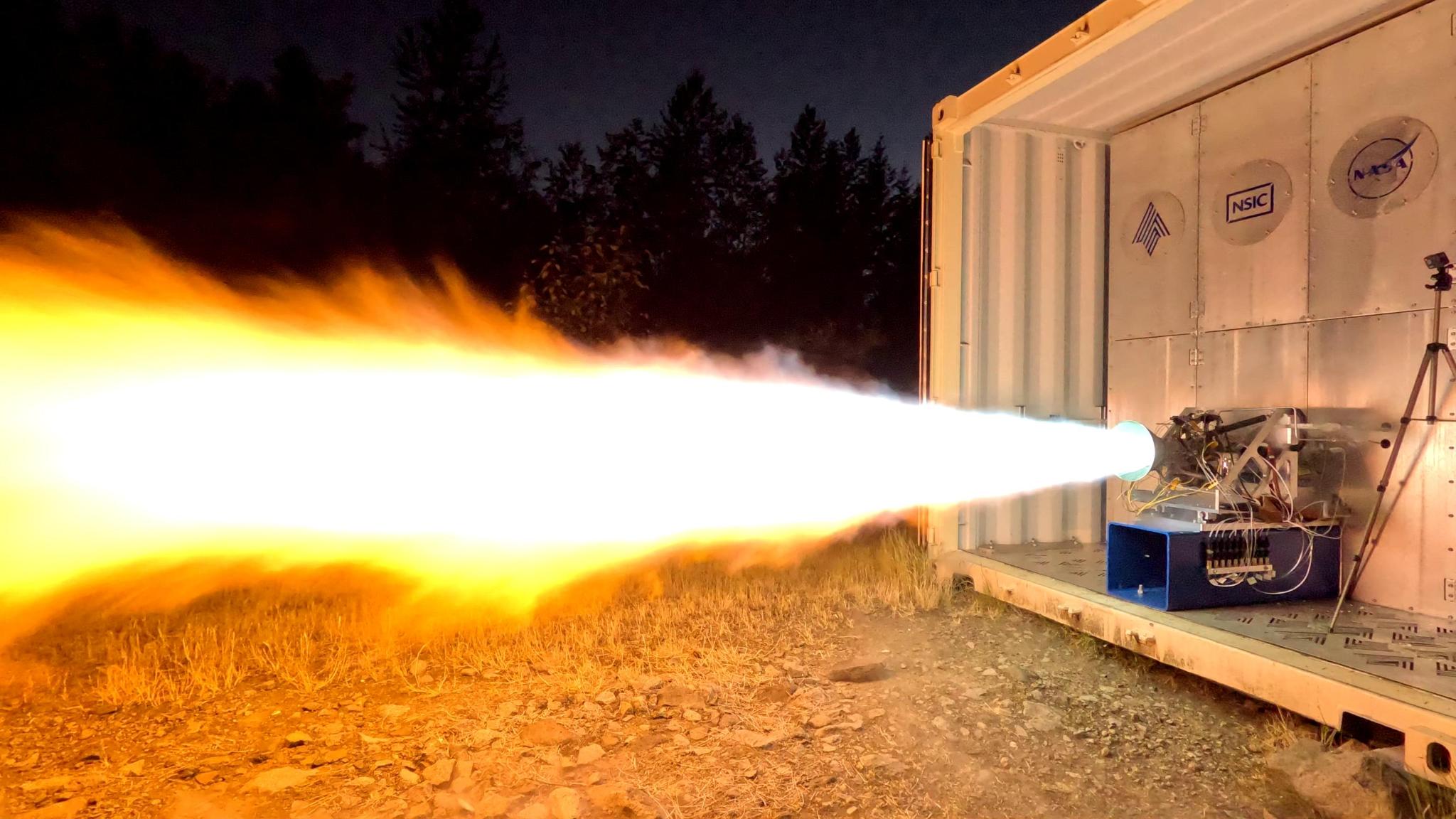
The company, headquartered in Kent, plans to offer the relatively compact, liquid natural gas-fueled engine, known as Mjölnir, for sale commercially, co-founder and CEO Bill Bruner told me. The design produces thrust via full-flow staged combustion, a process similar to that employed by the Raptor engines that power SpaceX’s Falcon rockets.
New Frontier says it is designing Mjölnir to power small satellites and rockets that fall under NASA’s Venture Class, which includes Rocket Lab’s Electron, for example.
New Frontier has been hot-firing the engines since mid-2024 and now plans to conduct the first flight of a Mjölnir “in the next few months,” Bruner said. The engine will be installed onto the company’s Pathfinder drone for a short hop, in which the 7.3-meter-tall test article is to rise vertically and briefly hover before descending.
The test is “designed simply to exercise guidance, navigation, and control for a stable hover, maybe a translation, and then a landing, safe and soft,” Bruner said, after which the engine’s in-flight performance will be evaluated.
Bruner, a former assistant administrator for legislative and governmental affairs at NASA, founded New Frontier in 2020 with David Gregory, former development lead for Blue Origin’s BE-3 engine, and Jess Sponable, a former DARPA program manager who led spaceplane development. They initially privately funded the company.
Based on the data gained from the test flight, New Frontier plans to develop a hypersonic vertical takeoff and landing aircraft and an orbital transfer vehicle the company calls Bifröst. (The engine and spacecraft names both stem from Norse mythology.)
Of the aircraft, Bruner said, the Pentagon “is interested in that for various purposes that you might imagine: a reusable hypersonic airplane powered by an engine that already exists that you don’t have to spend a billion dollars to develop.”
In 2025, the company received $3 million via a Direct-to-Phase-II Small Business Innovative Research (SBIR) award “to further develop” Bifröst, according to a press release. The company described the SBIR award as a “collaborative effort between SpaceWERX, the Air Force Research Laboratory Rocket Lab, Space Systems Command Assured Access to Space, and U.S. Space Command” that “seeks to significantly reduce response times in and beyond Low Earth Orbit.”
Previously, the company in 2021 secured a $750,000 contract from the Defense Innovation Unit’s National Security Innovation Capital initiative as well as a $1.5 million extension in 2023 for development and testing of the hypersonic aircraft and the Mjölnir engine that would power it. It has also received multiple smaller awards from NASA.
“Our goal is to transition from a development company funded by the government to being funded by sales,” Bruner said. “Selling the engine is the first step in that process, and then, in all likelihood, we will sell our spacecraft next, and then an aircraft. We’re hopeful that we can generate a few million dollars in revenue over the next few years.”
The company envisions several “in-space” uses for Mjölnirs, including powering vehicles ranging from rocket upper stages to lunar landers. Bruner said New Frontier has interest from several companies, but declined to identify them or to share the price of the engine.
“I can tell you the cost is so low that when we quote it to customers, they are very interested and the cost is kept down by the fact that we can outsource the 3D-printing of it,” he said, noting the printing is of a nickel alloy.
Ultimately, the company’s goal is to perfect hypersonic cargo and passenger transport with vehicles that could be reused hundreds or more times per year, he said, aided by the fact that LNG burns relatively cleanly, creating little soot that has to be cleaned.
During a panel at AIAA’s AVIATION Forum last month, Sponable described the company’s approach to flight as “trying to make things simpler and cheaper.”
The key will be perfecting Mjölnir, Sponable said, which only weighs around 12 kilograms and is “pretty much getting very close to being qualified. We’ve done around 100 tests or more, and there will be a lot more.”