

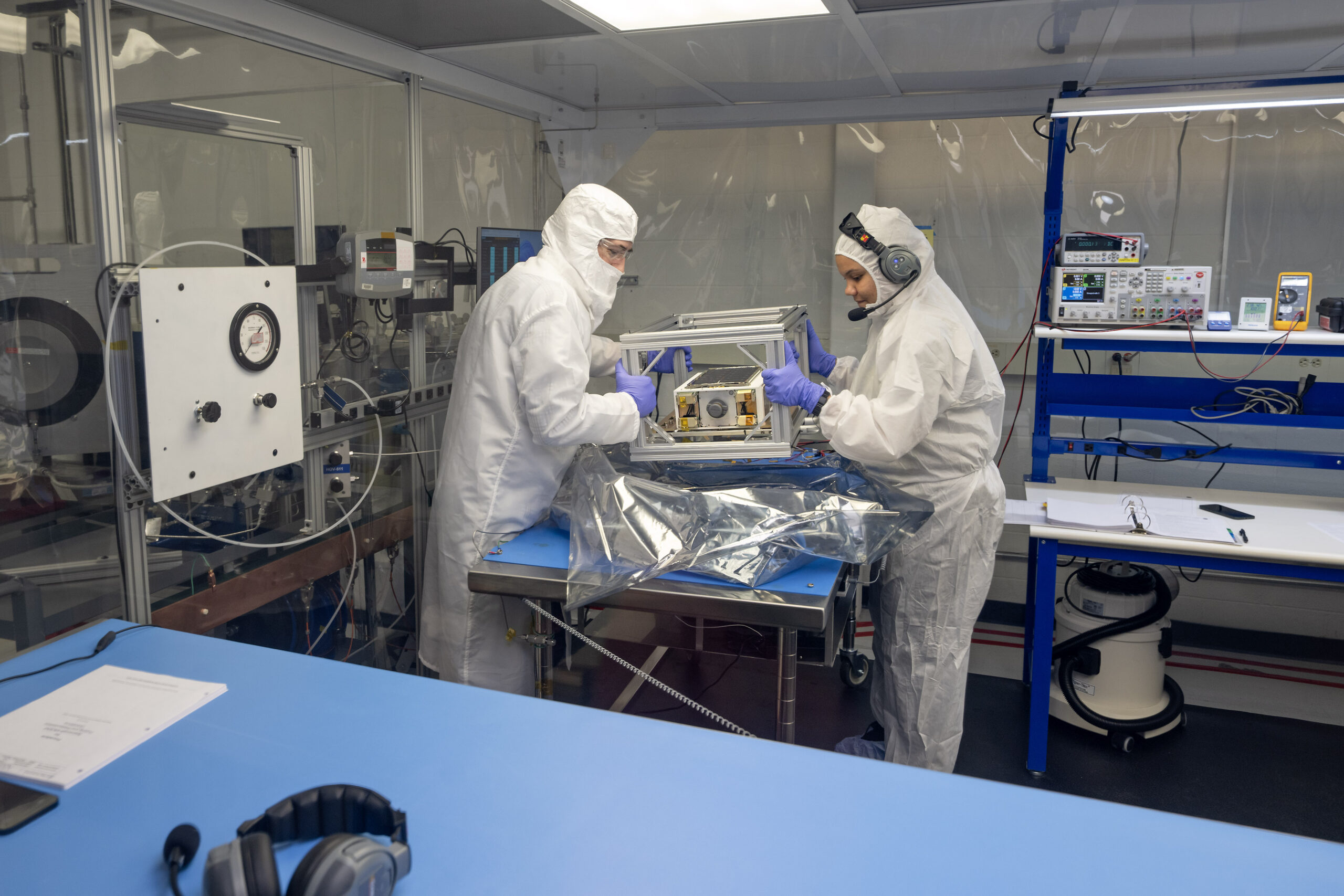
NASA MARSHALL SPACE FLIGHT CENTER, HUNTSVILLE, Ala. — Among the payloads scheduled for the next SpaceX rideshare mission is a shoebox-sized spacecraft for NASA’s latest flight demonstration of a low-toxicity propellant the agency has been studying for at least a decade.
This spacecraft, dubbed GPDM for Green Propulsion Dual Mode, is to spend nine months in low-Earth orbit testing a new dual-mode propulsion system with ASCENT propellant, said Nehemiah Williams, the project manager for green propulsion technology development at NASA Marshall.
Developed by the Air Force Research Laboratory, ASCENT — short for Advanced Spacecraft Energetic Non-Toxic — is an ionic liquid designed to be less hazardous than hydrazine, the dominant liquid propellant used by today’s satellites. Hydrazine, a hypergolic compound, requires careful handling because of its highly flammable and corrosive nature.
ASCENT also has a higher energy density, Williams said, meaning satellites can travel farther on the same amount of this “pinkish” fuel compared to hydrazine.
The upcoming GPDM mission is NASA’s third flight demonstration with ASCENT, he said, but marks “the first time that we’ve looked at dual-mode technology on a small spacecraft.”
The six-unit cubesat is equipped with one chemical thruster and four electric thrusters called electrosprays linked to the same propellant tank, Williams said. This will allow operators to switch between chemical and electric propulsion, so NASA can assess whether this dual-mode technique could allow spacecraft to leverage the advantages of both propulsion types.
Chemical propulsion offers high thrust, but low fuel efficiency, while electric propulsion offers low thrust, but high fuel efficiency. If you have both on a spacecraft, “you’re expanding the possible types of missions you can fly,” Williams said.
ASCENT’s composition allows for the choice of propulsion mode in a way that hydrazine does not, he said. For chemical propulsion, the propellant is “heated with a catalyst bed,” whereas electric mode calls for it to be ionized “using an electromagnetic grid.”
The GPDM spacecraft will launch aboard a SpaceX Falcon 9 that’s scheduled to lift off “no earlier than Oct. 1,” Jason Adam, director of NASA Marshall’s Science and Technology Office, said during a panel last month at the Space and Missile Defense Symposium.
Once in LEO, Williams said the spacecraft will spend “about a week” going through routine battery, solar array and communications checkouts. Then, in “the second and third weeks of the mission, we’re going to do chemical thruster burns first to make sure the chemical subsystem is working, and then [move] over to electrosprays.”
If all works as planned, the “nominal mission” begins, he said, which involves running the electrospray thrusters for varying lengths of time as well as using the dual propulsion system to change the satellite’s altitude and orientation.
NASA’s previous ASCENT flight demonstration, Lunar Flashlight, was launched in late 2022 but failed to produce enough thrust to reach its intended lunar orbit. A NASA Engineering and Safety Council investigation later concluded that powder from a 3D-printed part created blockages that prevented the thrusters from performing as planned.
Based on this, Williams said the GPDM team has taken “extra precautions” to “really make sure that the feed system ducts were clear of debris.”
“I’ve been involved in [GPDM] for over four years at this point,” he said. “It’s one of the most exciting things, I think, you can ever experience in life — to go from PowerPoint charts and sketches to a flight system that you get to show off to the world.”
If the GPDM mission goes to plan, “I would love to see a larger dual-mode small sat system that’s going to the moon or beyond,” Williams said. “That’s kind of what we’re looking at next,” although “we’ve got a lot of technology work to do in terms of scaling these systems to something larger.”
Adam also noted that NASA is planning a follow-on ASCENT demonstration involving larger and more capable thrusters.
In the future, small satellites equipped with more efficient propulsion systems could support NASA’s broader lunar exploration goals, Williams said. “You can use them as constellations for communication, for instance, around lunar surface assets,” or they “could do lunar missions and perhaps even interplanetary missions.”