

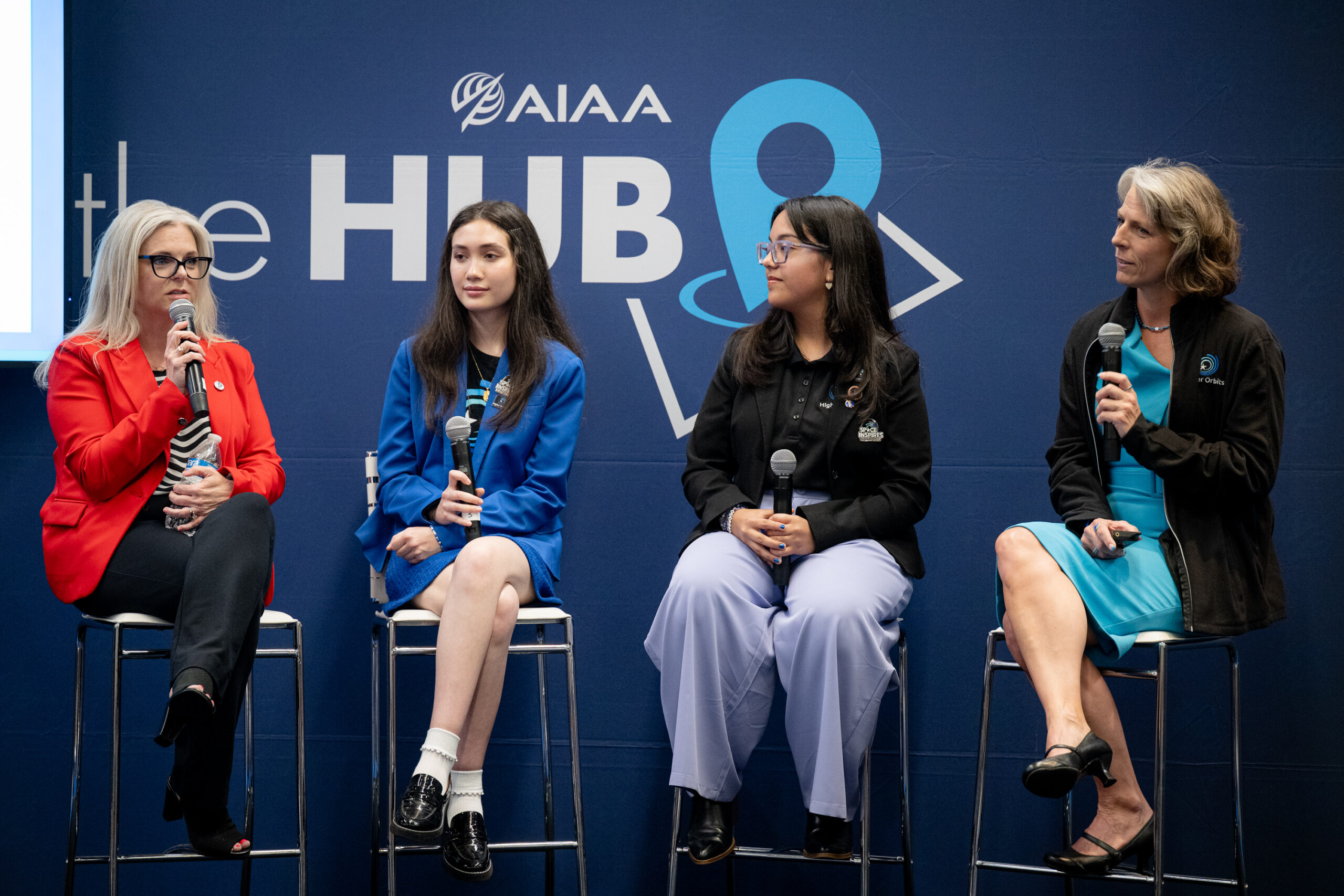
Ava Crowder, a high school junior in Virginia, has conducted research on a rust-eating bacteria to determine how it might perform in microgravity. Eva Estrada, another high school student from Texas, worked with a NASA astronaut on an experiment for the International Space Station.
The pair attended ASCEND 2026 to share their experiences with the nonprofit Higher Orbits that offers hands-on learning opportunities for high school students studying science, technology, engineering, and math (STEM) who might be interested in pursuing careers in the space industry.
The organization was founded a decade ago by Michelle Lucas, a former NASA flight controller and astronaut instructor. It has enlisted more than 2,500 students in 23 states, including in two-dozen experiments that have flown to space with the aid of Higher Orbit’s implementation partner, the space services company Space Tango.
“We had great inspiration in the Sixties. Artemis is bringing back inspiration,” Lucas told the ASCEND audience during a session titled “Higher Orbits: The Next Generation of Future STEM Leaders.”
“Our goal with Higher Orbits is to inspire the next generation of explorers,” she added. “We are literally launching their dreams to space.”
The real-world impact was clear on stage at ASCEND. Crowder, who was attending her first conference, said she was inspired by her sister, who got involved with Higher Orbits when she was in the 8th grade. Ava first participated in an art competition with a space theme and saw her entry flown to orbit. Then last year she participated in another project supported by Amazon Leo.
“My team decided to study a strain of rust-eating bacteria and kind of see how that would work in microgravity,” she recounted. “And not only does it remove corrosion from certain carbon steels, it can also produce electrical currents that are useable. So, we thought that would be really cool to study in space and kind of see how that could go. Maybe it could be used to create future Martian or lunar bases.”
Where does she see herself in the future? “I hope to pursue science communications in the future,” Crowder said. “Maybe a little of astrobiology or microbiology in the mix, too.”
Meanwhile, Estrada, 14, moved to the United States from Venezuela when she was nine. She attended her first Higher Orbits event in Midland, Texas, in 2024 and recounted how she spent two days “creating and designing an experiment that could potentially go to the ISS.”
“From there, I wanted to get more involved,” Estrada said. “I thought, ‘wow, that space thing is pretty cool.’”
She has since attended several AIAA space events. At ASCEND 2025, she said. “I was able to go to a bunch of sessions looking into how the human body changes in microgravity. And from that spark, Higher Orbits helped me kind of maintain that fire and learn more and more. And so there I was also able to make new friends and create industry connections and find mentors who can help me.”
She said she is now pursuing an engineering studies pathway with her local community college.
The imperative for developing a new cadre of STEM learners couldn’t be more acute, according to Sean Wilson, the principal director for strategic communications at The Aerospace Corporation and a member of the Higher Orbits’ board of directors.
“Getting people interested in STEM fields has been difficult,” she told the ASCEND audience. “Our adversaries are outpacing us in this area. So, it’s really important for kids to go into STEM careers to kind of help keep our edge in space.”
Wilson also stressed that Higher Orbits is “not just teaching kids about science and STEM. It’s teaching kids how to be leaders, how to collaborate, how to just work together and communicate.”
Indeed, both Crowder and Estrada have started organizing other students in their communities.
“I’ve also been inspired to kind of go down my own path and be my own little mini-Michelle [Lucas] and start a STEM workshop in my small town, which I believe barely even has a 1,000 people in it,” Crowder told the audience. “But I’m already able to encourage so many other young minds to pursue STEM and see that this field of study is possible no matter where you are in the world.”
Estrada said she has joined with a community college student to create their own local Higher Orbits chapter. “And we’ve been able to get over 40 people interested and we’re going to start getting guest speakers and do tours and all kinds of things to really spark up an interest in aerospace in our community,” she said.
Lucas said one growing emphasis for Higher Orbits is expanding to more rural communities like Crowder’s. “One of the things that we don’t talk enough about is access,” she said. “It is one thing to say things exist. It is another to give students access to opportunities.”
For example, she said that a wealthy suburb like Fairfax County in Virginia, just outside the nation’s capital, might offer hundreds of STEM opportunities for students. “What about the kid in Piedmont, North Dakota? What about the little girl in Iowa? In the community that has 63 people?”
But it’s clearly about much more than inspiring youngsters to find their professional path to success. Said Estrada: “I was also able to develop professional skills like public speaking and meeting people. But I think the most important thing is…that I found a place where I felt like I belonged.”