

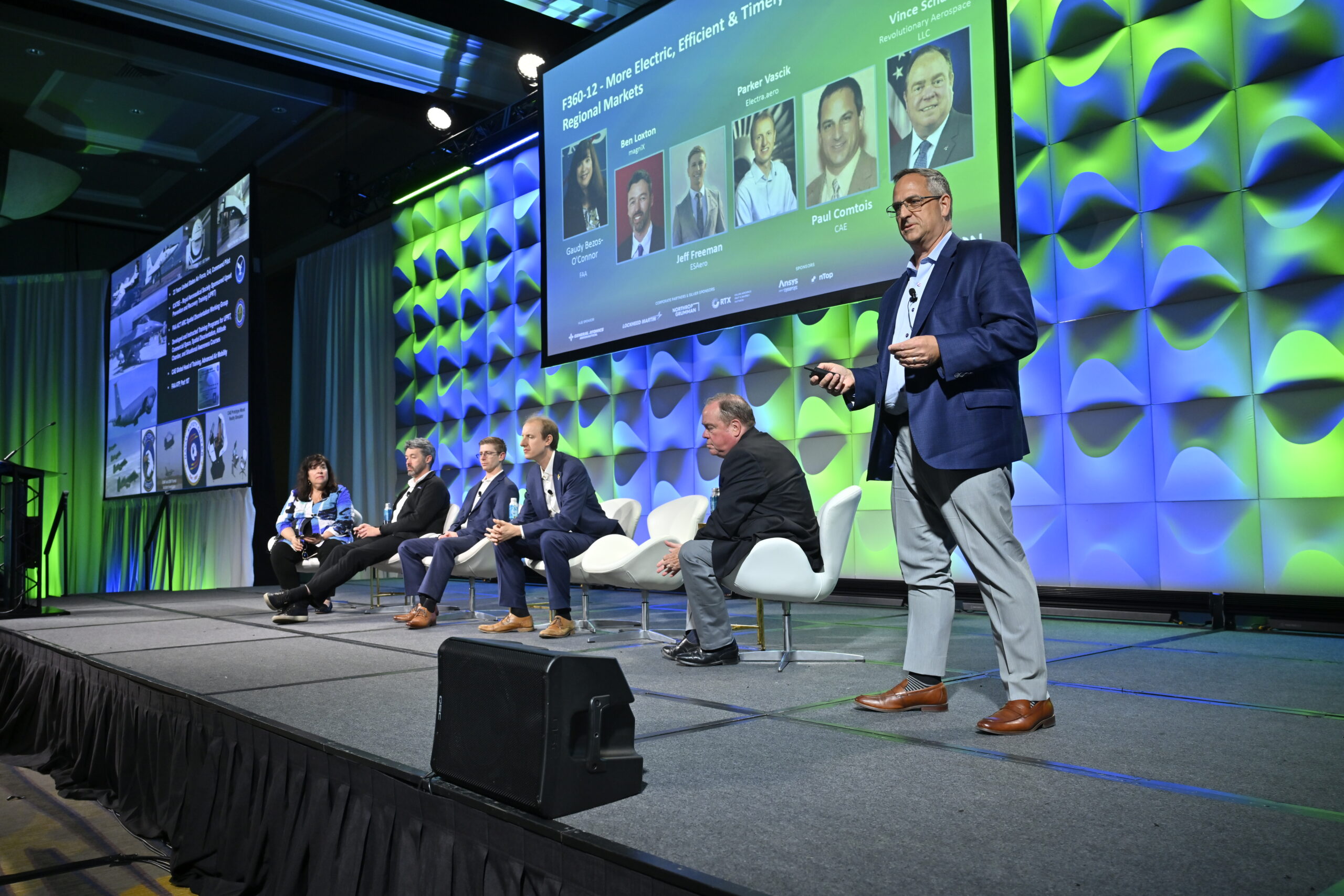
Panelists said progress in ATC procedures, infrastructure, and certification frameworks now matters as much as motors and batteries in bringing electric aircraft into everyday service.
SAN DIEGO – Electric aviation may have proven it can fly, but whether it can scale is now the central question, according to industry and government experts at AIAA AVIATION Forum 2026.
Moderated by Gaudy Bezos‑O’Connor, former NASA project manager for the Electrified Powertrain Flight Demonstration (EPFD) and now with the FAA, the session explored how more electric and hybrid‑electric aircraft can transition from high‑profile demonstrations to routine service in regional markets.
Bezos‑O’Connor framed the discussion around the broader ecosystem needed to support these aircraft, spanning certification, pilot training, infrastructure, and public acceptance, and then turned to leaders from magniX, ESAero, Electra, and CAE to detail what’s working, what’s still missing, and where early commercial opportunities are likely to emerge.
“It’s not so much: is it technically possible? Now it’s technically possible. The question is: how do we make this commercially viable and get these aircraft out into the market?” said Ben Loxton, vice president at magniX, a Washington-based electric motor and battery manufacturer.
From Technical Readiness to Market Reality
Loxton traced magniX’s path from early electric motor research to six high‑profile demonstrators, including Harbor Air’s electric Beaver and an electrified Robinson helicopter. Through NASA’s Electrified Powertrain Flight Demonstration (EPFD) program, magniX has helped regulators shape special conditions for certifying electric propulsion systems.
He stressed that short‑mission and training markets are viable today if aircraft are designed for real missions and economics.
“No good having a caravan that can do 50 miles if all the demand…is 500-mile flights,” he said. “There needs to be cost parity to the aircraft it’s replacing.”
Electric motors themselves are cost‑effective and low‑maintenance; batteries remain the dominant cost and life‑limit driver. By working with battery suppliers to optimize chemistries and pack parameters, magniX estimates roughly 13% per‑hour operating cost savings for an electric trainer versus a piston counterpart using today’s technology.
Where magniX focused on proving that electric propulsion can pencil out economically, Electra has taken a different approach: designing a new aircraft around the constraints of today’s batteries rather than waiting for the technology to improve.
Making Regional Travel Faster, Quieter, and More Direct
Electra is betting that a hybrid-electric, ultra-short takeoff and landing aircraft can make regional trips faster, quieter, and more convenient by flying people directly between smaller communities. Its nine-passenger EL9 is designed to operate from strips as short as a few hundred feet, slip into communities with minimal noise, and still offer the range and speed travelers expect on 50- to 500-mile trips.
To deliver that mix of performance, the EL9 uses distributed electric propellers blowing over the wing for quiet, precise, ultra-short operations near the ground, paired with a battery pack that is actually smaller than a Tesla’s and tapped only for the power-hungry takeoff and landing phases. Once airborne, an embedded turbine generator takes over for cruise, giving the aircraft more than 1,000 nautical miles of ferry range at about 175 knots. In effect, the design uses electrification where it adds the most value, while hybridization supplies the range, payload, and speed operators need for real-world missions.
“We wanted to create an aircraft that leveraged the opportunity that electrification can bring while overcoming the constraints of the technology, as they are today, to provide really unique performance capability that makes it an attractive vehicle for customers, for passengers, and really for the nation,” said Parker Vascik, director of product strategy at Electra.
Vascik illustrated why this hybrid approach is necessary by holding up a cup of jet fuel and a large battery module, each with 11 kWh of energy, to underscore how far batteries still lag on energy density.
Electra’s market modeling, based on cell-phone mobility data, identifies thousands of U.S. 50-500 mile city pairs where the EL9 could save travelers at least an hour compared to driving and hub-and-spoke flying. The company reports more than 2,200 letters of intent and deposit-backed sales, predominantly for regional passenger service, and plans to begin nine-seat flight testing in 2027.
Getting those aircraft into routine service, however, will require more than a certified airframe. CAE, the world’s largest independent aviation training provider, argued that training pipelines, operational approvals, and simulator programs must be built in parallel or entry into service will stall regardless of what the aircraft can do.
Training as the Critical Link
Paul Comtois, a retired U.S. Air Force colonel and head of Training Design and Advanced Air Mobility at CAE, the world’s largest independent aviation training provider, warned that approvals, pilot retraining, and data‑driven safety cases must mature alongside the hardware.
He broke the challenge into three buckets: approvals, understanding, and execution. Beyond certifying the aircraft itself, operators must secure approvals for their operations, training organizations (Part 142/ATO), simulators, courseware, instructors, and records systems, culminating in rigorous operational evaluations by regulators.
Regulators in multiple regions now expect commercial‑pilot level credentials (airplane or helicopter) for piloted advanced air mobility aircraft, but many pilots have never flown fly‑by‑wire or highly automated, multi‑motor electric platforms. Low‑altitude profiles and limited battery reserves compress decision timelines.
“There’s an operating envelope, and there’s a training envelope,” Comtois said. “You don’t just train the path; you train everything around it.”
Not every path to market runs through the same set of hurdles. ESAero described a military program that traded civilian certification requirements for speed, offering a different model for how fast electric propulsion can advance when some of those constraints are removed.
Crash, Learn, Repeat: High-Speed Experimentation
Jeff Freeman, director of Business Development at Empirical Systems Aerospace (ESAero), described reviving NASA’s canceled X‑57 program under a one‑year directive from the Office of the Deputy Assistant Secretary of Defense for Energy Resilience & Optimization. The goal: turn a crewed experimental electric airplane into an uncrewed hybrid‑electric demonstrator for Agile Combat Employment enabling technologies and more efficient military lift.
Under their one-year mandate, “a perfect flight a day late would be failure, but a risky, even messy attempt on time would still be judged a success” – a measure of how much the program prioritized speed over perfection.
By removing crew, ESAero accepted higher technical risk and less redundancy to move faster. A late ground run at Spaceport America ended in a high‑speed incident after an engine shutdown and electromagnetic interference (EMI) related autopilot fault, damaging but not destroying the aircraft.
Freeman described the outcome as a valuable stress test of the system, explaining, “We learned very much about items and failure modes…that we wouldn’t have identified right away if we had taken a slower approach,” he said. “My message to everyone is go crash, fly, repeat.”
Where to Invest Now in Electrification
During Q&A, the panel returned to the question Bezos-O’Connor posed at the outset: Given that the technology now works, where should the industry direct its attention and resources?
On technology gaps, Freeman singled out batteries as the core enabler for deeper electrification, while Loxton pointed to power distribution and supply chains, noting the scarcity of aerospace‑qualified high‑voltage connectors, cables, and power modules at scale.
Vascik argued that, over the next three years, air traffic control procedures and infrastructure are high‑leverage investments for governments and industry, including updating phraseology, approach/departure procedures, and building new short‑runway “access points” to support higher‑frequency regional operations.
On early business cases, panelists pointed to several complementary opportunities rather than a single dominant market. Vascik emphasized regional passenger service, or “direct aviation,” as a way to reconnect smaller communities with short, point‑to‑point flights. Loxton highlighted flight training, where electric trainers already make economic sense for the short sorties that dominate pilot instruction. Freeman argued that defense and autonomous cargo missions could move quickly as well, since they can sidestep some of the civil certification and public‑acceptance hurdles that constrain commercial passenger service. Public acceptance, they agreed, will hinge on visible, routine operations, such as advanced air mobility demos in major cities and the FAA’s new efforts to fly electric aircraft in “commercially relevant” settings.
Bezos‑O’Connor closed by underscoring NASA’s role in de‑risking enabling technologies, from thermal management and high‑voltage operations to powertrain integration, while industry leads commercialization. Her parting advice captured the forum’s mix of urgency and realism: “Think big, start small, act now.”