

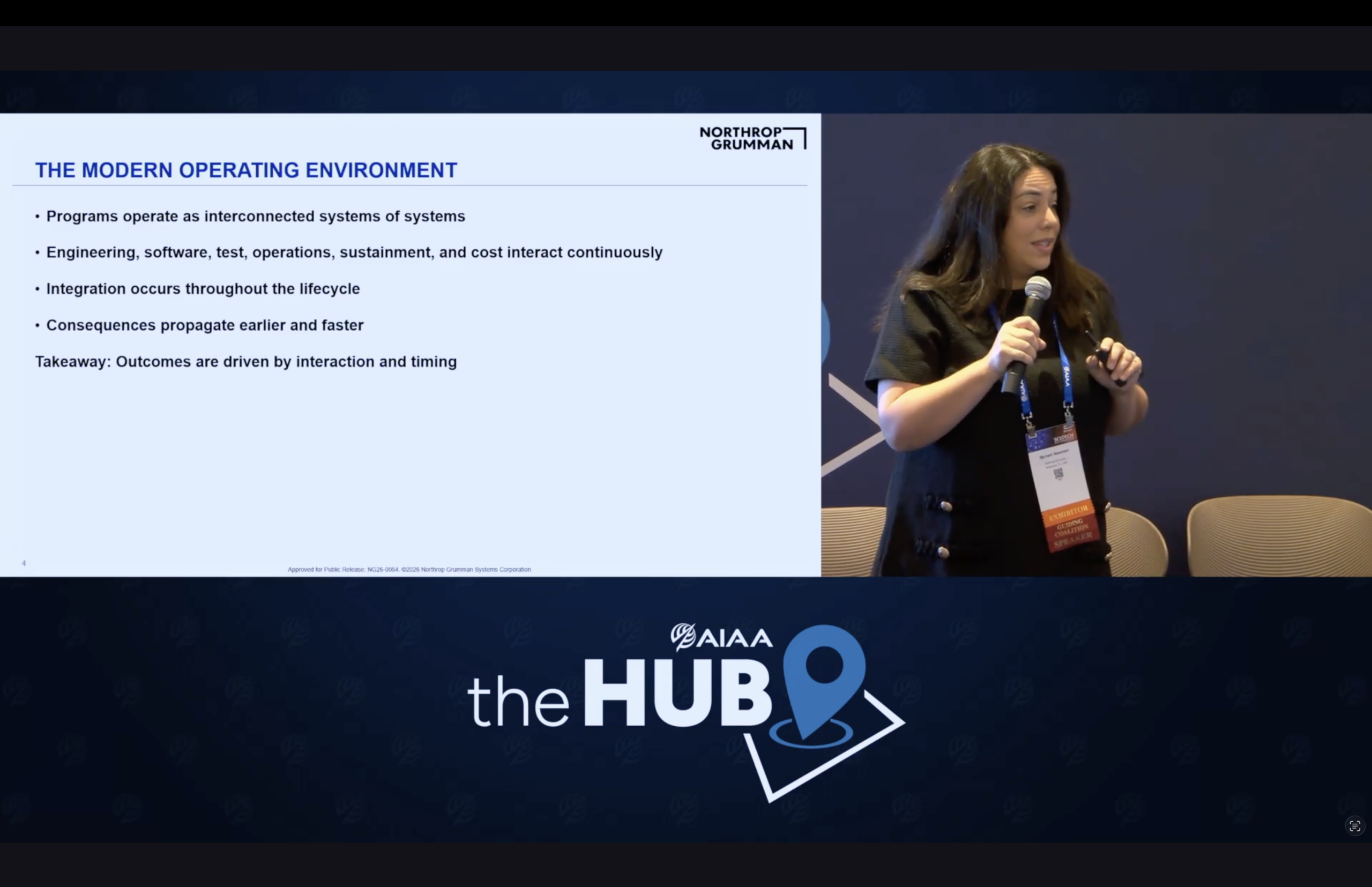
In the high-pressure arena of modern defense acquisition, speed often clashes with complexity. At a session during AIAA SciTech Forum 2026 in Orlando, Myriam Newman, Chief Cloud and Data Architect, Northrop Grumman Aeronautics, challenged the industry to move beyond traditional reporting and embrace a new paradigm: “execution intelligence.”
Drawing on a background in physics, Newman argued that modern aerospace programs are no longer linear hardware endeavors, but nonlinear “systems of systems” where data must be treated as a dynamic measurement, not just a historical record.
While the industry has mastered digital engineering and rapid prototyping, it often fails to carry the learning from these early phases into full-scale execution, Newman said. This disconnect creates “epistemic coupling,” where work continues at high velocity through human workarounds and tribal knowledge, masking underlying risks until they manifest as costly schedule variances.
Some of Newman’s key insights include:
- Move from Reporting to Sensing. Traditional Earned Value Management Systems (EVMS) act as lagging indicators, telling leaders what has already gone wrong. The proposed “sensing” approach uses real-time data topology to detect drift and broken assumptions early, providing the “runway” needed for course correction before costs harden.
- Beware the Cost of Workarounds. When teams rely on undocumented “heroics” to meet milestones, they preserve momentum but erode long-term affordability. These workarounds often hide the true cost per unit of work, leading to surprise integration failures later in the lifecycle.
- Employ Physics-First Rigor. By applying first-principles thinking to data architecture, organizations can overlay cost and schedule metrics onto engineering models (such as CAD drawings) to visualize systemic stress points and interaction densities that linear governance misses.
- Preserve Learning. The transition from Internal Research and Development (IRAD) to production often discards valuable experimental data. Execution intelligence ensures that the insights gained during prototyping travel with the technology into the program boundary, allowing for continuous assumption testing.
- Use Decision Sequencing. Rather than hardening all decisions at once, modern programs should sequence decisions based on coupling and uncertainty, keeping certain variables open longer to accommodate discovery without derailing the supply chain.
The ultimate goal is not merely to follow a plan, but to ensure the plan yields the desired outcome. By treating data as a living measurement of system behavior rather than a static report, Northrop Grumman aims to squeeze maximum value from existing digital investments, reducing sustainment costs and delivering capabilities faster. “Today is the most runway we’re going to have; let’s make it count,” Newman said.