

Digging Deep into Data has Allowed the NASA Research Engineer to Find Things Others Miss
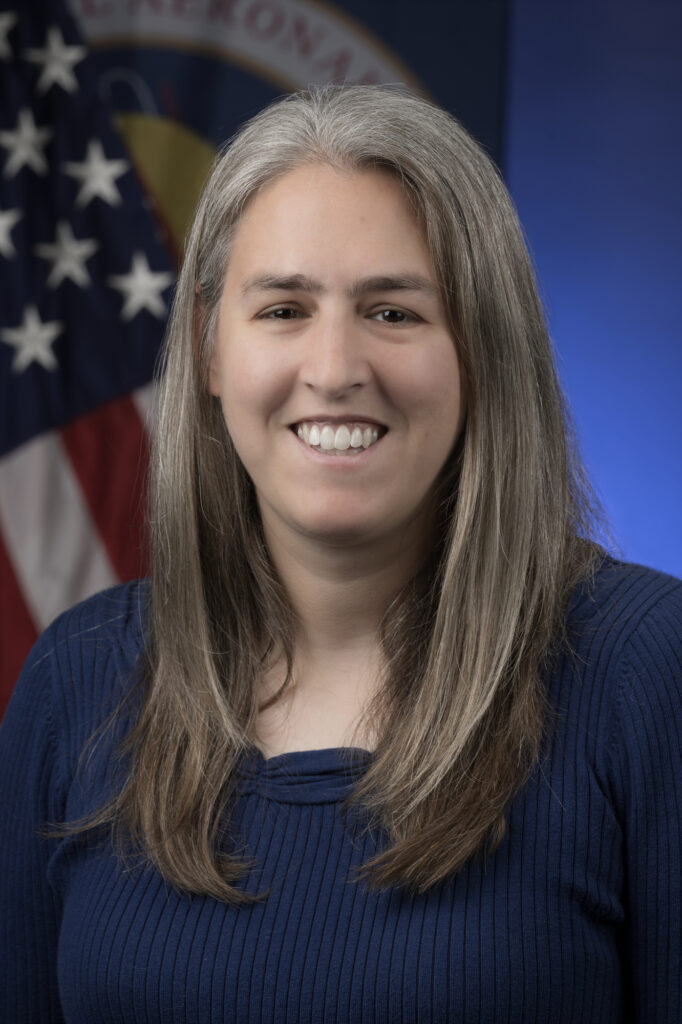
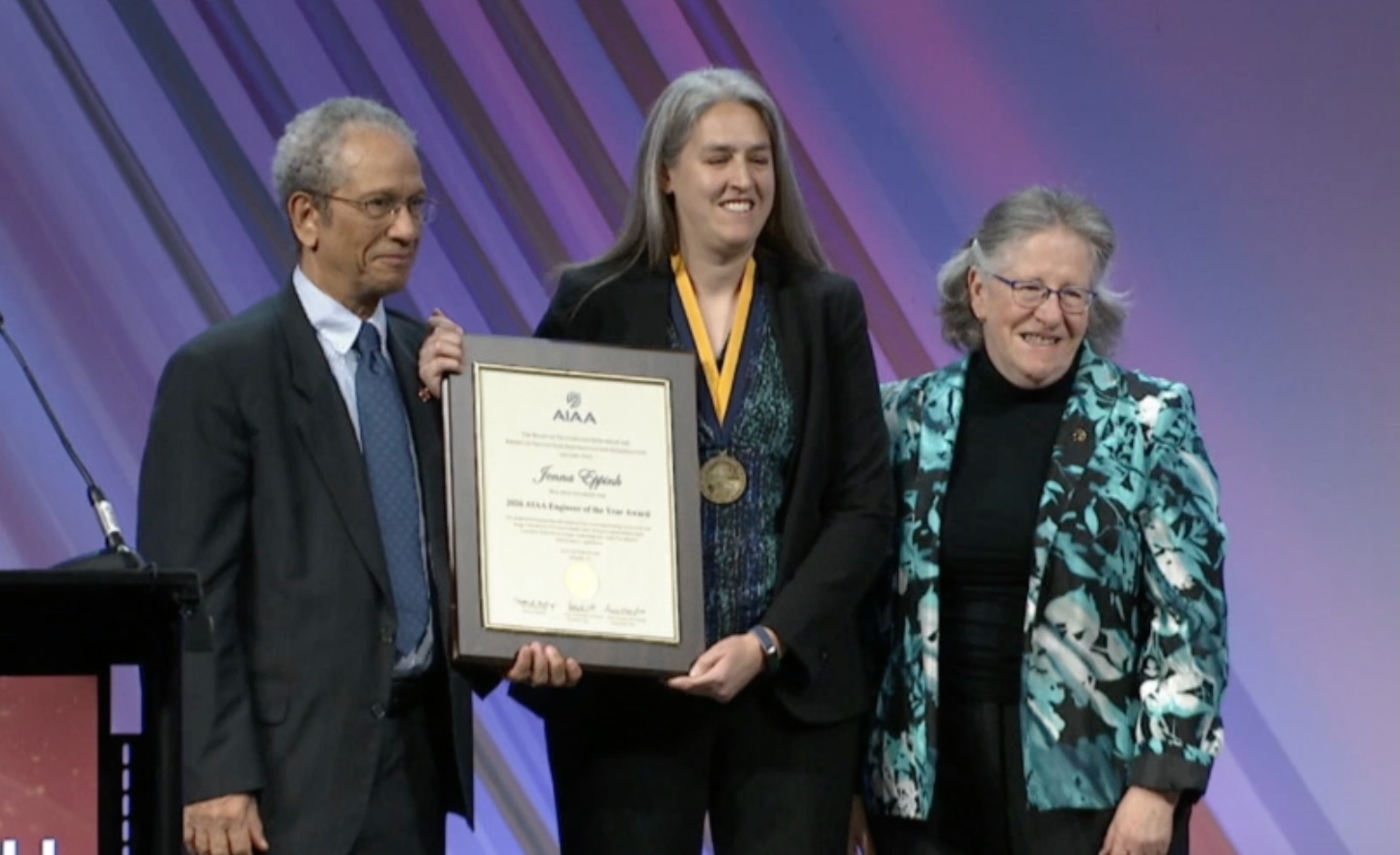
Jenna Eppink, a research aerospace engineer at NASA Langley Research Center, was recognized as the 2026 Engineer of the Year at AIAA SciTech Forum in January in Orlando.
She received the award for her significant contributions to flow measurement and near-body flow physics. As part of NASA Langley’s Flow Physics and Control Branch, Eppink’s technical innovation – particularly a boundary-layer transition detection technique – is expanding NASA’s research capabilities and setting new standards in experimental aerodynamics.
In aerospace, the boundary layer is the thin region of air directly next to a vehicle’s surface, where air slows down due to friction (viscosity). This can lead to velocity changing from zero at the surface to the free-stream speed outside the layer, significantly impacting drag, heat transfer, and aerodynamic performance. It can be smooth (laminar) or chaotic (turbulent), and its behavior, especially transitions and separation, is crucial for aircraft and spacecraft design.
“The boundary layer is very important for how an aerodynamic vehicle behaves, which is an interesting problem because it happens so close to the surface in a very small region,” said Eppink.
Despite it being such a small location, the boundary layer “impacts everywhere [on a vehicle] as it can change separation behavior; it can change the overall drag of the vehicle.”
Eppink’s research is particularly important to hypersonic vehicles given their sensitivity to thermal effects. In hypersonics, vehicle designers need the right amount of material to account for heating.
“They have to be able to predict how much material they’re going to need. If they overpredict, the vehicle will be too heavy and then there’s less payload. If they underpredict, it could cause the vehicle to overheat and possibly burn up in the atmosphere,” explained Eppink.
The core problem her work helped solve is accurately predicting and controlling the boundary layer transition to ensure vehicle safety and efficiency, especially as small changes in transition can lead to drastically increased drag or potentially disastrous overheating – critical issues for hypersonic and advanced aerospace vehicles.
Attention to Detail Pays Off
Analyzing data is one of her favorite activities, and that penchant for painstaking, thorough analysis exposed a new method for detecting the boundary-layer transition.
“For a lot of people…they get what they’re looking for and then move on, but I like to do a deep dive… Sometimes, that’s how you find things that others miss,” she said.
Eppink’s breakthrough was recognizing that a “basic” and surprisingly simple approach to plotting experimental data could detect boundary-layer transition – something that had been overlooked in the literature and by others in the field.
“When I found this technique, I was really surprised because it’s so simple. I spent a couple of days doing a literature review because I thought, ‘Surely somebody else has found it?’ But nobody had thought to plot things in a certain way to look for it.”
NASA already is using her technique for advanced aerodynamics test programs. It’s expected to have broad, lasting impacts on aircraft development.
A Passion for Math and Physics Turns into a Career
Eppink’s path to an engineering career began early.
“I always loved math. When I took my first physics class in high school and saw how you can take math and apply it to real problems, I was hooked,” recalled Eppink, whose father was also an engineer.
Her academic path led her from Baylor University in Waco, Texas, to Tufts University in the Greater Boston area, where an adviser connected her to NASA work for her graduate research. Participation in NASA’s Pathways Co-op Program during her Ph.D. studies seamlessly blended her research with hands-on NASA experience, setting her on a course for long-term impact.
Asked about her NASA career, Eppink said, “I’m most proud of bringing a fundamental understanding of flow physics to the aerospace field.”
Eppink’s other research that contributed to her AIAA recognition involves demonstrating lensless particle image velocimetry (PIV). Lensless PIV eliminates the need for imaging lenses to measure flow fields near a surface. Only the camera sensor, a thin mask, and computations are required to image particles in a flow field and to compute the velocity field. The small form factor could enable embedded sensors for near-wall measurements, work crucial for understanding aerodynamics, internal combustion and microfluidics, where traditional methods struggle with optical access.
Pastime Passions
When not discovering aerospace measurement breakthroughs, Eppink plays the oboe and piano, performing with bands, orchestras, and jazz ensembles in Virginia. Her favorite binge-worthy TV sitcom series is M*A*S*H, the 1970s and 1980s war comedy about doctors and nurses assigned to a U.S. Army Mobile Army Surgical Hospital during the Korean War.
“My mom used to watch it all the time, and as a kid, I thought it was just a boring old show. But one time, I actually sat down and watched, and I realized it’s a really good show!” she laughed.
Eppink also enjoys the show for its connection to science communication. “[The actor] Alan Alda, who played Hawkeye, is really into science communication. He actually brought his science communication course to NASA Langley, and I was able to participate in that,” she added.
Advice for the Next Generation
Eppink exemplifies the blend of technical rigor and personal curiosity that propels aerospace innovation. Her advice to young engineers? “Follow your passion… it makes the hard work worth it.”