

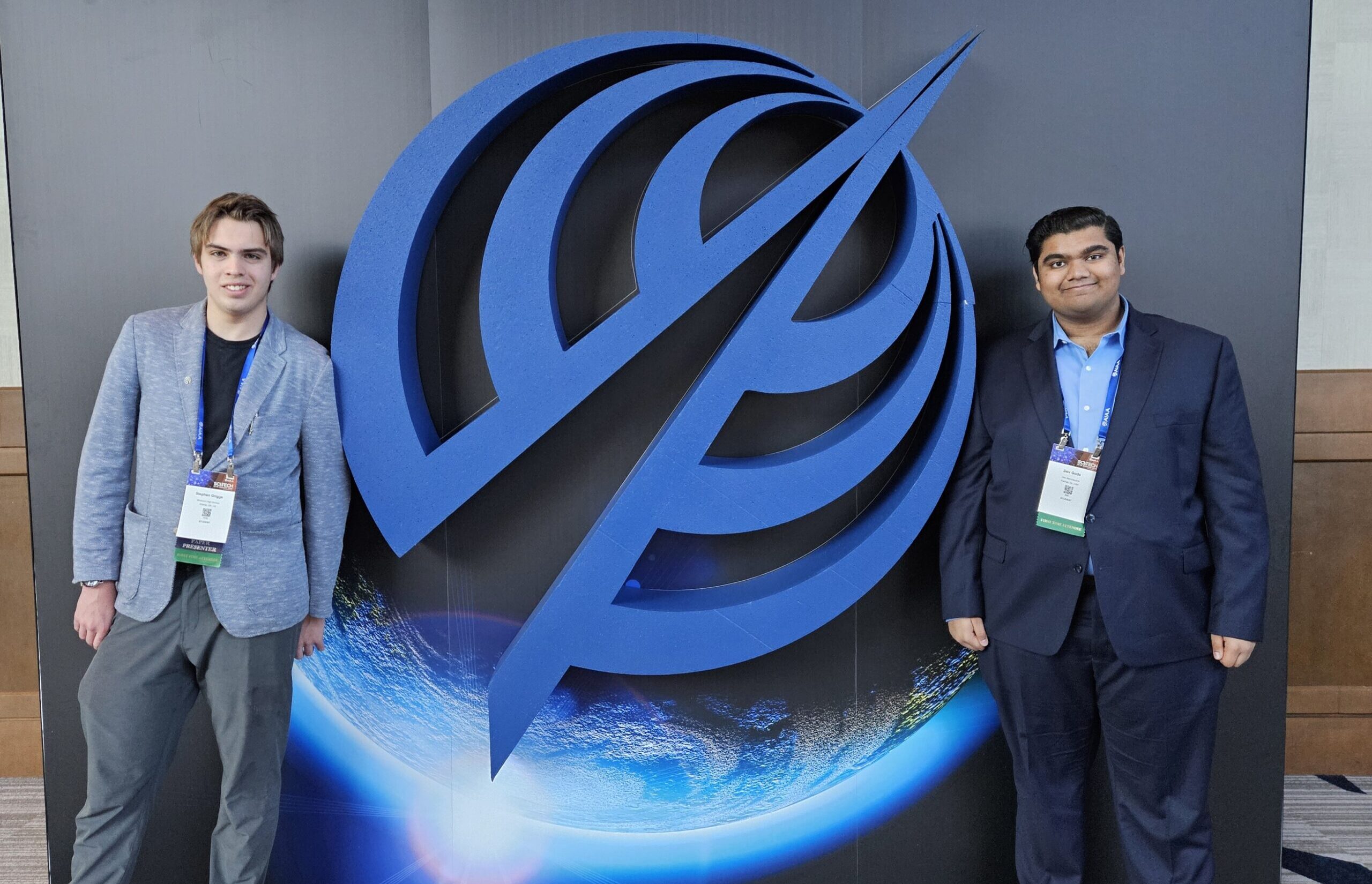
In January 2026, two high school students attended AIAA SciTech Forum for the first time. Stephen Griggs was an 18-year-old senior from Georgia and Dev Goda a 17-year-old junior from Northern Virginia. The two young men had first met and bonded over their shared interest in flying model airplanes and discovered a mutual connection through AIAA.
“I’ve been an AIAA member since my sophomore year in high school,” Stephen said. “I’ve been following AIAA news and conference proceedings for a while and I had a paper that I figured may be AIAA SciTech worthy, so I sent in an abstract and was delighted when it was accepted.” He remembers the shock and excitement he felt while sitting in a café with his mother and receiving the email saying his paper had been accepted. “Presenting it here has been amazing because so many people had great questions for me. I appreciated the audience engagement and their experience.” Stephen’s accepted paper focused on the design, analysis, and testing of a long-endurance solar UAV intended to support emergency communications in disaster environments, with an emphasis on power-constrained flight, endurance trade studies, and real-world deployment considerations.
Dev became an AIAA member a year earlier when he heard about the organization after winning a regional science fair. Stephen encouraged Dev to join him on his first trip to the forum and the two students traveled to Orlando, Florida.
“My whole experience with AIAA has been incredible.” Stephen said. “One of the things I appreciate about being a member is the Aerospace America subscription, and My Daily Launch. I generally like to read those each morning. I appreciate the technical documentation through ARC. I’ve referenced that many times. And I enjoy the networking opportunities that AIAA offers… I appreciate the people here taking the time to talk to us and guide us through our future as AIAA members and future professionals.”
Dev agreed. “Before coming to AIAA SciTech I didn’t have many connections in the industry. I didn’t know many people who do this work. … I was surprised at all the things to see and do, and the variety of people to meet. I’ve made so many connections. I’ve already met multiple mentors who are willing to help me through the processes as I work on hopefully having a research paper to present next year.”
One of the networking opportunities Stephen and Dev took advantage of was Meet the Employers: an event for students and young professionals to engage with AIAA corporate members and learn about internships, corporate culture, future employment opportunities, and various company projects. At the event, they met John Langford, the aerospace entrepreneur who founded Aurora Flight Sciences, Athena Technologies, and Electra.aero, and is a past President of AIAA. Langford was impressed with the two students and interested in the overlap between Stephen’s paper and a new initiative Langford was working on.
The three had a follow-up lunch to discuss their respective interests in greater depth. Stephen noted, “[Langford’s] an amazing man with an amazing history. It would be an honor to have anything to do with one of his projects.”
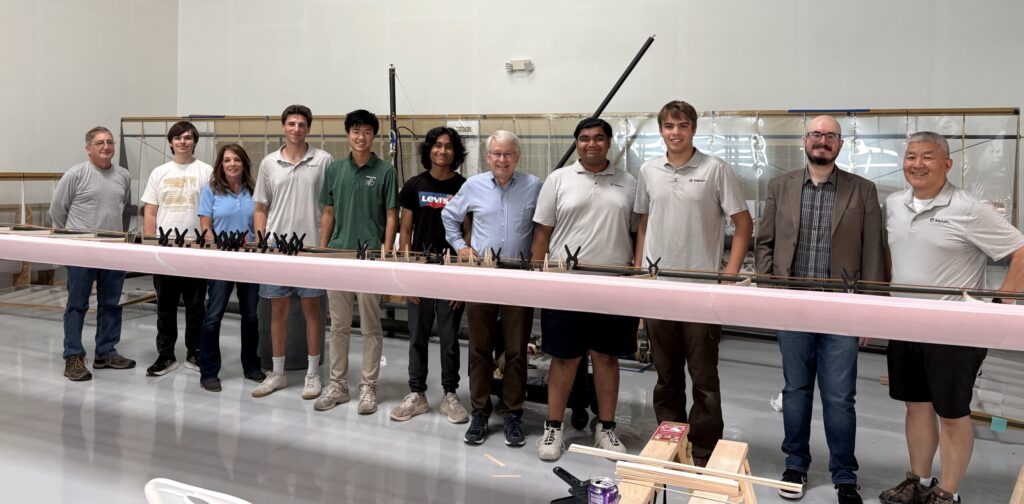
That dream came true this past summer, as both students interned at a new Langford company; Iris Aero was founded in 2025 by Langford and atmospheric scientist James Anderson. Their focus is on opportunities that leverage recent breakthroughs in solar power, lightweight structures, batteries, and sensing technologies to create and develop the Stratospheric Airborne Comprehensive Observation System (SACOS), an ultralight, autonomous, all-electric aircraft designed for persistent stratospheric operations.
Stephen and Dev joined a select group of other students working with experts at Iris Aero to make the Dawn One solar aircraft flightworthy. In addition to the expertise, guidance, and support they received from company employees, they also built indelible friendships with the other interns who worked together shoulder-to-shoulder throughout the summer.
In comparing their past experiences experimenting with RC aircraft and how that’s different from the advanced, real-world work they’re did over the summer, Stephen and Dev laughed: “In the past we did a whole lot of educated guessing, and now we’re doing a whole lot of education.”
“We learned so much doing this project; doing the structural tests, doing the documentation, because this is our first internship and work environment we learned so much about how to properly document,” said Dev.
“I could not have had a better preparation for working in aerospace,” emphasized Stephen, “This opportunity was the best thing to happen to me, truly.”
Standing in the Iris Aero headquarters, Langford reflected on the moment he first met the students at the beginning of the 2026, back in Orlando: “It’s unusual to have a high school student presenting a paper, and Stephen was giving a paper in exactly what we were interested in. So that was a no brainer… AIAA SciTech did exactly what it was supposed to do in terms of being the networking center.”
Dev is now in his final year of high school and working on college applications. However, he plans to come back to Iris Aero regularly to continue working on the project throughout the year.
Stephen has started his first year at Purdue University where he is studying aerospace engineering. He also plans to continue working on his own side solar projects.
As he left his first summer internship, Dev remarked, “I plan to be an AIAA member for life.”
Learn more about AIAA membership and the opportunities for students to get involved at aiaa.org/membership and aiaa.org/foundation.