

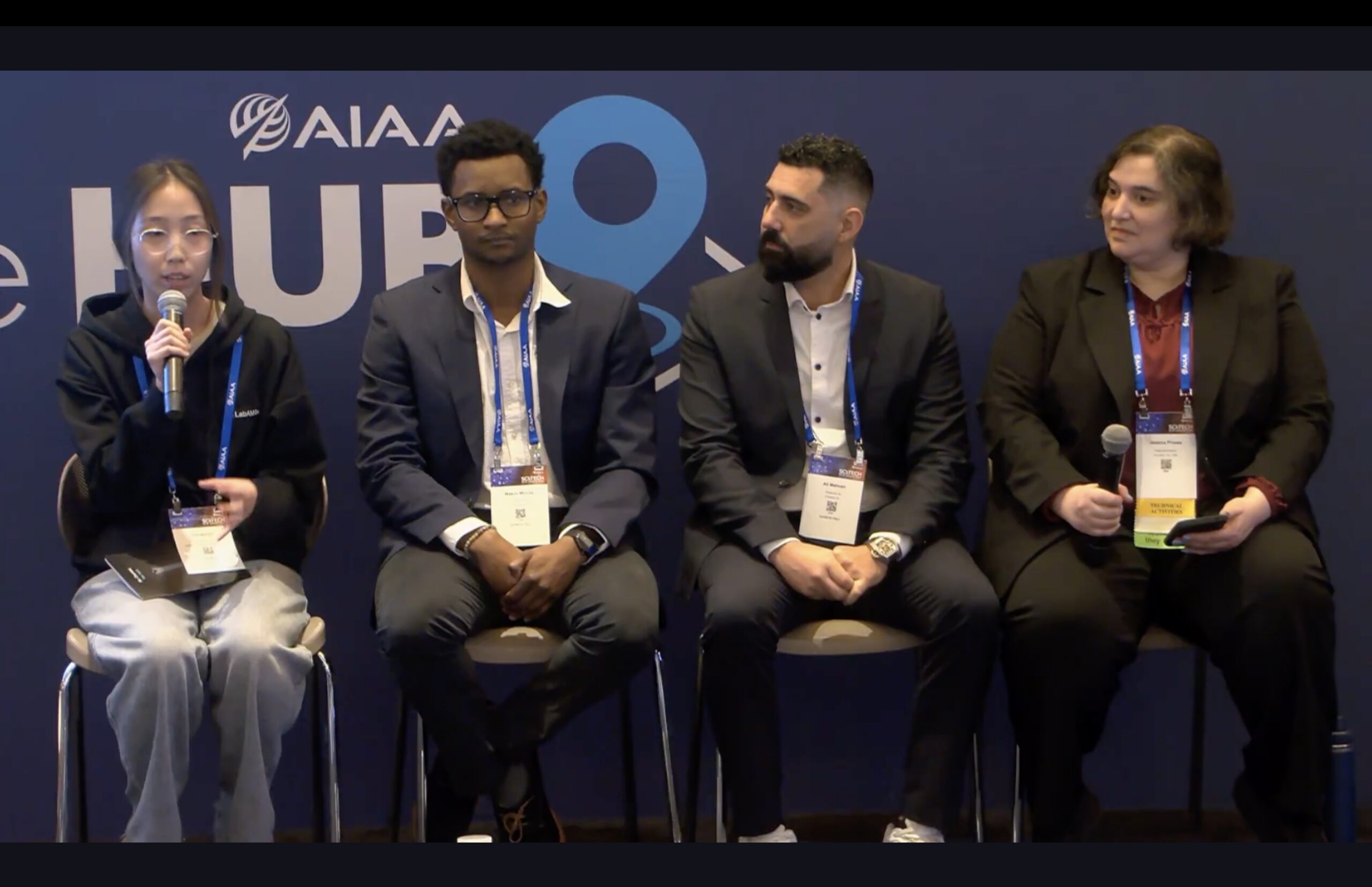
At the 8th Annual Materials Startup Panel, a diverse trio of founders and executives peeled back the curtain on the high-stakes world of aerospace innovation. Moderated by Jessica Piness of Aegis Aerospace and the AIAA Materials Technical Committee, the session at AIAA SciTech Forum 2026 in Orlando featured founders and executives from three startups, revealing unconventional paths to revolutionizing aerospace materials.
Disrupting the aerospace industry requires persistence, unconventional problem-solving, and a willingness to tackle “impossible” challenges that legacy primes often overlook, the panelists said.
The panel featured Ali Mahvan, CEO, Terasynth, a serial entrepreneur who pivoted from a boxing glove brand to becoming a prime contractor for the Department of War; Mason Mincey, Co-founder and COO of Soarce, whose journey began with a college rocket explosion that sparked a decade-long quest to revolutionize composites; and Christy Zo, principal research engineer of LabAM24, a South Korean startup pioneering oxidation prevention for metal 3D printing. Despite their disparate backgrounds, a common thread emerged: the necessity of being a “cockroach”– resilient enough to survive near-death experiences in the market long enough to find the winning formula.
These companies are fundamentally redefining material capabilities. Soarce is converting biomass into nanomaterials eight times stronger than steel, offering a “drop-in” solution for carbon fiber composites that enhances strength without altering manufacturing processes. LabAM24 has eliminated the need for massive inert gas chambers in directed energy deposition (DED) by creating a portable, localized inert environment, enabling the scalable printing of highly reactive metals like titanium and niobium alloys. Terasynth is leveraging applied AI to automate frontline warfare systems, moving beyond human-in-the-loop workflows to fully autonomous operations.
Key takeaways include:
- Resilience as a Core Competency. Survival in the startup ecosystem often depends on the ability to endure financial and technical crises (“being a cockroach”) until a breakthrough occurs.
- Drop-In Innovation. The most successful materials startups offer solutions that integrate seamlessly into existing manufacturing workflows, avoiding the need for customers to overhaul their entire production lines.
- Biomass to High-Performance. Converting abundant, low-cost biomass into high-strength nanomaterials is a viable path to enhancing composites and energetics, offering both economic and environmental benefits.
- Scalable Additive Manufacturing. Eliminating bulky infrastructure (like inert gas chambers) allows for the scalable production of large, complex components using reactive aerospace metals.
- Diversity Drives Innovation. Teams composed of individuals with non-traditional backgrounds, “quirky” initiative, and varied expertise consistently outperform homogeneous groups in generating unique solutions.
- Seeking Strategic Partnerships. Startups are actively looking for teeming partners with primes and government agencies to accelerate R&D, with specific calls for collaboration in composites, energetics, and autonomous systems.