

Houston and Luxembourg-based Exobiosphere Edges Out Field in Inaugural Pitch Competition
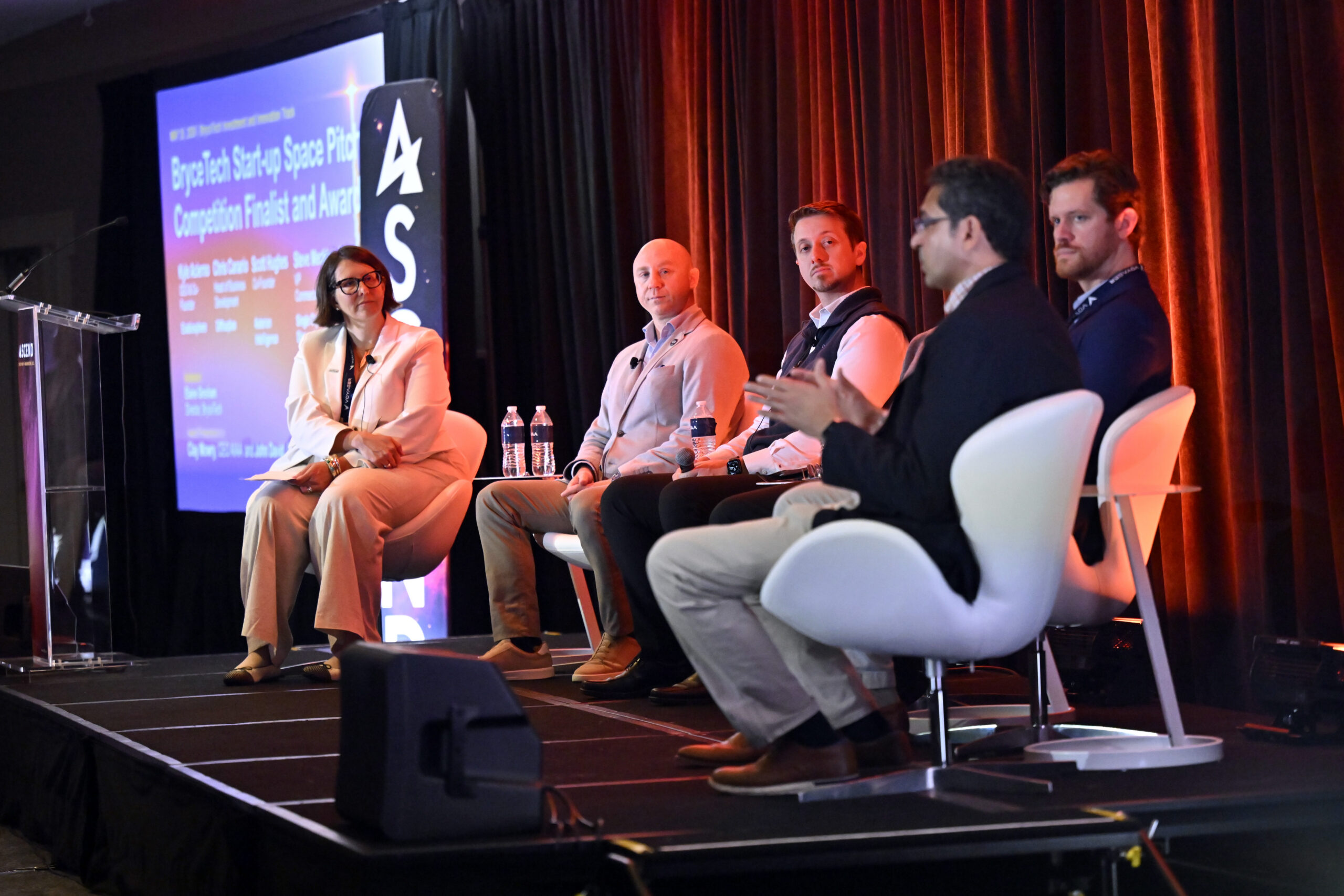
WASHINGTON, D.C. – Finalists of BryceTech’s first-ever Start-Up Space Pitch Competition took the ASCEND stage twice – first to pitch their technology and market strategy before a panel of space and technology investors and then to share their vision with the broader ASCEND community.
“It was a diverse group of companies, both in terms of stage and in the markets they’re going after,” said contest judge Tom Gillespie, partner and head of the Alliance Fund at Geodesic Capital, an early-stage dual-use deep tech venture firm. “Impressive teams all around.”
One team built a human-curated, AI-enhanced supply chain intelligence platform that maps aerospace and defense suppliers down to raw materials; another is using the microgravity environment of the ISS to grow high-purity single crystal diamonds for power electronics and room-temperature quantum devices; a third is shrinking bulky laser communication terminals with wafer-fabricated meta-optics that promise more than 10x reductions in size, weight, and power.
“We are very proud of all our finalists that advanced to this stage,” said Elaine Gresham, director of BryceTech’s Space Center of Excellence. “These deep‑tech, infrastructure-first space start-ups span supply chain intelligence, advanced materials, and next‑gen communications. [Meet each company below.]
During the start-up panel, which Gresham moderated, principals explored why they entered the space sector, what they learned and struggled with in building their start-ups, how they view accelerators and incubators, and what technologies they believe will shape the next decade in space.
BryceTech created the competition to connect promising early-stage companies with investors and technical experts. “Your companies, your people, and your technology really deserve to be up here,” said John C. David, chief transformation officer of BryceTech, who also served as a judge. “You’ve all done a wonderful job, and I appreciate the time and effort you took to be part of this program.”
“We really love the idea of bringing this competition here to ASCEND, and I appreciate all of you for coming. I heard it was a vigorous competition,” said Clay Mowry, CEO of AIAA, who joined David on stage to announce the winner.
The winning firm was Exobiosphere, a Houston and Luxembourg-based space bio company that automates biological research in space. Exobiosphere aims to change how lifesaving therapies are discovered both on Earth and in orbit. Its automated, high-throughput miniaturized laboratory can run up to 2,000 experiments at once on human-rated platforms and free flyers, giving scientists the statistical power they need to uncover new treatments faster and with greater confidence. Exobiosphere’s early customers – leading academics and hospitals like Cedars-Sinai – are using the platform to push the frontiers of space-based research, from stem cell studies to organoid models.
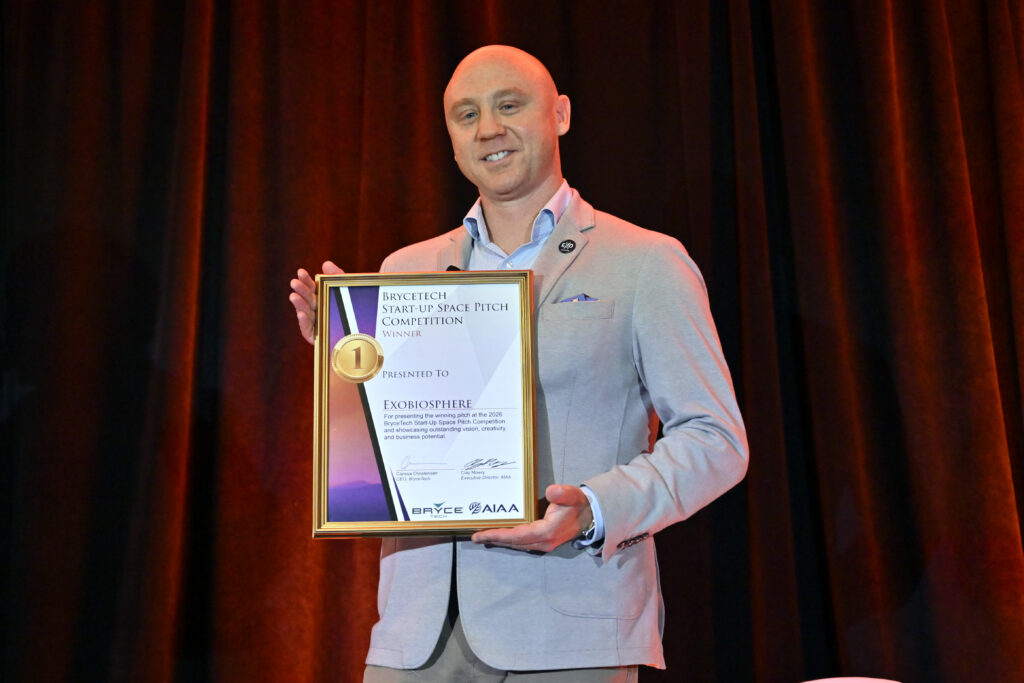
“I’m extremely happy and grateful,” said Kyle Acierno, CEO and co-founder of Exobiosphere after the ceremony, noting the caliber of the finalists made for “pretty stiff competition.” He added that the judges BryceTech brought in “were really top tier.”
As the winning start-up, Exobiosphere receives a BryceTech analytics strategy package, which includes analysis and two coaching sessions with the CEO. AIAA donated a booth and four individual passes to next year’s ASCEND event in Washington, a one‑year Corporate Membership to AIAA, and a complimentary invitation to the annual AIAA CTO Summit held in the fall at MITRE Corporation.
Acierno envisions Exobiosphere one day serving as a discovery engine in its own right, targeting some of humanity’s most devastating conditions, including Parkinson’s, ALS, dementia, and cancer.
Meet the Other BryceTech Start-up Space Finalists
Asterion Intelligence is building evidence-backed supply-chain intelligence for national-security launch, defense aerospace, and critical infrastructure. The platform transforms publicly available information – including government procurement records, regulatory filings, patents, trade data, and industry reporting – into structured intelligence graphs that map supplier relationships, program dependencies, and risk signals. Its evidence-first workflow ties every relationship in the platform to source support, confidence state, and provenance, allowing decision-makers to inspect the reasoning behind a conclusion before acting. Asterion was developed at Harvard Innovation Labs and is led by co-founders Scott Hughes, a Marine Corps veteran and AI engineer, and Karen Nguyen, a Harvard STEM and Teaching Fellow; both are co-authors of peer-reviewed AIAA 2026 publications.
Diffraqtion, based in Somerville, Massachusetts, is developing quantum cameras to deliver real-time, high-resolution visual intelligence for the next generation of autonomous systems. Diffraqtion’s technology, built on over a decade of fundamental quantum research with NASA and DARPA, extracts insights directly from incoming light to unlock 20x higher resolution and 1000x faster processing than conventional imaging systems. The result is a step-change in visual intelligence, enabling autonomous systems both in space and on Earth to see further and think faster. Diffraqtion recently demonstrated quantum imaging capabilities at a leading astronomical observatory as part of a Phase II SBIR with DARPA, validating the technology for space observation applications.
Ravee Optics, based in Dayton, Ohio, develops ultracompact laser communication terminals and high-performance, infrared thermal imaging systems that enable high-bandwidth data transmission and 3D mapping for small satellites, CubeSats, drones, and handheld devices. Founded in 2024, the company is pioneering miniaturized laser communications and thermal imaging to allow seamless, efficient inter-satellite data exchange and 3D mapping, even during inclement weather. It’s now commercializing a compact, infrared thermal image sensor for drones and small vehicles. This technology, licensed from the U.S. Air Force, enables 3D mapping and thermal imaging even in harsh weather. Ravee Optics is a member of Seraphim Space’s (Generation Space) Accelerator, a premier program dedicated to advancing space technology start-ups.
Single Crystal Diamond, Inc. draws on the semiconductor scientists and executive leadership who first brought man-made diamond to market in 2001. It combines 25 years of experience and intellectual property development to deliver ultra-high-quality diamond wafers for quantum technologies, power electronics, and advanced optics. The company leverages the microgravity of space to produce plasma-enhanced chemical vapor deposition (PE-CVD) diamond materials with a crystalline perfection unattainable on Earth, then processes the space-grown crystals in terrestrial facilities using proprietary techniques. A core innovation is its “Atomic Separation” liftoff technology, which lifts pristine thin films from a single bulk diamond grown in space – turning one crystal into hundreds of ground-processed devices – overcoming the cost-per-unit barriers that have historically limited in-space manufacturing. Through NASA’s In Space Production Applications program, the company successfully completed its Critical Design Review, clearing the path to deploy a PE-CVD reactor to the International Space Station, with a targeted launch in Q4 2026.