

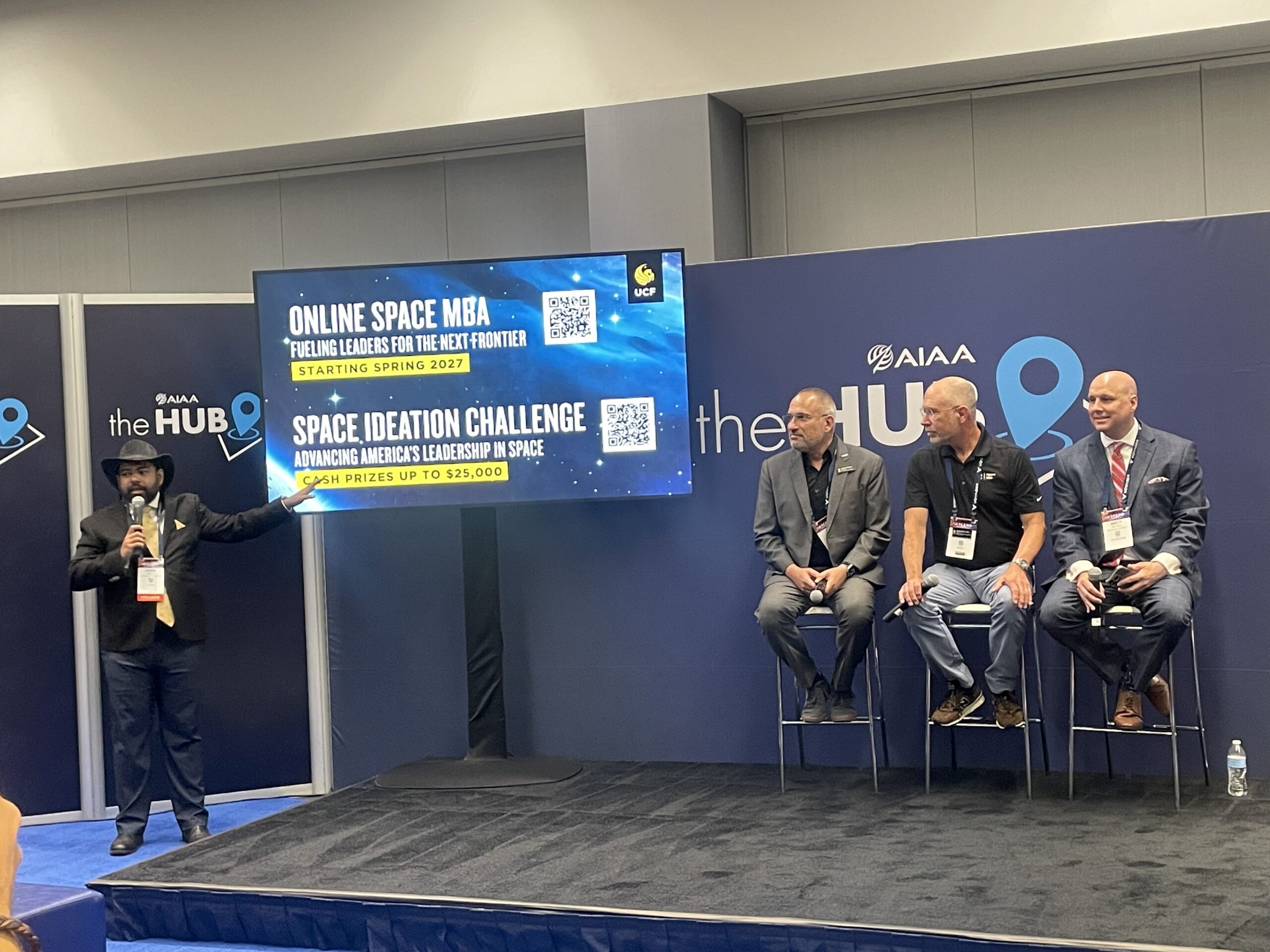
WASHINGTON, D.C. – Policy and research experts from the University of Central Florida joined Arizona’s first space commissioner in a lively debate on America’s drive to the moon. The session, held on the HUB stage at ASCEND 2026 on Tuesday, explored what needs to happen from policy and technical perspectives to bring America’s lunar ambitions to fruition.
“It’s who gets there first that matters,” said Brett Mecum, Arizona’s space commissioner, on the race between China and America to reach the moon. “That is why General Michael Guetlein, program manager for Golden Dome of America, called space the next warfighting domain.”
“There is a global sense of importance of returning to the moon,” observed UCF Professor Greg Autry, author of the 2024 book Red Moon Rising, which details the space race between the United States and China.
Despite bipartisan continuity of support for the Artemis program across the Biden and Trump administrations, Autry shares NASA Administrator Jared Isaacman’s view that NASA has moved too slowly for too long. He applauded the administrator’s “singular sense of purpose and drive.”
The panelists emphasized that sustained lunar operations will require advanced nuclear power systems due to energy demands, the length of lunar nights, and the need for industrial scalability. Recent U.S. policy shifts are accelerating interest in nuclear systems for space.
Zaheer Ali, the session’s moderator, a former nuclear engineer with the Department of Energy and a UCF professor who developed the college’s new Space MBA program, noted that “nuclear fusion is the future, full stop.” He asked the panel whether sustained human presence on the moon is realistic without nuclear power.
Alain Berinstain, director of the Florida Space Institute at UCF, concurred. “Being able to survive the lunar night on the moon — 14 days of constant darkness where temperatures plummet below -133 degrees Celsius — is a showstopper for so many reasons. If you’ve got nuclear, you’ve got power. Generating it is not the full answer, but if we really want to accelerate the work, then we’re going to need that nuclear power.”
Mecum called nuclear a “game changer,” envisioning a truck trailer-sized reactor powering entire settlements and enabling deep space missions. “Nuclear engines have the possibility of cutting down the travel time to Mars from months to days,” he said.
Getting there will require real interagency cooperation from entities such as the EPA and the Department of Energy, as well as strong state-level incentives tied to universities for nuclear R&D, Mecum noted. He has successfully secured support from Arizona state lawmakers and congressional leaders to fund Arizona’s commercial space initiatives.
Ali added that he “would love to see a Rickover-type program for space,” referring to Admiral Hyman Rickover’s push for the Navy to embrace nuclear-powered submarines.
The experts outlined several business cases that must be made for the moon to become commercially viable and justify serious investment. Autry cited helium-3 mining as a potential high-value export, along with lunar sample return. Berinstain argued that the real inflection point will be a continuous human presence on the moon that allows an economy to form. Ultimately, the panelists foresee the need for a model that includes government-backed infrastructure and governance — particularly around lunar resource extraction and long-term presence. Without policy clarity, capital and innovation remain bottled up.
“The moon is a strategic necessity for commercial, civil, and national defense purposes, and it’s going to take a national effort to make sure that we’ve got a base there,” Mecum concluded.
Do you have an idea for advancing America’s leadership in space? UCF’s Space Ideation Challenge seeks high-impact, market-shaping proposals. Submit a 3-to-5 page white paper proposing concrete, feasible initiatives to accelerate U.S. leadership in space, national security, and the space economy. The deadline is 30 June, and the challenge will award $125,000 in prizes to the best proposals. Learn more at the Space Ideation Challenge page on the UCF College of Business website.