

Embraer’s Research and Technology head details capabilities engineers need to thrive in aerospace today, as the Brazilian OEM focuses on achieving net-zero by 2050 and expanding into eVTOL
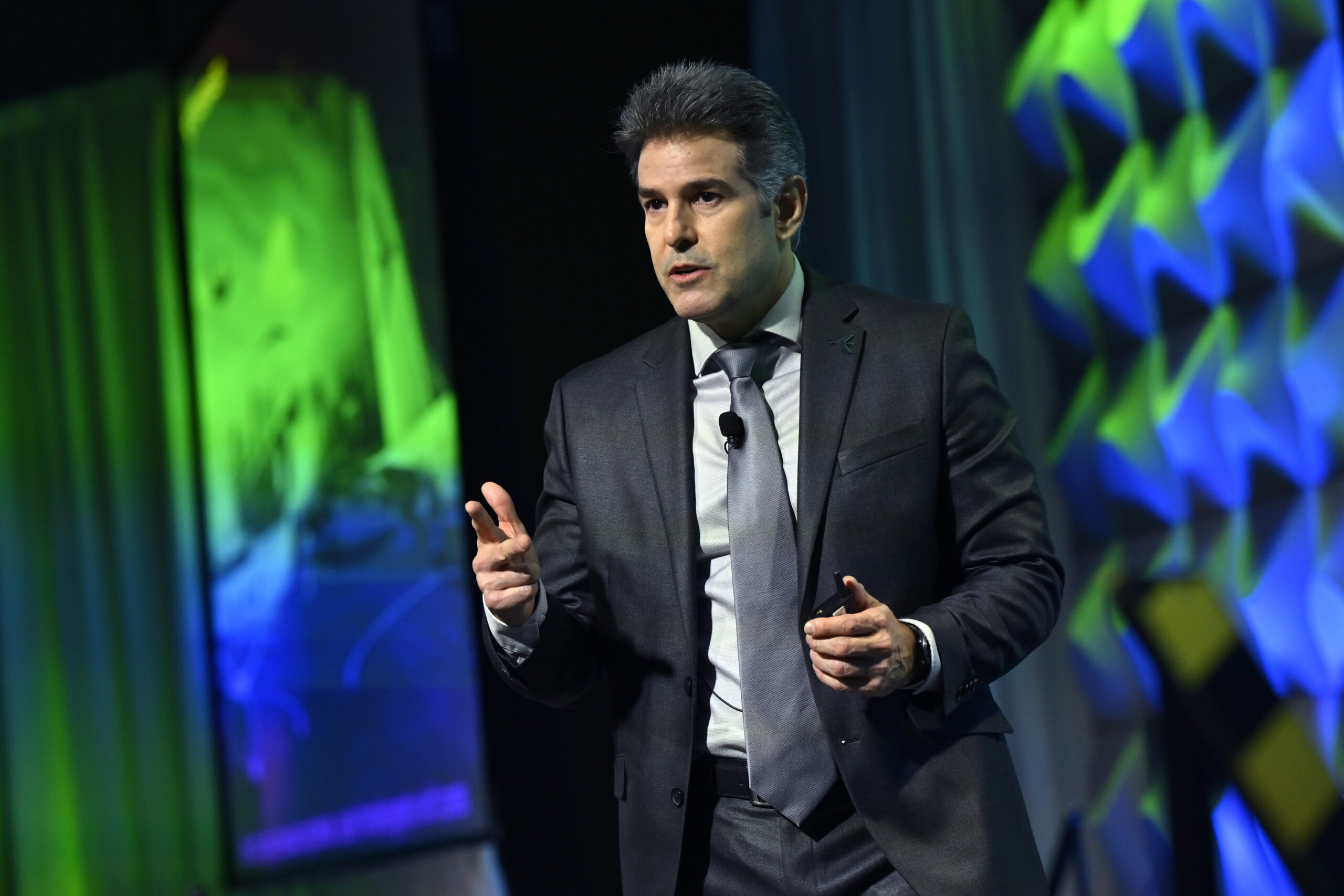
SAN DIEGO —The head of research and technology for Embraer said the secret sauce to Embraer’s innovation successes is one thing – its people.
Speaking at the opening plenary of AIAA AVIATION Forum in San Diego, Maurílio Albanese Novaes Jr., said that this people focus was rooted in the company’s origins. Brazilian aviator Casimiro Montenegro Filho, for example, idealized the aeronautical conglomerate that later resulted in Embraer’s creation, once observing, “Before producing aircraft, we need to produce engineers.”
“We believe aviation can be safer, simple, and more effective,” said Novaes, Embraer’s director of Research and Technology, noting that engineers are driving that future.
The Engineer of Tomorrow
He described three key qualities for tomorrow’s engineers: technical excellence, system-level and business awareness, and strong soft skills, with the latter his favorite because of the importance of communication, negotiation, and collaboration in meeting today’s engineering requirements.
Another driver of Embraer is “end-to-end capability,” enabled by the engineering side for research and technology development and its advanced design and integrated products development teams.
The formula has worked well for Embraer, which has achieved notable success in the markets in which it operates. Today, Embraer employs 4,200 engineers, many of whom are based in Melbourne, Fla., home of Embraer’s Engineering & Technology Center, the U.S. headquarters for its Executive Jets division and its Global Center of Excellence.
Because aircraft are so complex, Novaes said Embraer needs “full collaborative model-based development” so teams can simulate the entire aircraft together, get more precise results faster, and optimize at the system level rather than part by part. This approach shortens development time, improves early design decisions, and creates the digital environment where AI tools, standards-compliance agents, and data from flight tests can be fed back into the models to boost safety, performance, and sustainability.
Innovation Priorities Drive Embraer’s Future
Embraer is betting its future on a set of six innovation priorities:
- Zero‑emission technologies – blending sustainable aviation fuel, electric, and hybrid propulsion
- Progressively more autonomous flight operations
- More competitive airframes through better aerodynamics and lighter, integrated structures
- AI, data science, and cybersecurity
- An Industry 5.0 mindset in manufacturing – where AI and human–machine interfaces and connected factories will reshape how aircraft are built
- Passenger experience – redefining the connection of the passenger and the aircraft
Achieving Net-Zero by 2050
To achieve zero carbon emission by 2050, he added, requires a multipronged effort. “There’s no silver bullet.” The company will lean on sustainable aviation fuel across all aircraft sizes, including the existing fleet. Embraer’s strategy involves delivering full-electric propulsion for smaller aircraft (up to roughly 10–12 passengers), hydrogen fuel-cell systems for regional jets, and liquid-hydrogen or dual-fuel concepts combining sustainable aviation fuel (SAF) and liquid hydrogen, or LH₂, for larger narrowbodies. Those propulsion shifts are backed by continuous gains in airframe efficiency and noise reduction, he added.
Eve, Embraer’s electric vertical take-off and landing (eVTOL) aircraft, includes an all-in-one services portfolio for operating and maintaining eVTOLs (Eve Take Care) and Eve Vector, its urban air traffic management for air, ground, and fleet operations. Embraer spun Eve off as a separate company from its Innovation Center in 2020. While totally independent, Eve depends on Embraer engineers to develop both the vehicle and its other solutions, Novaes said.
Audience Perspectives
Audience member Brad Pande, a 40-year aerospace mechanical design engineer and founder of start-up, iPropulsion, was impressed by Embraer’s growth story: “Embraer started with a little plane in Brazil. We always think of titans in the United States and Europe but here Brazil has this homegrown company that has become an incredible industry. They’re very well recognized.”
Garrison Smith, flying qualities engineer at Lockheed Martin, observed, “Embraer is a little bit different in the case that Lockheed doesn’t make their products, but they have a lot of the same goals and aspirations and pillars they want to work toward, incorporating AI.” Smith acknowledge that AI is a big buzzword in aerospace now – “How do we leverage AI to make tools faster and remove processes that slow us down.”
Asked if anything from the talk surprised him, Smith said he didn’t know Embraer was developing eVTOL aircraft but added that it’s “absolutely good” for advancing the market. “The more we learn as a community, the faster we can get there.”
Embraer’s Businesses
The OEM focuses on commercial aviation, executive aviation, defense, services and support offerings, and since 2000, has delivered more than 9,000 aircraft to over 2,000 clients. The company’s E-Jet E2 regional twinjet family delivers 20% lower CO2 emissions and over 30% less external noise than its competitors, Novaes said. In the regional, single-aisle segment, Novaes said Embraer positions itself as a benchmark for efficiency, noise, and operating economics, noting that 30+ aircraft models have been certified in the last 25 years. In addition, Embraer’s Phenom 300 “has been the best-selling executive jet for 14 consecutive years,” Novaes added.
Within the defense market, Embraer is a reference supplier to multiple air forces worldwide. Novaes called out the KC-390 Millenium multi-mission transport and the A-29 Super Tucano, which has over 600,000 flight hours and 60,000 combat hours completed.
The company also has thrived in the certification arena. For its E-Jet 2 commercial jet, Embraer beat its own performance targets (lower noise, better fuel burn, and longer maintenance intervals) in less than five years. Project Management Institute awarded Embraer its “Best of the Best” award for being the first company in aviation history to achieve simultaneous type certification from ANAC (Brazil), EASA (Europe), and the FAA (U.S.) on the same day.
Another successful milestone was Embraer’s E2TS advanced take-off system for the jet, which automatically determines the optimal climb profile for each take-off. “Take-off distance is reduced and takeoff weight is increased, which means the E2 can carry more payload and fly longer distance,” the executive explained, noting that the new system will allow Embraer to operate in places with smaller runways, like London City and Florence, Italy.