

Electra, Georgia Tech, and JetZero Present Findings from 2050 Advanced Concepts Study
SAN DIEGO — Three aerospace teams working under NASA contracts have independently concluded that reaching NASA’s ambitious efficiency and environmental targets for new commercial airlines in 2050 requires moving away from tube-and-wing aircraft configuration that has defined commercial flight for six decades. The findings, presented on 8 June at AIAA AVIATION Forum 2026, carries a corollary: the decisions NASA makes in the next 10 years will largely determine whether a transformative aircraft is ready for service by 2050 or not.
The results came from Electra, Georgia Tech, and JetZero, three of the five contractors for NASA’s Advanced Aircraft Concepts for Environmental Sustainability (AACES) 2050 program. The session drew a standing-room crowd and a sustained round of audience questions. The two additional study participants, Pratt & Whitney and Boeing/Aurora, presented later in the day.
RELATED READING: NASA Funds New Studies Looking at Future of Sustainable Aircraft
Jesse Quinlan, program technologist for Advanced Air Vehicles at NASA, noted that the agency’s updated subsonic transport metrics table sets far-term goals on energy consumption, NOx, particulate matter, and noise that engine efficiency and advanced materials alone cannot reach. “The only way that we’re going to be able to satisfy that goal is through configuration change,” he said. “Today is the time where we need to start assessing, exploring, identifying, and making calculated investments.”
The featured speakers each presented findings from their 18-month studies – the opening results in what Quinlan described as NASA potentially using the findings to inform more than two decades of upcoming work. He pointed to NASA’s N+3 program, a series of studies launched in the late 2000s that defined revolutionary concepts for next-generation subsonic transports, as the template. That work took roughly two decades to mature into today’s X-66 transonic truss-braced wing demonstrator and the Sustainable Flight National Partnership. AACES is a similar process, designed to produce results that could help shape aviation for 2050.
Electrification as an Enabler
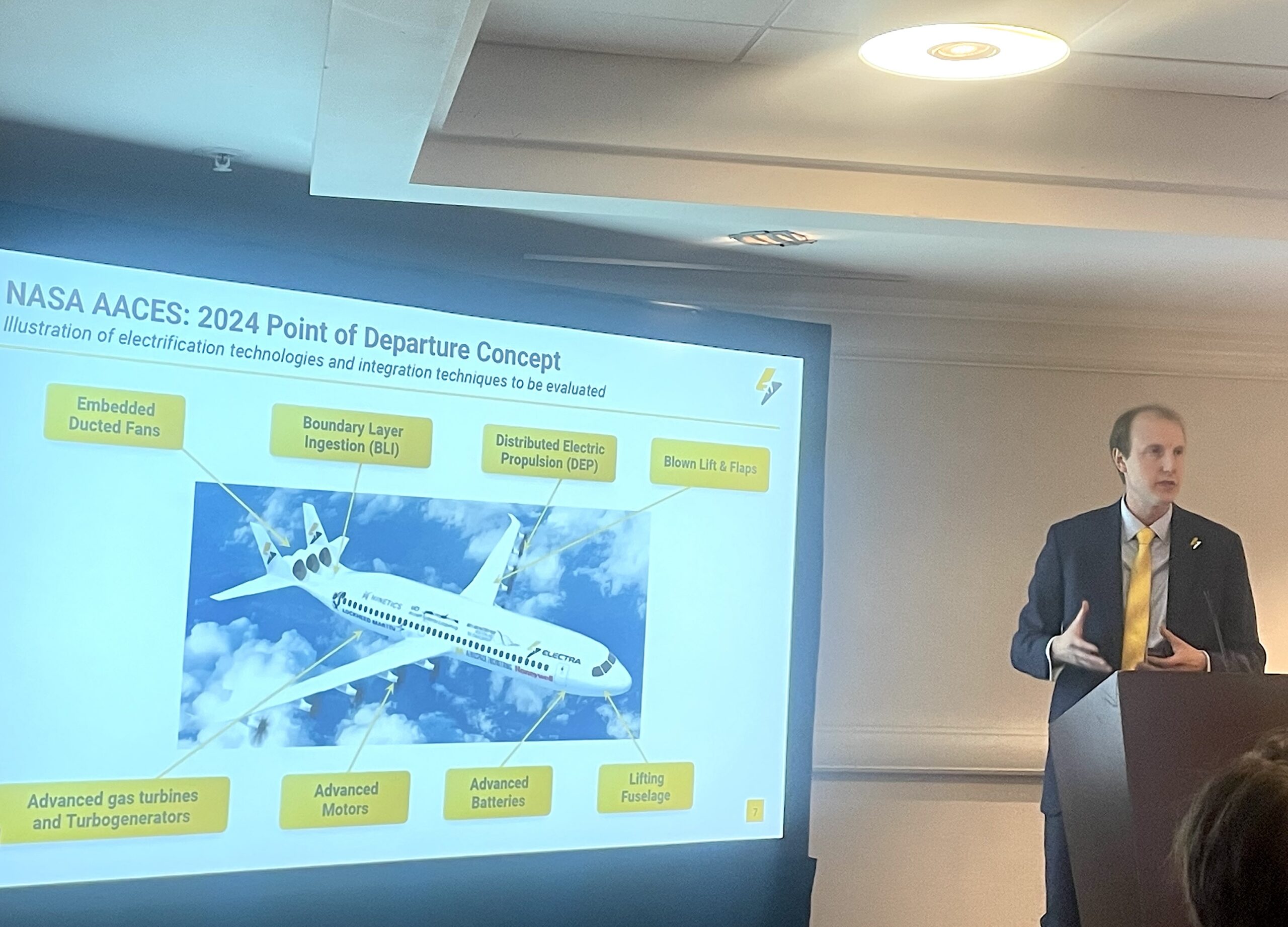
Electra embraces a targeted electrification strategy – to use electric propulsion only where it delivers the biggest efficiency or performance benefits. Toward that end, Parker Vascik, director of Product Strategy at Electra, presented a family of narrow-body concepts serving 114 and 178 passengers that moves away from the conventional single-aisle layout in two ways: a wider (double-bubble) fuselage that generates lift, and electric fans at the tail that recapture energy that current designs simply waste.
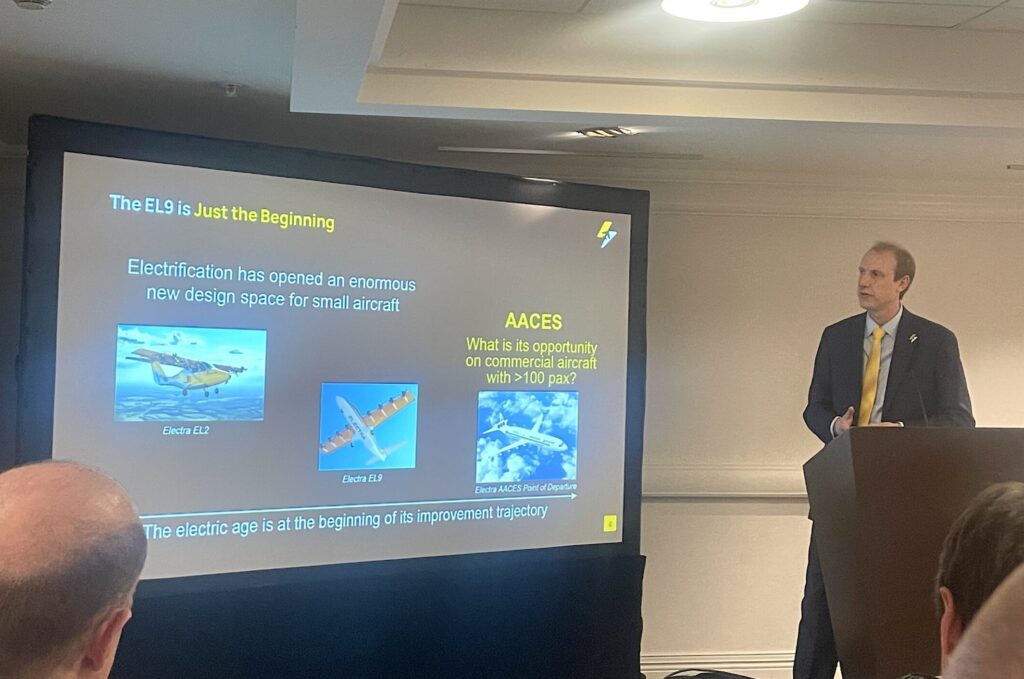
Electra’s team evaluated more than 100,000 optimized configurations before settling on this concept, which projects a 15–17% fuel burn improvement on top of expected 2050 engine and structural advances, and retains 11–13% even if motor performance falls short of optimistic assumptions. It fits at standard narrowbody gates, uses Jet-A or sustainable aviation fuel, and requires no new ground charging infrastructure.
One finding surprised the team. Wing-distributed electric fans, long considered a promising concept, did not justify their added weight at this scale. “When we dove into that study with more advanced electric motor models, we identified that it really doesn’t buy its way on,” Vascik said. Smaller motors lose efficiency relative to larger ones, and aerodynamic gains did not compensate.
Vascik’s recommendation for NASA: within the next 10 years, lead a technology initiative to fly a double-bubble demonstrator and validate multi-megawatt integrated generators and kilovolt-class power distribution. “By 2035, NASA can work with industry to complete a tech maturation initiative,” he said, adding that without that step, industry will not have the confidence to commit to commercialization by 2050.
A Case for Liquefied Natural Gas
Jai Ahuja, senior research engineer at Georgia Tech Aerospace Systems Design Laboratory, presented the Athena, a longitudinally extended blended wing body designed for 150–178 passengers on missions up to 3,500 nautical miles, fueled by liquefied natural gas.
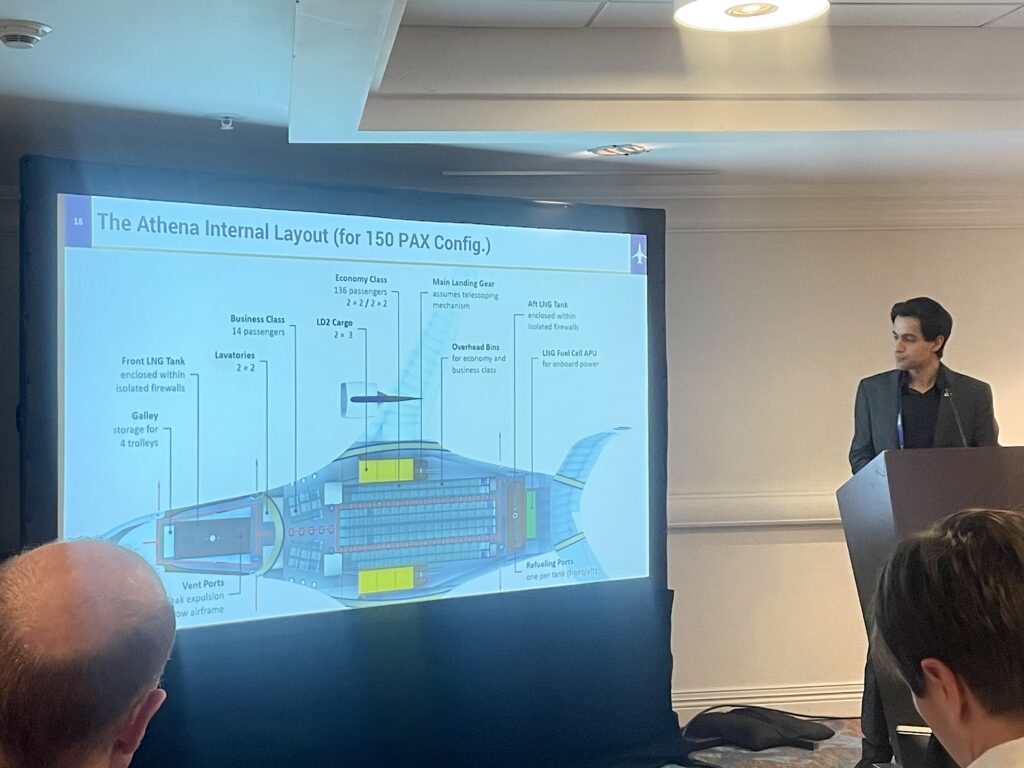
Georgia Tech evaluated SAF, hydrogen, and LNG across aircraft performance, regulation, infrastructure, and resource availability. No fuel won on all dimensions. The team chose LNG partly on supply-security grounds: Jet-A is a co-product of petroleum refining representing roughly 10% of refinery output. As electric vehicle adoption reduces gasoline demand, a large number of refineries are at risk for closure by 2035, according to some projections in the literature. “There’s a need to diversify from Jet A, not just from an environmental perspective, but also from a supply perspective,” Ahuja said.
The Athena showed a 23–25% vehicle efficiency improvement over a technology-equivalent tube-and-wing in 2050. According to Ahuja, Athena’s unique outer mold line, or OML, offers more flexibility for integrating non conformal cryogenic tanks, especially for more demanding missions, thereby reducing the stretch penalty that burdens conventional airframes.
Ahuja also flagged a practical constraint on airline operations: turn times. Reducing cruise Mach number offers theoretical energy savings, but analysis of actual airline schedule data showed that slowing down would force a growing share of high-frequency hub flights to miss their connections. The team held Mach 0.80. “The direct operating cost impacts of a longer turnaround time just don’t make it viable,” he said.
Hydrogen and the Blended Wing Body
Marty Bradley, a sustainable aviation consultant at JetZero, presented a 250-passenger blended-wing-body concept designed for a 5,000 nautical-mile mission using liquid hydrogen. The team ended up extending the fuselage by a few meters and adding an aft hydrogen tank to meet range requirements. Lift-to-drag ratio dropped by roughly one unit. “We did not reduce the range of the airplane or the payload,” Bradley said.
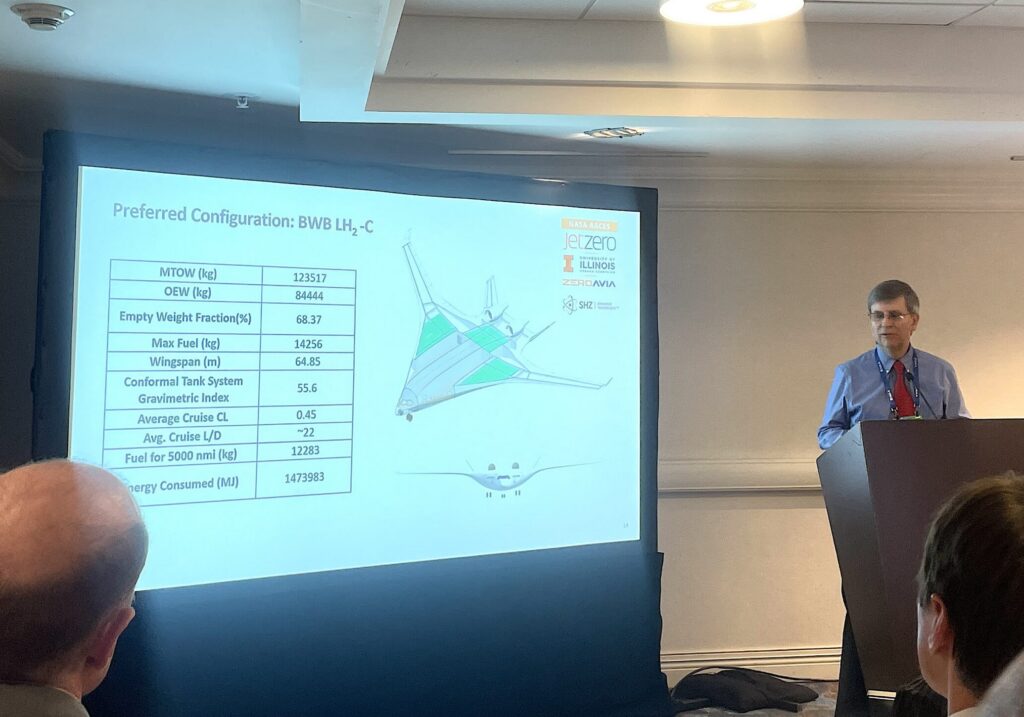
The study selected conformal aluminum tanks with vacuum cellular multilayer insulation, targeting a gravimetric efficiency of about 55% across the full tank system. Bradley identified hydrogen pump technology as a critical gap. “Pumps that we use routinely on the ground are not suitable for flight,” he noted.
Lifecycle climate impacts of emissions drop by roughly half compared to Jet-A if hydrogen is produced with the renewable energy mix projected for 2050. With low-NOx combustors, the reduction could reach 75%. But Bradley was direct about what lies outside the aircraft designer’s control: clean hydrogen production and airport infrastructure must develop in parallel. “You can’t have one without the other,” he explained. He called on NASA to actively engage the Department of Energy on production pathways and work with airport authorities and the FAA on infrastructure, rather than waiting for those conditions to emerge on their own.
Key Takeaways
Three conclusions held across the presentations from Electra, Georgia Tech, and JetZero.
- Configuration change is unavoidable: No tube-and-wing variant, however well optimized, reaches NASA’s far-term environmental targets.
- No single fuel wins on all dimensions, which means NASA and industry face pressure to invest in SAF, LNG, and hydrogen simultaneously rather than betting on one pathway.
- And NASA’s role in the coming decade is to reduce technology risk to the point where industry can commit.
Investments shaped by these results will determine what aircraft are flying in 2050, the studies found. As Quinlan put it: “Today is the time where we need to start assessing, exploring, identifying, and making calculated investments.”
An Operator’s View
Following the session, Jean-Pierre Dagon, a recently retired Southwest Airlines captain, offered a perspective from the operational side. He found the Electra double-bubble concept the most immediately compelling, in part because it works within existing airport infrastructure.
Dagon, who logged 17,000 hours as a Southwest captain before retiring in April, said the session reinforced his view that the blended wing body represents the direction commercial aviation is heading. He was more guarded about hydrogen, citing unresolved questions about composite tank integrity under pressure and the practical demands of airport operations.
“The blended wing body is the trend of the future,” he said. “But you still have to fit at the gate, support a turnaround within 45 minutes to keep the cost per available seat mile competitive. The engineers have the concepts right. Now somebody has to make them work at an airport.”
On the topic of alternative fuel, he said, “What JetZero is doing is on the right track – keep Jet A, maybe move to LNG. I’m more skeptical about hydrogen. A lot of things have to happen before hydrogen becomes viable.”
Specifically, he raised concerns about the storage issue of using hydrogen onboard a plane. “I’m not a chemist; I’m a pilot. However, I’m aware that hydrogen has very small molecules so to prevent a leak, aircraft OEMs have to use a very strong container of steel or carbon material. I heard during the talk that some of the companies are considering composite and conformal tanks. Hopefully the technology will catch up, and we’ll have solid assurance about leak prevention,” he said.
Dagon also raised a point several engineers in the room acknowledged: operational voices are underrepresented in advanced concept work. “There’s a lot of engineers here, but there’s a lack of operational perspective,” he noted.