


AIAA AVIATION Forum opens with a candid look at how AI can tackle aerospace’s toughest problems – from rising complexity and cost to the need for speed and safety.
SAN DIEGO —The first Forum 360 panel at AIAA AVIATION Forum asked a simple question when it comes to AI’s growing role in aerospace: What problems are we trying to solve?
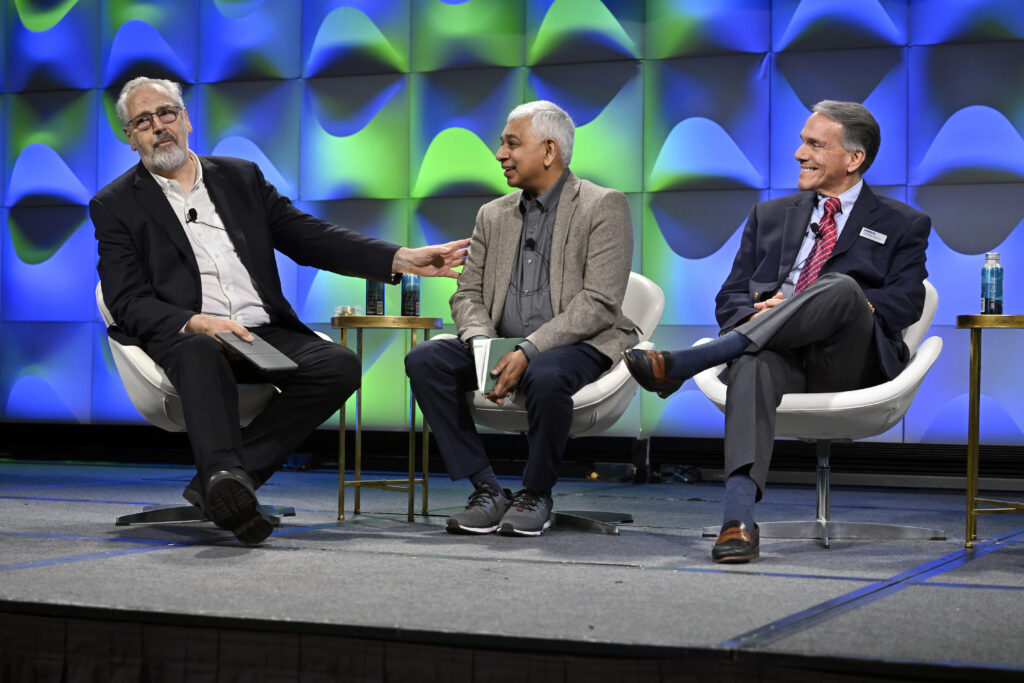
That conversation, moderated by Graham Warwick, executive editor of Aviation Week, featured several answers from experts representing major aerospace OEMs, defense primes, and the U.S. Air Force’s main research lab that set the tone for the rest of the week’s programming.
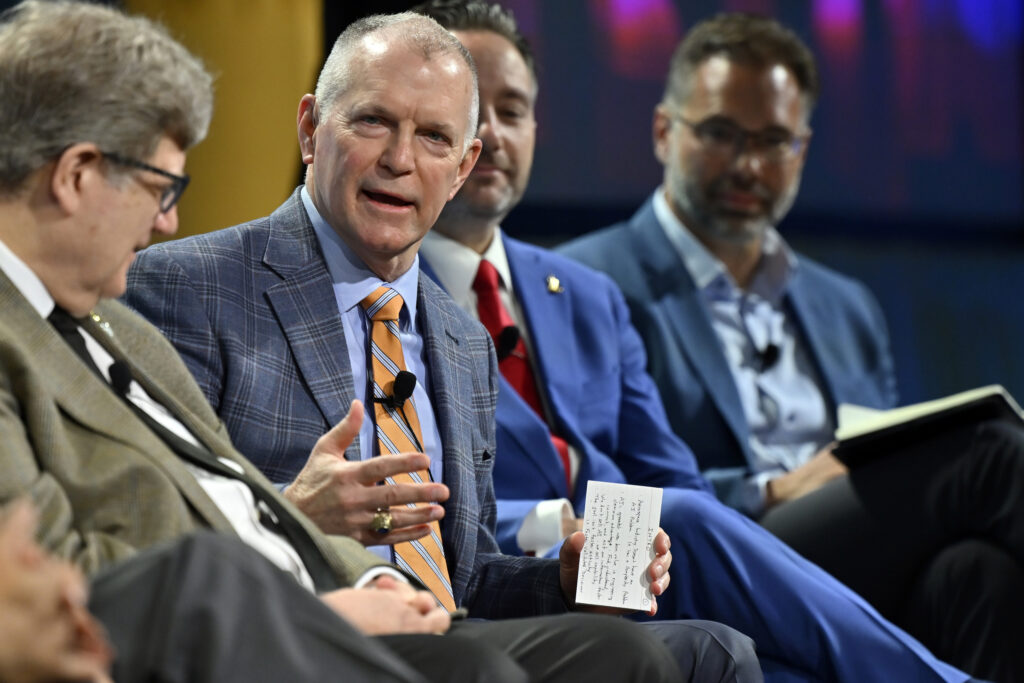
“The aerospace industry does not have an AI problem; it has a complexity problem,” said JD McFarlan, vice president of Air Vehicle Engineering at Lockheed Martin Aeronautics. That complexity includes more sensors, software, and mission scenarios than humans can manage with traditional tools. Engineers, he added, burn time “hunting and pecking” through decades of data instead of making decisions. “The goal is not faster activity; it’s faster validated decisions.”
Lockheed Martin is already turning that “faster-validated-decisions” mantra into practice: Project Overwatch uses AI to retrain F‑35 combat ID algorithms between flights, while MARVIN, a Retrieval Augmented Generation LLM, mines more than 40 years of F‑16 quality data so engineers can solve issues on the production floor faster. Together, they show how AI is being applied not as a product in itself, but as an engine for faster, better-informed engineering and mission decisions.
The sole government representative on the panel, Venke Sankaran, chief scientist in the Air Warfare Directorate in the Air Force Research Laboratory, noted that AI can speed up technology discovery and development and transition new capability into a fieldable product. He explained that traditional development was too slow – taking a sequential approach, where you retired risks before moving to the next stage.
“If you want to go faster, you have to start overlapping tasks and taking more risks, but do it smartly,” said Sankaran. (In April, the AFRL restructured, bringing the former Munitions Directorate and Aerospace Systems Directorate together). The AFRL is investing in “capability-driven portfolios like modular, scalable UAS, hypersonics and affordable mass, “where cost-effective solutions are central. … The stakes are high but the opportunities are tremendous,” he added.
Global OEMs, Airbus and Boeing, offered their takes. Airbus is using AI and digital tools to advance efforts in digital transformation – linking globally distributed engineering teams, managing growth complexity and accelerating aircraft development and production, said Gil Perez-Abraham, head of Engineering, Airbus Engineering Center in Wichita, Kansas, which was established in the early 2000s to provide aerostructures engineering expertise to bolster Airbus airframe Engineering capabilities. This center became the foundation for establishing Airbus Engineering centers outside of Europe.
He tied AI and digitalization to the broader industry challenge of meeting high demand and large backlogs while maintaining safety and certification standards. The focus is on using AI within a robust, highly regulated environment, not bypassing it.
“When I look at what my team is doing right now with all these advancing digital technology [and] AI, I really can’t help think that we’re really starting a journey that is very exciting,” he said, explaining, “The physics haven’t changed… but the idea now is, ‘How do we advance this digital thread to keep uniting the world in a safe and comfortable way, and also advancing the technology [while we] accelerate production?”
Rob Gregg, principal senior technical fellow in Aerodynamics, Boeing Commercial Airplanes, framed Boeing’s opportunity as designing and delivering “the best aircraft for the market” amid increasing complexity. The company’s core question centers on how to design the best next-generation airliner against growing requirements, data, and edge-of-envelope complexity.
AI, he emphasized, is a powerful helper – but only if it’s tightly validated and doesn’t replace human judgment. “AI doesn’t replace engineering judgment… the engineer is responsible for the results. They have to be able to defend it,” he said.
“Northrop Grumman isn’t new to AI, generative AI and agentic AI that the industry has adopted,” said Adam Shepherd, the company’s Fellow for Digital Engineering. Noting that the company has been doing autonomy for nearly four decades, experience that have shaped where the company is now.
A month ago, Shepherd was also named Northrop Grumman’s AI sector lead. “What does AI mean for us? I would answer the question, ‘What problems are we trying to solve?’ I would say our customers’ problems, full stop.”
He concurred with other panelists that “data elements themselves, uncurated, siloed, not managed, truly become the problem, not AI.”
Even with those issues, AI applications are now becoming more proficient in back-office functions. “That’s where we’re starting to see some of these accelerated ideas. We want to treat AI as an assistant, not as an oracle. We have to maintain the domain expertise of our brilliant workforce, but it is removing barriers from them, enabling them to be creative and, ultimately, do what they were hired to do rather than getting lost in the drudgery of being an engineer.”
He used an analogy of open gardens versus closed ones to emphasize Northrop Grumman’s desire for “truly open systems, not open walled gardens” so different sectors and partners can integrate and collaborate more effectively. The 2021 Digital Pathfinder Program “was meant to prove that data models and a digital ecosystem ultimately can enable us to go faster and be safer,” added Shepherd.
The tech demonstrator was demonstrated on the first flight of Model 437, an experimental stealth-capable jet, then applied to Northrop Grumman’s Blue Talon next-generation autonomous aircraft program, which is now flying using autonomous artificial intelligence capabilities. Together, they serve as a pipeline from digital design to AI-enabled flight on an operational platform, said Shepherd.
RTX’s Scott Kaslusky, vice president of Aerospace Technology, framed his company’s AI agenda squarely around its mission to “connect and protect the world,” arguing that AI must tackle real operational bottlenecks rather than be pursued as a standalone objective.
Kaslusky said RTX delivers platform-independent systems for “just about every mission in aerospace and defense” including for all the organizations represented on the panel.
He noted that AI is advancing rapidly, driven by investments coming from outside of aerospace and defense. “As an industry, we’ve got to be really quick to adapt capabilities as they become available.”
On the commercial side, he highlighted three core challenges: building more aircraft faster, fitting more traffic into the same airspace, and cutting costs while boosting safety by linking design, operations, and maintenance data. He pointed to opportunities for “software‑defined manufacturing” and AI‑driven automation as ways to bring automotive‑style efficiency into low‑rate, high‑mix aerospace factories, and to AI “agents” that will support pilots and air traffic controllers as the system grows more complex.
AI, the panelists agreed, is not a magic solution but a new tool for solving old aerospace problems: complexity, cost, and speed. The real advantage will go to the teams that use AI to make safer, smarter decisions faster – without losing the hard-won engineering judgment that keeps people flying safely.