

ORLANDO, Florida—Luminary Cloud, an AIAA Corporate Member, announced the release of three new physics AI defense models designed to dramatically expedite U.S. defense technology development while at AIAA SciTech Forum 2026.
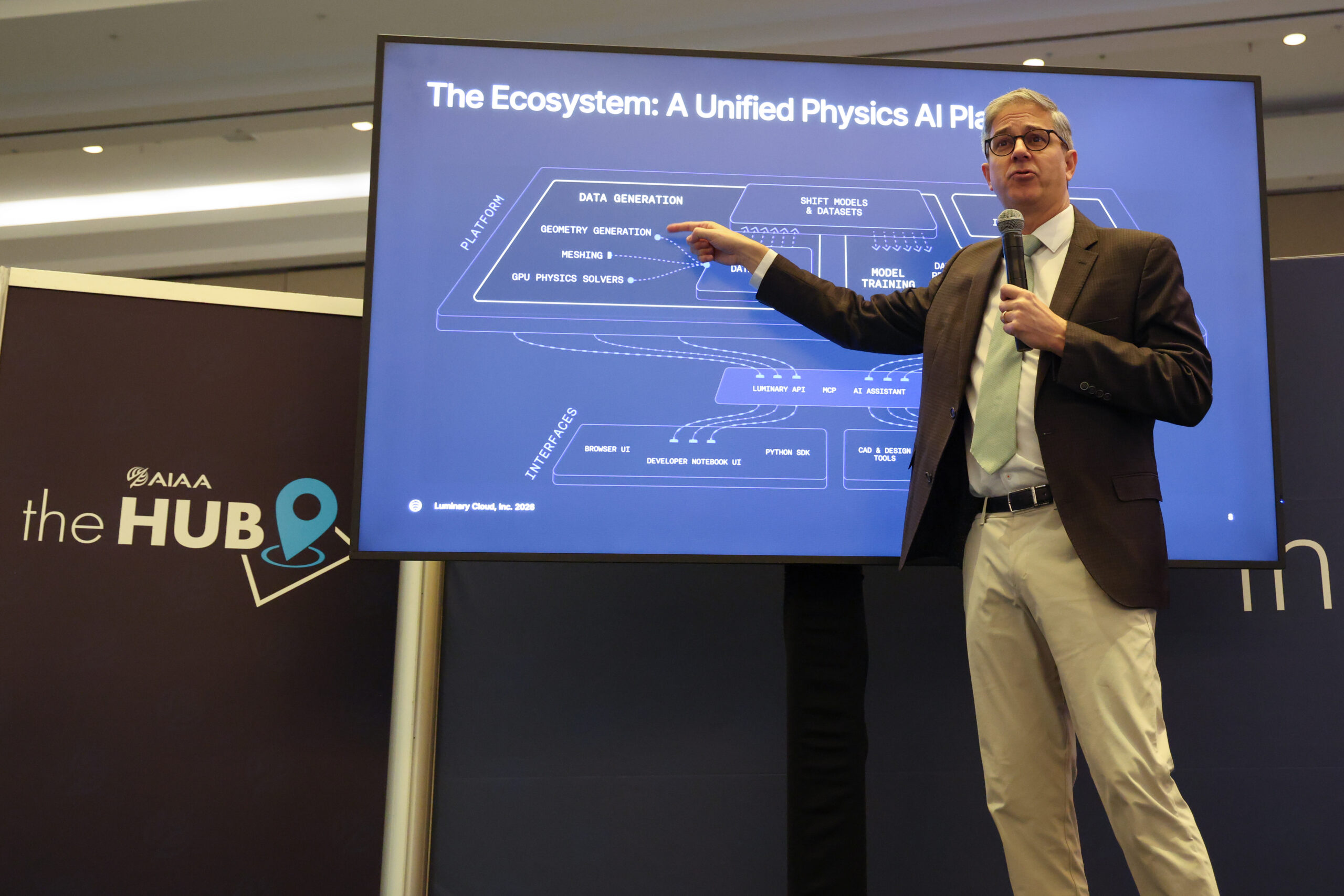
“The new physics AI models are intended to complement simulation technology, and instead of giving execution times in hours, they will provide answers in less than a second,” said Juan Alonso, Chief Technology Officer and Co-Founder, Luminary Cloud. “This is a significant acceleration of engineering workflows, which is made possible by the very large data sets we are able to create with GPU-native physics solvers and by the revolution in Physics AI methods.”

The three new defense-focused AI models include SHIFT-CCA (Collaborative Combat Aircraft), SHIFT-Submarine, and SHIFT-Pump, which deliver secure, U.S.-controlled Physics AI capabilities to Department of Defense operations across air, maritime, and ground domains.
Luminary expects to make at least two of the models open-source domain on Hugging Face to advance the field, Alonso said, since improvements are still likely possible. “When you generate 20,000 different variants of an aircraft, that takes a lot of time and effort and expertise, so many people who could contribute to improving the physics AI models are unable to do so because they cannot generate realistic data sets of high quality. We are putting them out there to help push the field forward.”
Related Viewing: Learn more about how Physics AI technology is accelerating engineering workflows in mission-critical aerospace applications.
Luminary’s new models were produced using its Physics AI Factory, an end-to-end, secure, U.S.-based platform purpose-built to design, train, and deploy Physics AI models inside trusted environments. SHIFT is a family of models that provides access to both high-quality datasets and pretrained models for a variety of applications and industries, the company stated.
“Luminary is proud to be presenting this at AIAA SciTech, the premier aerospace conference in the world. This is the perfect audience to share these advancements with, and we hope AIAA SciTech participants can help push the envelope of current Physics AI models,” Alonso said.