


The next generation of aerospace innovation doesn’t begin on the flight line or at the launch pad. It begins with engineers confronting difficult design problems. Through AIAA’s Design Competitions, university students step into that role, responding to industry-style Requests for Proposals that reflect the challenges shaping aerospace today.
The winners of the 2026 AIAA Design Competitions demonstrated technical excellence as well as the ability to solve complex engineering problems where every design decision comes with consequences. From carrier-based aircraft and high-performance racers to affordable defense systems and ambitious space missions, this year’s teams confronted complex design problems that demand both technical ingenuity and disciplined systems engineering.
Engineering the Next Generation of Flight
This year’s Undergraduate Team Aircraft Design Competition challenged students to develop a next-generation carrier-based strike fighter aircraft, requiring teams to weigh carrier suitability and cost requirements.
The top honor went to Monkey’s Fist, the team from University of Illinois, Urbana-Champaign. The University of Illinois, Urbana-Champaign swept the awards and demonstrated the depth of its aircraft design program by claiming a tie for second place with team Boom Hitch and team Catshank, as well as third place with their Team Bowline.
The Graduate Team Aircraft Design Competition challenged students to design an affordable short takeoff and landing (STOL) aircraft capable of serving remote Arctic communities, where aviation is often the only reliable transportation link. The aircraft had to operate from short, unprepared runways in extreme cold while transporting passengers, cargo, or medical evacuation patients.
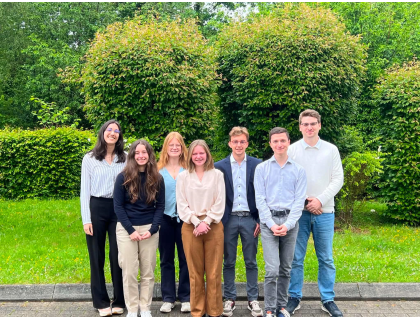
Three teams from the Université de Liège captured the top honors with first place going to team Penguin crew, second place to team Avion and third place going to the Balto Engineering Team.
The Undergraduate Individual Aircraft Design Competition presented a very different challenge: reimagining the unlimited air racer. While speed remained paramount, students also had to be creative without violating the spirit of the race.
The top honor went to Thomas Baker from the University of Kansas and second place was awarded to Chase Stohlmann from the South Dakota School of Mines.
Mission Capability at Scale
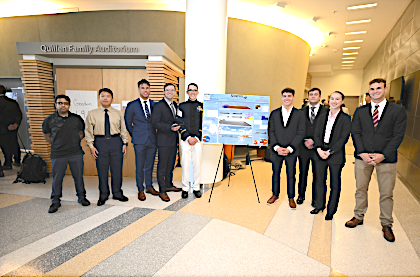
Missile Systems Design Competition.
In this year’s Missile Systems Design Competition, students were challenged to design a high-volume, low-cost cruise missile capable of delivering operational capability while remaining affordable to manufacture and sustain.
The top honor went to Virginia Tech, whose Scorpius: A High-Volume, Low-Cost Supersonic Cruise Missile Proposal earned first place. Georgia Tech students claimed second place with SWARM: Scalable Warfare-Affordable Range Missile while Worcester Polytechnic Institute claimed third place for Project Crimson: a Cost Reduced Infrared Missile System for Operational Navigation.
Planning Humanity’s Next Steps Beyond Earth
This year’s Space Design Competition challenged students to develop a Heliophysics Science Observer and Communications Platform. Teams had to make significant design decisions regarding the configuration and characteristics of their preferred system.
First place was awarded to the University of Illinois, Urbana-Champaign for their Heliophysics and Advanced Detection System (HADeS) proposal while second place was awarded to Istanbul Technical University for its HELIOS-Net: A Multi-Point Space Weather Monitoring Constellation for Solar-Earth-Mars Connectivity design. Third place went to the team from Virginia Tech for their Advanced Research and Communications Alert Device for Interplanetary Applications design.
Preparing Students for the Future
Although each competition focused on a different mission, they all shared the same underlying objective: preparing students to think like practicing aerospace engineers.
The winning entries represent more than successful student projects. They offer a glimpse of how the next generation of aerospace engineers is approaching some of the profession’s most challenging design problems; applying creativity within constraints, balancing competing priorities, and developing practical solutions to increasingly complex missions.
Students interested in participating in the 2027 Design Competitions
can find the RFPs listed on the AIAA website.