

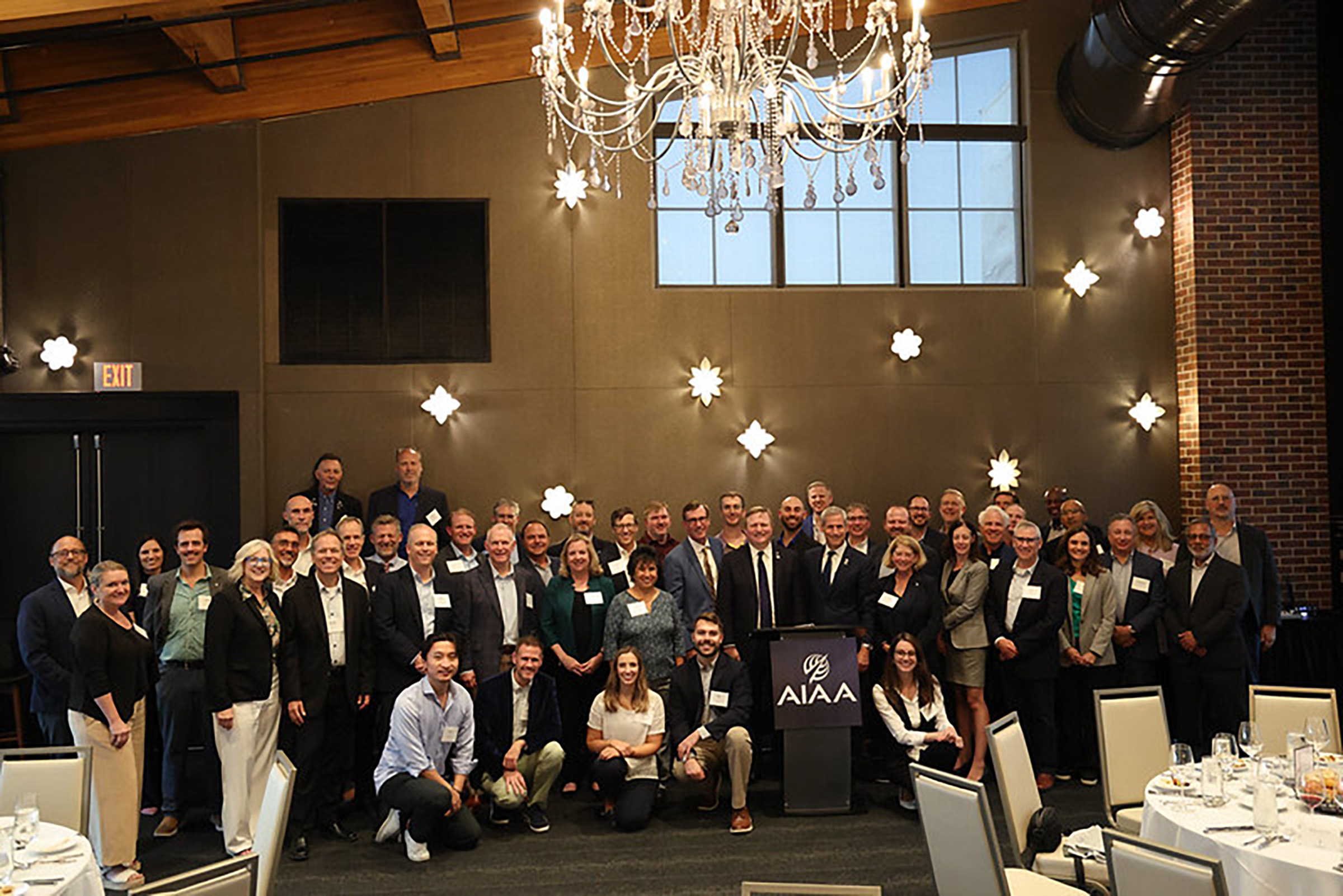
The Institute’s technical leaders gathered at The MITRE Corporation outside Washington, DC, for our third annual CTO Summit on 9-10 September, and the conversation turned quickly to the promise and peril of artificial intelligence (AI) as it hurtles forward in aerospace engineering. The Summit saw a 30% increase in attendance as we heard from Department of War, Congressional staff, and think tank leaders about the need to accelerate the production of aerospace systems to serve growing demand across commercial, civil, and national security verticals.
Whether it’s our return to the moon, defending against adversaries, or meeting the growing backlog for aircraft to connect the world, AIAA’s engineering workforce is being sought after as never before. AI is seen as a key enabler to aid digital thread engineering as the community looks to scale design, test, and production capabilities.
Speed, AI adoption, and engineering workforce capacity continue to be the key themes driving aerospace forward in 2026.
Speed as a strategic asset. In aerospace, we talk about speed in terms of Mach numbers. But the speed I continue to hear about is the pace of technical progress and how AI-compute power can push development forward. It’s how companies can build momentum fast enough to effectively deliver aerospace innovations to the marketplace. It’s how quickly investments in technology are multiplying, powered by reformed government acquisition models and private capital investments.
NASA Administrator Jared Isaacman made the case at ASCEND’s opening session in May, framing lunar return as a new space race measured in months, not years, and calling on industry to relearn the iterative discipline of the Mercury-Gemini-Apollo era rather than trying to leap straight to a finished product. Don’t delay even a day a problem that we can solve, he told the standing-room-only crowd.
At our two classified events this year – AIAA DEFENSE Forum at Johns Hopkins University Applied Physics Laboratory and ASCEND’s inaugural Classified Day at The Aerospace Corporation – we picked up the same thread. Technology leaders discussed the impact of government acquisition reform and updated financing models, as well as whether our manufacturing capabilities can move at the pace the moment demands.
During the CTO Summit, we convened around the theme: Driving Faster Production and Technology Superiority: The Evolving Role of the CTO. We heard a message to American aerospace and defense manufacturers – prime contractors, second tier suppliers, and the extended supply chain – from multiple government speakers: The demand signal is clear. Push production to scale with the confidence that the U.S. government requires reliable technologies today to equip and support our warfighters. This was not a call for exquisite systems, but rather the “good enough” solutions that can be produced quickly at volume.
I also heard this refrain recently from Palmer Luckey, founder of Anduril Industries, a new entrant to the U.S. defense technology industry that designs and manufactures autonomous systems, when we sat down at Anduril headquarters in Costa Mesa, California, for the inaugural recording of my new podcast, Up Next.
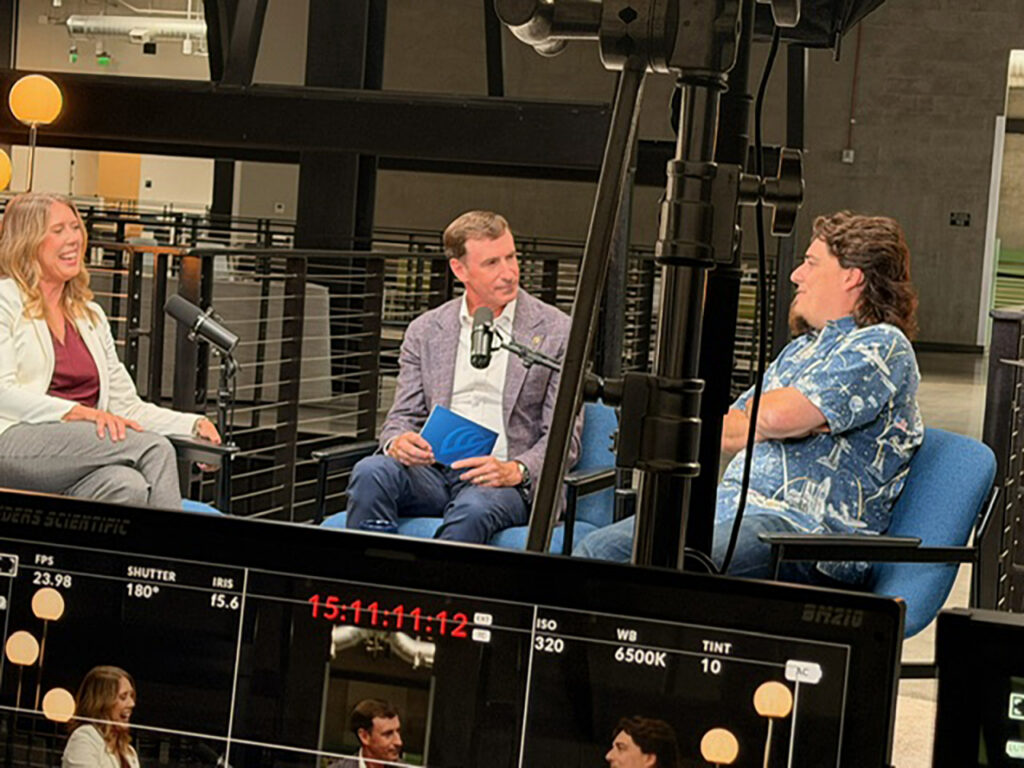
Palmer was emphatic about American aerospace and defense manufacturers establishing a production capability second to none. He offered this idea, “We’re living in an age of unprecedented possibility. We need to design missiles that can be made in car factories. We need to design aircraft that can be made in tractor factories. They’re not waiting to be invented. They’re waiting to be implemented.”
I encourage you to listen to our full conversation. It was fascinating how a new, innovative defense company is approaching today’s challenges with fresh thinking. Regularly, I have similar conversations with the engineering leaders, CTOs, and CEOs of other AIAA Corporate Member organizations. I’m excited to share more of these insights during the first season of Up Next (read more on next page).
AI adaptation is essential. AI cannot be treated as hype, but as a genuine test of what engineering organizations are willing to change. This is what we heard from Lockheed Martin’s Renee Pasman during this year’s AIAA AVIATION Forum. Renee is vice president, chief information officer, and digital transformation executive at Lockheed Martin Aeronautics. She framed AI as software, with its unique value as a tool that can be used throughout the process of finding a solution. We are all learning how to adapt to working with AI as a tool, even as AI capabilities continue their rapid evolution.
The discussion at the CTO Summit went even further, beyond the thread of defining new AI use cases. ChatGPT debuted four years ago. Newly minted engineering grads have been immersed in AI throughout their college education. And aerospace companies are employing AI in digital thread engineering. Now industry, FFRDCs, and government must work to adapt their organizations and processes to utilize AI tools safely and securely. The key questions raised were:
- How do we build trustworthy AI adoption across aerospace?
- How do we collaborate as a community on setting high standards of AI validation and verification?
- How do we remove friction in integrating AI technologies into manufacturing processes?
We need to grow our workforce to meet demand. There is no dispute the most vital element to addressing the speed and AI themes is ensuring our engineering workforce has the needed skills and tools to accelerate technology at speed.
The discussion among the CTO Summit attendees acknowledged our industry faces a challenge in equipping today’s aerospace workforce with new tools and new methodologies, as well as its companion challenge of preparing the next generation of aerospace professionals for new and future realities while they are still in school.
We know the aerospace workforce shortage is being driven by demand outpacing supply, with nearly 29% of the aerospace and defense workforce 55 or older, and industry attrition running close to 15% annually, which is more than double the average across other U.S. industries, according to the 2025 AIA/McKinsey annual workforce study. The Bureau of Labor Statistics projects we will need about 3,800 new aerospace engineers every year through 2031 just to keep pace with growth and retirements, not counting the existing gap. Yet our Corporate Members tell us that they have a hiring problem. The AIA/McKinsey study illustrates this: 76% of aerospace and defense companies are struggling to hire engineering talent specifically, with 56% facing shortages in skilled trades.
AIAA pulls two levers to help address this. Our robust continuing education catalog is aimed directly at closing the skills gap. We bring the most current topics to our members, offering more than 40 live instructor-led courses annually, plus a library of over 70 on-demand courses. In the past year, a dozen courses focused on the latest topics in AI, autonomy, and digital engineering. And our dynamic student programming targets the next generation, with engagement from our growing student branch network that surpassed 270 this year, as well as the extensive scholarships and grants available to help offset education expenses.
Where the threads converge.It is clear that speed, AI adoption, and engineering workforce capacity aren’t three separate agenda items. They’re three faces of the same underlying question: can aerospace move as fast as the moment requires without sacrificing the safety and mission success that have always been non-negotiable in our community?
I do not believe any one company, government agency, or university answers that question alone. I believe we answer it the way AIAA always has – by getting the right people together and pushing the conversations further.
CTO Summit attendees underscored this important role for AIAA in their recommendations. Conversations repeatedly returned to our ability to serve as a neutral convener across companies, government, and academia. Their ideas included developing mission-to-capability roadmaps; advancing shared approaches to AI assurance, provenance, and interoperability; creating practical case studies and implementation playbooks; and establishing grand challenges or testbeds where organizations can learn together around consequential but appropriately noncompetitive problems.
They believe the Institute must continue creating the connective tissue that allows aerospace organizations to learn, trust, and act together. It’s an evolving mandate for aerospace technology leadership: Shape. Don’t react.