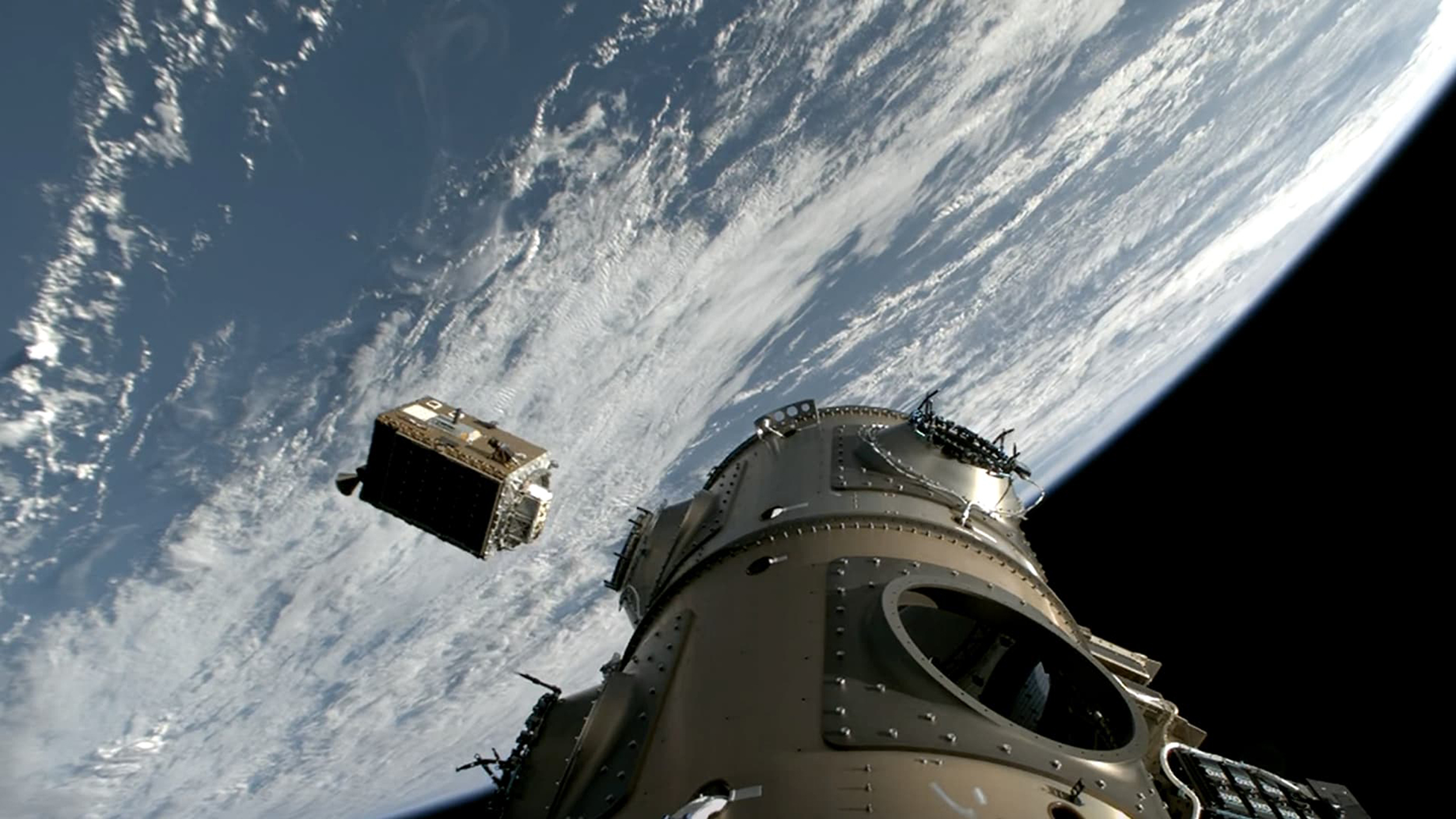


SpaceX and others have proposed launching tens of thousands of massive satellites for AI processing and other functions in a bid to alleviate some of the woes of terrestrial data centers. But can the technical challenges be overcome? Jonathan O’Callaghan takes a look.
What if the next time you sent a question to OpenAI’s ChatGPT or Google’s Gemini, the answer didn’t come from microchips inside a massive building somewhere on Earth, but rather from ones housed within thousands of orbiting satellites? That’s the pitch of orbital data centers, or ODCs.
To proponents, these spacecraft could solve the growing problem of needing to construct scores of massive facilities on Earth to run AI tools, among other computing tasks. These terrestrial centers are seeing considerable backlash as they soak up power and expel huge amounts of heat.
“People don’t want to live next to an ugly data center,” says Lori Gordon, a systems director at the Aerospace Corp. in Chantilly, Virginia, which is conducting a feasibility study on ODCs.
A dozen U.S. states are now looking at ways to curb the growth of terrestrial facilities, such as freezing approvals. Moving such computing to orbit could alleviate many of these concerns and ease data center operations, because solar power from the sun is free and abundant and the coldness of space provides a natural, if complicated, cooling remedy.
“We are almost hitting the energy limit on Earth to power data centers,” says Yonggang Wen, a professor in the College of Computing & Data Science at Nanyang Technological University in Singapore. “We have to think creatively.”
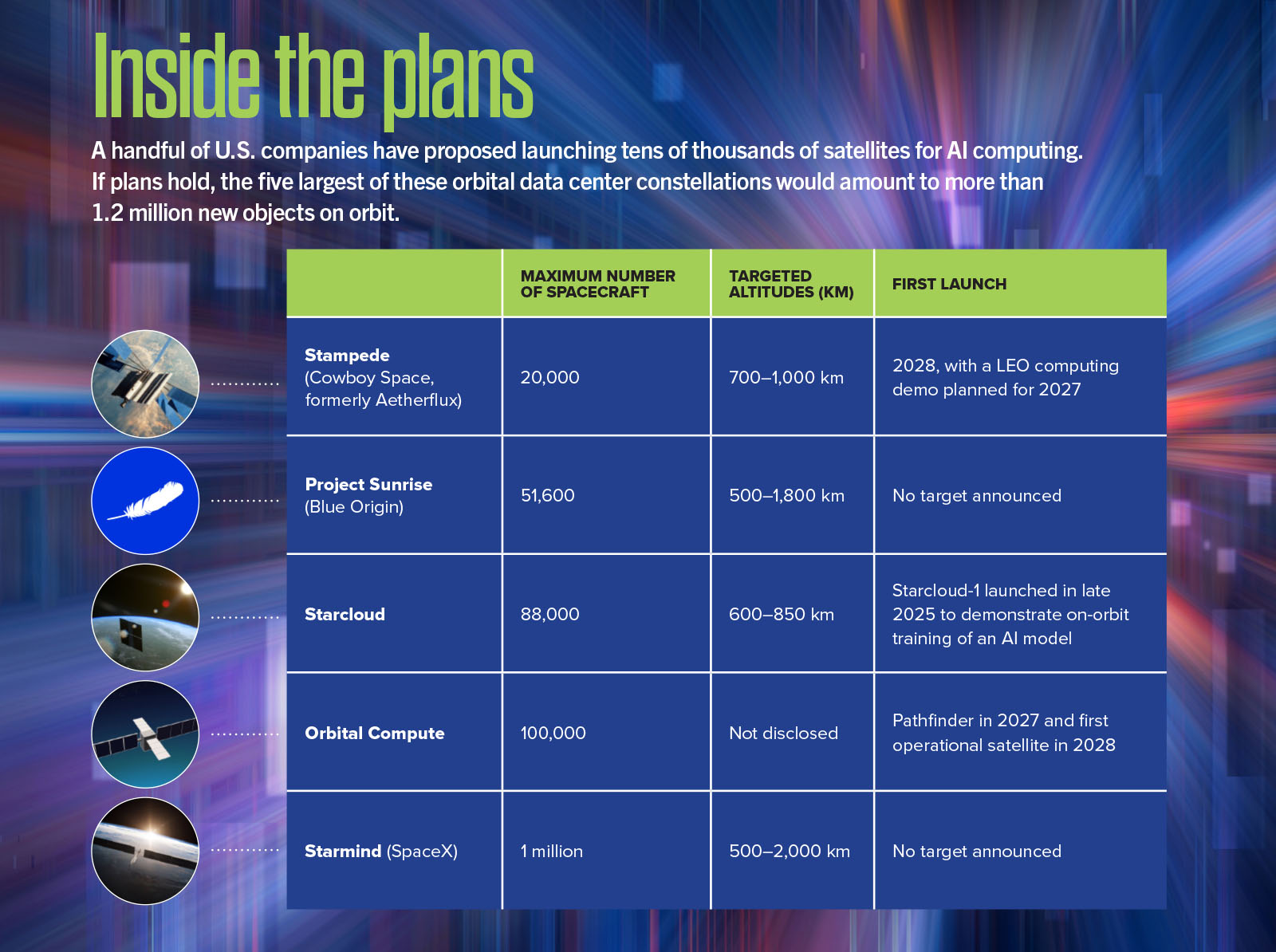
A handful of Chinese companies have announced plans to launch satellites for on-orbit AI processing, and multiple U.S. companies are seeking regulatory approval to launch thousands of ODCs of their own. Among the largest proposals are 1 million from SpaceX, 88,000 from Starcloud and 51,600 from Blue Origin. The market is predicted to grow to a value of $39 billion by 2035, according to market intelligence company BIS Research.
But many challenges remain, not least the size of the satellites — some of which could be nearly as big as the International Space Station — and their impact on the orbital environment. Also under discussion are the technical hurdles of building them and the sheer volume of satellites being proposed.
Space chips
ODCs are, at a very basic level, containers for high-performance chips operating in space.
There are a small number of satellites currently demonstrating this technology, one of which is Starcloud-1. That spacecraft, launched in November, carries an NVIDIA H100 chip to train a Google AI model. And last May, the Chinese firm ADA Space launched its first 12 satellites of a planned 2,800-satellite constellation for on-orbit AI processing.
As news of these developments trickled out, interest in ODCs started to grow. It skyrocketed in January, when SpaceX founder Elon Musk tweeted the company will launch 1 million AI satellites. (The Federal Communications Commission filing specifies a constellation of “up to” 1 million, indicating that fewer could be launched.)
“The history about how space data centers accelerated in just the last six months is incredible,” says Jaroslaw Jaworski, CEO of the Luxembourg-based space computing firm Edge Aerospace. “Elon tweeted, and here we go. We have a new reality.”
Moving these operations to orbit would relocate some of the compute power needed for AI. Instead of your query to an AI chatbot being handled inside a data center on the ground, it could be sent to a fleet of satellites, each running state-of-the-art chips.
From the user perspective, there won’t be much difference, says Wen. “You give a command to your [AI] agent, it will run, and then come back to you.”
“For low-Earth orbit, the round-trip time is around 800 milliseconds,” he adds, a latency that is more than sufficient for most modern AI needs.
Satellites equipped with high-performance chips could also handle the growing problem of processing space data. Take Earth imaging satellites, for instance. Every day, they generate a huge amount of data that must be downlinked and then processed on the ground, which can be time-consuming. But what if the satellites themselves could process their own images, without ground involvement?
Jaworski gives an example of soldiers on a battlefield needing to know if enemy troops are nearby. “They’re not looking to do map interpretation,” he says. “This interpretation in real time could be done on the satellite, and you could pass the information directly to them.”
ODCs could also allow countries to develop sovereign AI capabilities in space, which are harder to attack than on the ground, notes Wen. “The potential attack to a data center in space is much more challenging than on Earth, both physically and in cyberspace.”
It is energy, however, that is one of the biggest drivers. The International Energy Agency estimates that by 2030, terrestrial data centers could consume as much power as the entire country of Japan. Another study, by Arizona State University, found that the heat generated from running and cooling these facilities can increase the temperature of nearby neighborhoods by as much as 4 degrees Fahrenheit (2 degrees Celsius).
But for all their seeming potential, ODCs also raise governance questions.
“I would not allow one company, one country or one institution to decide alone whether orbital data centers are worth it,” says Nimra Javed, a research officer at the Center for International Strategic Studies in Pakistan. “If we build them first and think about rules later, then we may simply transfer the problems of Earth into space.”
Power hungry
For orbital data centers to make a meaningful dent in terrestrial center usage, they would need access to gigawatts of power. Generating such amounts is no easy feat. The ISS today generates just 75-90 kilowatts of continuous power — one kilowatt being 0.000001 gigawatts — from its football-pitch-sized solar panels.
SpaceX and others have proposed ODCs with similarly huge solar panels. According to a June fireside chat with Musk, SpaceX’s AI satellites will be 20 meters tall, more than double the size of the largest variant of the company’s Starlink broadband satellites. Once unfurled on orbit, their solar panels would have a wingspan of 70 meters (230 feet) — roughly the height of a Falcon 9.
Although necessary to generate the 120-150 kW of power Musk estimated, these solar arrays would also give each satellite a huge footprint. Coupled with the sheer size of the constellation SpaceX is proposing, that dramatically increases the chance of collisions, experts say.
Starlink alone — which currently numbers a little over 10,000 satellites — performed 300,000 collision avoidance maneuvers in 2025, according to documents SpaceX filed with the FCC. SpaceX did not respond to a request for comment.
“That’s an awful lot of maneuvers to attempt to keep those [data center] systems safe,” says Hugh Lewis, a professor of astronautics and an expert in space sustainability at the University of Birmingham in the U.K. “I don’t think that’s really reasonable.”
Further complicating matters is that many ODCs would also need to be located in sun-synchronous orbits, which travel almost from pole to pole, to keep them in near-constant sunlight and provide power almost around the clock. This means they would continuously cross the paths of most other satellites, which orbit around the equator.
Millions of maneuvers would be needed not every year, but every day, Lewis predicts. “You’re into territories of half a billion maneuvers a year.”
One novel solution might be to erect separate satellites that would collect solar power and beam it to ODCs, or even directly to terrestrial data centers, avoiding the need for ODCs altogether. One company investigating the former is Florida-based Star Catcher, which last year completed a ground demo of its power-beaming technique. The company converted electricity generated from solar panels into a laser, focused with lenses, and beamed it across a football stadium and then an old space shuttle runway, both in Florida. The runway test reached 1.1 kW, a world record for optical power transmission.
The company’s plan is to station thousands of satellites in relatively high orbits, about 1,500 kilometers (930 miles) above Earth, to transmit power to ODCs and other satellites.
“Our approach is a one-to-many architecture,” says Andrew Rush, co-founder and CEO. “Each one of our power node satellites can provide energy to tens of client satellites simultaneously,” with the beamed power also providing “five or 10 times the amount of energy density they would get from the sun.”
Overview Energy of Virginia is taking a different approach, planning to operate thousands of satellites in geostationary orbit, roughly 35,000 kilometers (22,000 miles) above Earth. The satellites would beam the power they collect directly to terrestrial data centers, many of which are already equipped with vast solar panels. In April, the company announced an agreement with tech giant Meta to provide up to one gigawatt of power from space.
Overview hopes to start launching satellites in 2030, says founder and CEO Marc Berte, with each satellite capable of sending a megawatt of power back to Earth.
“We want to be deploying a gigawatt a year by 2035,” he says.
Even if the power issues can be solved, there remains the challenge of how to expel the heat from ODCs that will be generated as the microchips use electricity. This heat does not convect in the vacuum of space, so large radiators will be needed — like those on board ISS — to get rid of it.
“On Earth, we reject heat from data centers using cooling towers,” says Igor Bargatin, an associate professor of mechanical engineering and applied mechanics at the University of Pennsylvania. “In space, that doesn’t work. You cannot use any water. The only thing we can do is use infrared radiation, and that just needs a lot of area.”
Some companies, like Sophia Space of California, propose a different method: Make the satellites so thin that some heat radiates away directly, eliminating the need for elaborate radiators. Sophia’s satellites, called TILEs, would be grids of flat platforms only a few centimeters thick with a solar panel on one side, a disassembled chip flattened into a middle layer and a thin aluminum radiator on the other side. Co-founder and CEO Rob DeMillo compares it to an Oreo cookie.
By connecting these into 50-meter-squared structures made of thousands of TILEs, the company believes it can offer megawatts of power. “Two thousand of our TILEs with the current CPU [central processing units] and GPU [graphics processing units] combination we’re using will generate a megawatt of power,” says DeMillo.
The hope is that as chip designs advance, smaller groups of TILEs in the hundreds or fewer can provide the same amount of power.
Launch costs
Another big factor working against orbital data centers at the moment is launch costs. To deploy enough satellites to make them competitive with terrestrial centers, prices must drop to a few hundred dollars per kilogram, Wen and others spoken to for this article estimate.
“We have to really wait until launch costs get to $200 or $300 per kilogram,” says Wen. And to do that, “you will need Starship.”
Today, it costs thousands of dollars per kilogram to send something to space, and it’s unclear — even when SpaceX begins Starship operations — if costs will ever drop low enough for ODCs to be viable at a large scale.
“I do not think it is the most effective solution to the problem,” says Kathleen Curlee, a research analyst at Georgetown University’s Center for Security and Emerging Technology in Washington, D.C. “It would be cheaper, faster and much easier to just come up with more environmentally friendly solutions for [terrestrial] data centers, rather than trying to put them in space.”
Chipmaker NVIDIA agrees orbital data centers “are more likely to complement terrestrial infrastructure than replace it,” said Dion Harris, NVIDIA’s senior director of HPC and AI hyperscale infrastructure solutions, in response to written questions.
Despite the uncertainty, there remains considerable interest in how these orbital platforms could develop. In May, the European Space Agency announced a contract with Edge Aerospace to study the future of ODCs. In the same month, Aetherflux (created by Baiju Bhatt, who co-founded the trading platform Robinhood) announced it is rebranding as Cowboy Space to focus on both space-based solar power and ODCs, having raised $275 million in backing. The company has yet another concept of operations in mind: building rockets with detachable upper stages that also serve as the individual data centers.
“Our current roadmap is to have our first chips operating in a space environment in early 2027,” Bhatt told me via email. “From there, we iterate toward our first proprietary rocket launch carrying a one-megawatt data center, which we are targeting by the end of 2028.”
The company is planning a constellation of 20,000 satellites, he added.
Even if these constellations deploy on schedule, it will take some time to erect them. In the near-term, Jaworski and others think it’s more likely AI processing will focus on space data as a particular niche.
“We think the immediate step is to actually provide space data center services for space customers with problems processing or moving data,” he says.