Stay Up to Date
Submit your email address to receive the latest industry and Aerospace America news.


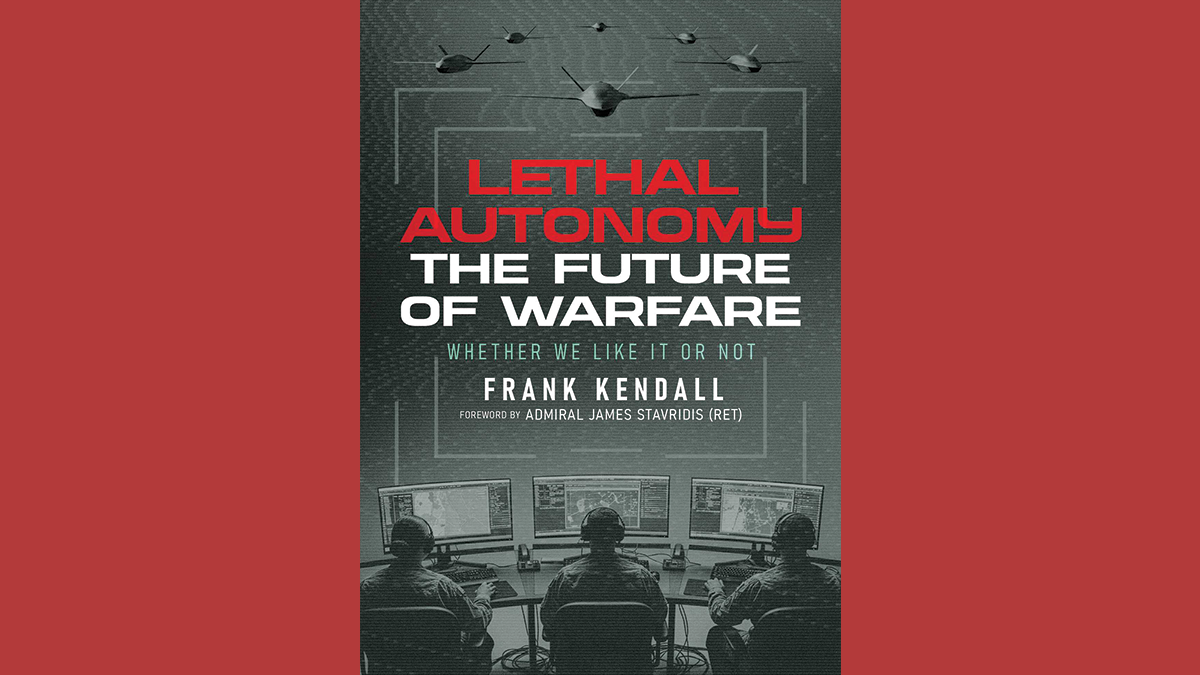
The following is an excerpt from Frank Kendall’s book, “Lethal Autonomy: The Future of Warfare Whether We Like It Or Not,” which will be released by Knox Press on July 7.
For the space domain, I will discuss two somewhat separable conflicts instead of one: a future offensive conflict, where one tries to eliminate an adversary’s space capabilities, and a future defensive conflict, where one tries to defend one’s own capabilities against attack. This stems from the nature of space as having military value largely as a location from which to provide support to operations in other domains and from the fact that space systems are generally either one or the other—support systems or weapons—but not both.
In a space conflict, there are no fixed territories or zones of control to defend and attack; everything is intermingled. Conceptually then, there are two overlapping warfighting missions in space: providing and protecting the support functions we depend upon space for, and denying similar support to adversaries. Some tools apply to both conflicts, but many do not.
Space as a warfighting domain today has two other unique features; there has never been a real conflict in space and we are behind China in fielded space order of battle. In other domains, such as sea surface, there may not have been a major peer-on-peer conflict with modern military technology for several decades, leaving us without any relevant current experience to guide us. In space, we have no warfighting experience to guide us at all.
We may get the opportunity to have that experience. For decades, China has been fielding a space order of battle designed to support its operational forces and, in particular, to support its anti-access area denial strategy of defeating US power projection in the Pacific. China can easily be considered to be ahead of the US in fielded space order of battle if one looks just at numbers of systems. I’ve said this publicly many times. We may be ahead in technology, and there is more to the balance of space power than visible fielded systems, but we are behind in numbers of fielded ISR satellites and in the numbers of fielded anti-satellite systems.
In 2014, I showed the Deputy Secretary of Defense’s senior budget deliberating body, the Deputy’s Management Action Group (DMAG), a PowerPoint slide I had constructed that characterized the choices in space facing the DOD. The slide depicted alternatives necessitated by the fact that China and Russia were both developing a suite of space control systems designed to kill the satellites the US depended on for intelligence, communications, navigation, timing, missile attack warning, and missile defense. Our most important assets in space numbered in the few tens of satellites and were in predictable and visible orbits. For decades, we had operated those assets with almost complete impunity from attack. That time was fast ending if it had not already.
My point was the DOD had three choices. We could keep building these kinds of often multibillion-dollar satellites and try to defend them; we could rethink our space architectures and create more resilient or defendable architectures; or we could reduce our reliance on space-based assets. Business as usual was not a viable choice.
I pointed out that peacetime intelligence collection requirements—the traditional mission of the National Reconnaissance Office (NRO)—argued for very sophisticated high-resolution sensors, and therefore large, complex, and expensive satellites that are very hard to defend in a conflict. There was certainly an overlap in requirements, but our warfighting needs and our peacetime intelligence needs were diverging. We could either reconcile those requirements or build separate systems for the two missions. I’ve become increasingly convinced we will be forced to do the latter; exquisite peacetime intelligence collection systems are needed, but they will go on being small in number, big in size, high in cost, and vulnerable to attack. They can be hardened and defended to a degree, but at the end of the day, they will not be adequately survivable against a determined, capable, and well-resourced adversary.
In about the same period, roughly 2014 to 2016 we were also trying to define the content of the Third Offset Strategy concept that Deputy Secretary Bob Work had initiated. As part of that effort, I chartered a Long-Range Research and Development Planning study chaired by Stephen Welby, Assistant Secretary of Defense for Research and Engineering. One of the critical questions I asked that group to address was whether we should continue to rely on space for the important military support functions it provided, or shift to other domains and assets, such as standoff or penetrating long-endurance unmanned airborne systems. The group’s answer (which I accepted at the time, but which I was not 100 percent sure was correct) was to increase our reliance on space systems rather than decrease it.
To do this, we had to design space architectures that could survive attack and/or be quickly reconstituted at reasonable cost. That was the course of action recommended by the study. When I became Secretary of the Air Force, I found that the DOD was moving in that direction, but still had not fully resolved the issues of just what the US space order of battle should be, how much resilience was needed, or how it would be achieved. In 2021, we had a Space Force and a Space Development Agency, but we had not answered some fundamental questions: What will war in space look like in the future, and what order of battle should the US invest in to prevail?
After having the opportunity to lead the Space Force for several years, I feel that we have made a great deal of progress. I would particularly credit General John “Jay” Raymond, the first Chief of Space Operations (CSO), and the Space Warfighting Analysis Center led by Andrew Cox for the professional judgment and analysis that informed decisions about creating a new space order of battle for the United States.
That work isn’t finished, but it is being continued by CSO Chance Saltzman and Secretary of the Air Force Troy Meink. It has happened slower than I wanted, and the rate of progress and funding are not what I would like to see, but we are going in the right direction, and we are beginning to field the essential operational capabilities I will describe here.
In addition to the support functions the United States has come to depend upon, we will also need an offensive space capability. While it is highly desirable to maintain US space-based capabilities in a conflict, it is essential to deny them to threat nations. A peer adversary cannot be permitted to retain access to persistent targeting quality data to support operations. This would put the entire joint force and our allies at unacceptable risk. I have a hard time imagining a future great-power conflict in which achieving control of space would not be decisive.
For a country like the United States, whose military is built around the ability to project power and to defend far forward, being able to decisively deny an adversary observation from space is as essential as control of the air has been to ground and sea operations for the past several decades.
For this reason, offensive counter-space systems should be a priority investment for the US. It may be possible to limit at least some offensive capabilities of a potential adversary through international agreements, prepositioned co-orbital anti-satellites or nuclear anti-satellites for example. I’m skeptical this can be accomplished, but the potentially hair-trigger nature of war in space and the perception of a first-mover advantage suggests that effort should be undertaken. I’m reminded of the naval arms races that in some part led to World War I and World War II. It would be wise to avoid going down the arms race path, but we have already started, and the pace is accelerating.
Policy people like to talk about space being crowded, congested, and contested. Military operators like to talk about it as a warfighting domain and as the “high ground” in future conflicts. I’m inclined to think of space more as a sort of no man’s land. Both sides have it under continuous observation, both sides can cover it by fire, and there is limited opportunity for concealment. During a conflict, space becomes a hard place to survive, especially over time. Passive systems have a better chance to survive than active systems, but to be useful, almost all space systems must be able to receive and send information. In peacetime, space is open to all and there is high opportunity for unimpeded deployments and deception.
This fact grants a potential adversary an opportunity to conduct reconnaissance, gather intelligence covertly or overtly, station sensors and weapons in orbit, and prepare the battlefield in detail prior to the start of hostilities. Presumably, deception would be used to achieve some objectives surreptitiously. This situation is tactically and strategically unstable; it can make the risks of not moving first to attack the other side appear very high during a period of tension.
Think of space as a chessboard where both sides get to preposition pieces prior to the start of the game, without full knowledge of the other side. Then either side can start the game at its own discretion by moving all its pieces at once. The rewards for going first, and the penalties or risks for going second, are very high.
All of this is a new dynamic and one that has not been explored or thought about very well at scale. Most war games and scenarios I’ve seen concern themselves with limited-scope and short-term attack scenarios—more like sniping or skirmishing than a full-out assault. The reality, I’m afraid, is that an adversary would move quickly and decisively, with surprise, if possible, to completely destroy all relevant adversary space-based capabilities. (Note that destroying capability is not the same as destroying assets.)
There is a high payoff to identifying and destroying key nodes, such as unique C2 (command and control) assets, that can bring down an entire suite of capabilities.) Ground stations and launch stations would likely be attacked as well, especially the more assessable overseas assets if there was a desire to avoid “homeland” attacks. The attack would likely blend all available types of attack, including kinetic, directed energy, cyber, and electronic warfare.
Future space conflicts will be characterized by a high degree of automation and autonomy. Space systems are already going to be unmanned and largely autonomous, especially once they are committed to a course of action. High-fidelity war game participation has taught me time is a critical parameter during a conflict in space. Orbital transfer times, ascent times, fuel burn times, and the tyranny of orbital mechanics conspire to limit operational choices very quickly as decision time compresses.
In this construct, effective automated decision-making for battle management can be a crucial determiner of outcomes. Humans may be able to monitor and override automated battle management tools, but those tools and their ability to successfully simulate many-on-many engagements and optimize actions will be essential to success—for both defense and offense.
There is another destabilizing offense-defense asymmetry here; the attack planner may have infinite time to plan and rehearse an attack. If a conflict begins by surprise in space, the attacker can choose the most ideal time for the attack from several perspectives. The defense does not have these advantages; it must respond in real or near real time and do so at a moment the attacker has chosen as the least favorable for the defense. Because a successful surprise attack in space can also be decisive for operations in other domains, the temptation to launch such an attack can be very high, especially if it is seen as preempting a similar attack on one’s own assets.
Frank Kendall was the U.S. Air Force secretary from 2021 to 2025. He has held a variety of other roles in government, including under secretary of defense for acquisition, technology and logistics as well as deputy director of defense research and engineering for tactical warfare programs in the Office of the Secretary of Defense.
Related Posts
Stay Up to Date
Submit your email address to receive the latest industry and Aerospace America news.