Spacecraft without gas tanks


In the coming months, a cubesat is slated to arrive at the International Space Station equipped with a novel kind of thruster: Unlike today’s liquid- or gas-propelled designs that require fuel tanks, it will rely on plasma.
This thruster is the work of JivaJet, a Washington, D.C., startup that stemmed from the doctoral research of former George Washington University students. For the ISS demo, the thruster will be tested at an altitude of 415 kilometers, but the company’s long-term goal is for its plasma propulsion to enable satellites to operate for extended periods at altitudes below 200 km — dubbed very low-Earth orbit, or vLEO.
This orbital regime offers a range of potential benefits, including reduced communications delays and quicker revisit times, but also requires constant propulsion for spacecraft to overcome gravity’s pull. With conventional liquid-based thrusters, the size, weight and power equation does not balance out, says Anmol Taploo, one of JivaJet’s three founders and its chief technology officer. Satellites require a large fuel supply, which adds to overall weight, which increases the necessary thrust to stay in orbit, which requires more fuel in an ever-increasing loop.
JivaJet’s solution is to rely on air-breathing plasma propulsion and operate in the “sweet spot” of 80–110 km, as identified by simulations in GWU’s electric propulsion laboratory under professor Michael Keidar, an adviser to JivaJet. At these altitudes, air does not need to be compressed or slowed to power a thruster but can directly feed into the system.
As a result, the thruster “actually takes hypersonic air and just slightly accelerates it,” says Keidar.
“If we can manage all of the odds, then we can do miracles operating the thruster at the lower altitudes,” says Guru Duppada, a GWU doctoral candidate researching plasma propulsion and a subcontractor to JivaJet.
Plasma is a lesser-understood state of matter, occurring when another state — typically a gas — is ionized to a certain degree. Unlike solids, liquids and gases, plasma is not a resting state.
JivaJet is developing two variants of its thrusters: a metal-based one for satellites orbiting 200 km and above, and an air-breathing one for those operating between 80–150 km. Both use the same multi-stage hardware to create and accelerate plasma but differ in fuel source and operational dynamics.
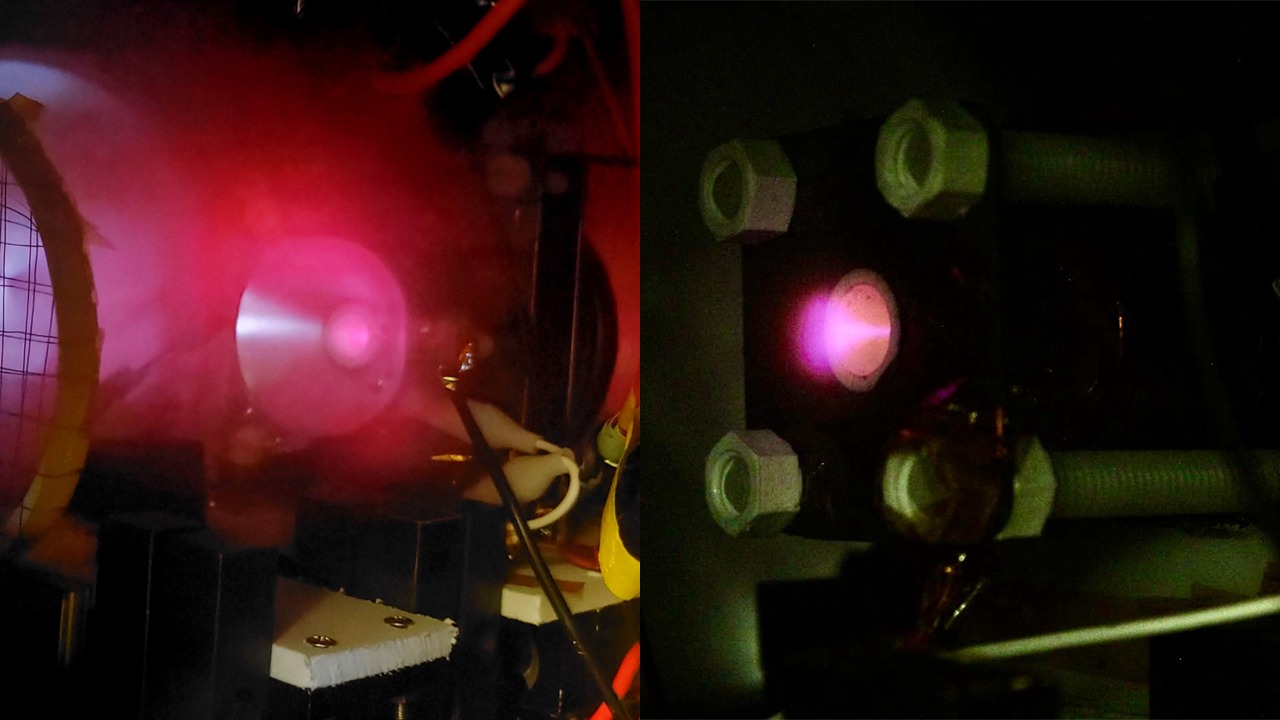
The thruster’s first stage resembles a thick disk, says Duppada, and either takes in passing air or relies on a built-in metal feeding system for fuel. The fuel enters and is hit with electricity, ionizing it and creating plasma. The plasma naturally begins moving through a funnel to the second stage, a self-extraction process aided by a magnet.
The second stage looks like a cone and has a series of electromagnets to accelerate the newly created plasma. These electromagnets operate in pulses with a higher charge than any magnets in the first stage, pulling the plasma forward at an increasing rate for added thrust.
The accelerated plasma exits the thruster and soon changes to a gas. The resulting plume automatically maintains a neutral electric charge, so the thruster has no charge neutralization component.
In this, JivaJet’s designs differ from comparable ion propulsion systems, such as Hall thrusters, which require electron neutralization devices to keep positively charged exhaust plumes from forming. Those thrusters split the incoming fuel particles to ionize just positive ions. This makes the electrical charge of the exhaust plume
positive, requiring electrons to be discharged nearby to return to a neutral charge. JivaJet’s thrusters instead ionize full particles, resulting in neutrally charged plasma and plasma plumes.
The air-breathing variant also relies on a “natural phenomenon” to maintain a neutral charge, says Taploo. In his doctoral research, he discovered that below 100 km, “whatever is happening inside the [ion] engine also starts happening outside.” This leads to an “ion cloud” forming in the air around the engine, attracting electrons toward it and self-neutralizing.
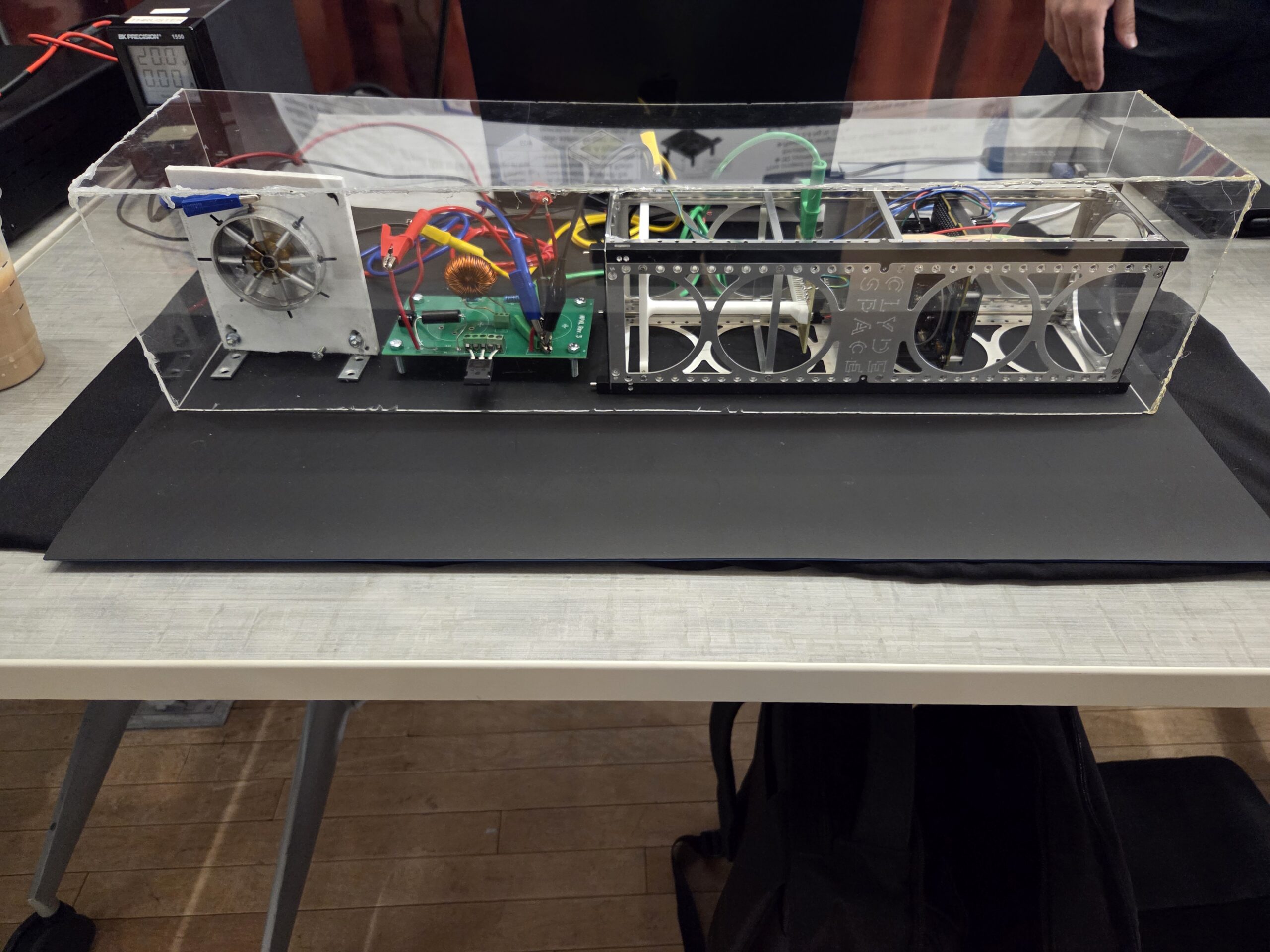
For the ISS demo, JivaJet is sponsoring a GWU student team participating in NASA’s CubeSat Launch Initiative to build a satellite with its metal-based plasma thrusters. The three-unit cubesat is slated to launch aboard a Northrop Grumman Cygnus no earlier than “Fall/Winter,” NASA told me.
Once aboard the station, the cubesat will be deployed and spend six months testing the thrusters at 415 km before deorbiting. Because this orbit will not have as much atmospheric drag as vLEO, the primary goal “is to test the tumbling and satellite rotation,” as well as “the thrust it’s producing and also any wobbling,” says Sarah Levine, the team member assembling the thrusters.
In preparation, she is working with Duppada to extend the system’s run time by adjusting how the metal fuel feeds into the thruster.
If this demo goes well, “it just opens the door for this new kind of innovation,” says Marc-Andre Berthin, another team member. “Looking back, I’d be very proud if we did something that is kind of like the first step.”
Building on the ISS mission, JivaJet is targeting 2027 for the first on-orbit test of the air-breathing thrusters. For this test, a custom-designed satellite will be deployed to 80–150 km for similar maneuvering experiments.
If successful, “we’ll be the first in the world to do that,” says Taploo.