
The heat inside the combustion chamber of a rocket or turbine engine can create a hellscape for metal components, with temperatures often exceeding 1,000 degrees Celsius.
To ensure the injectors, nozzles, preburners, shrouds and turbine blades can withstand the heat, engine designers and builders have long relied on two kinds of superalloy metal mixtures — but neither amounts to a perfect solution. Nickel-based mixtures are relatively cheap but weaken at at temperatures over 1,000 C, degrees, whereas superalloys of refractory metals like niobium remain strong above 1,000 C but are up to 100 times more expensive, plus they’re corrosion-prone.
NASA might soon be able to offer a better alternative: GRX-810, a nickel-based superalloy in formulation over the last several years that combines the best attributes of today’s alloys. Early tests indicate the material retains its strength above 1,000 C while also remaining resistant to corrosion.
The current phase of testing seeks to address the cost portion of the equation. Since October, researchers have been evaluating a new manufacturing method that, if successful, could expand the use of GRX-810 and enable manufacturers to build engines that are significantly cheaper and more reusable, proponents say.
First, the alloy: Based on initial tests, GRX-810 stacks up impressively against today’s nickel superalloys, most of which were developed in the 1960s. It can last 2,500 times longer, is twice as resistant to oxidation and retains its strength at up to 1,300 degrees. It was first created in 2021 by NASA materials engineers Christopher Kantzos and Tim Smith as a powder that can be 3D-printed, building parts from thin layers of the powder as it is melted by a laser.
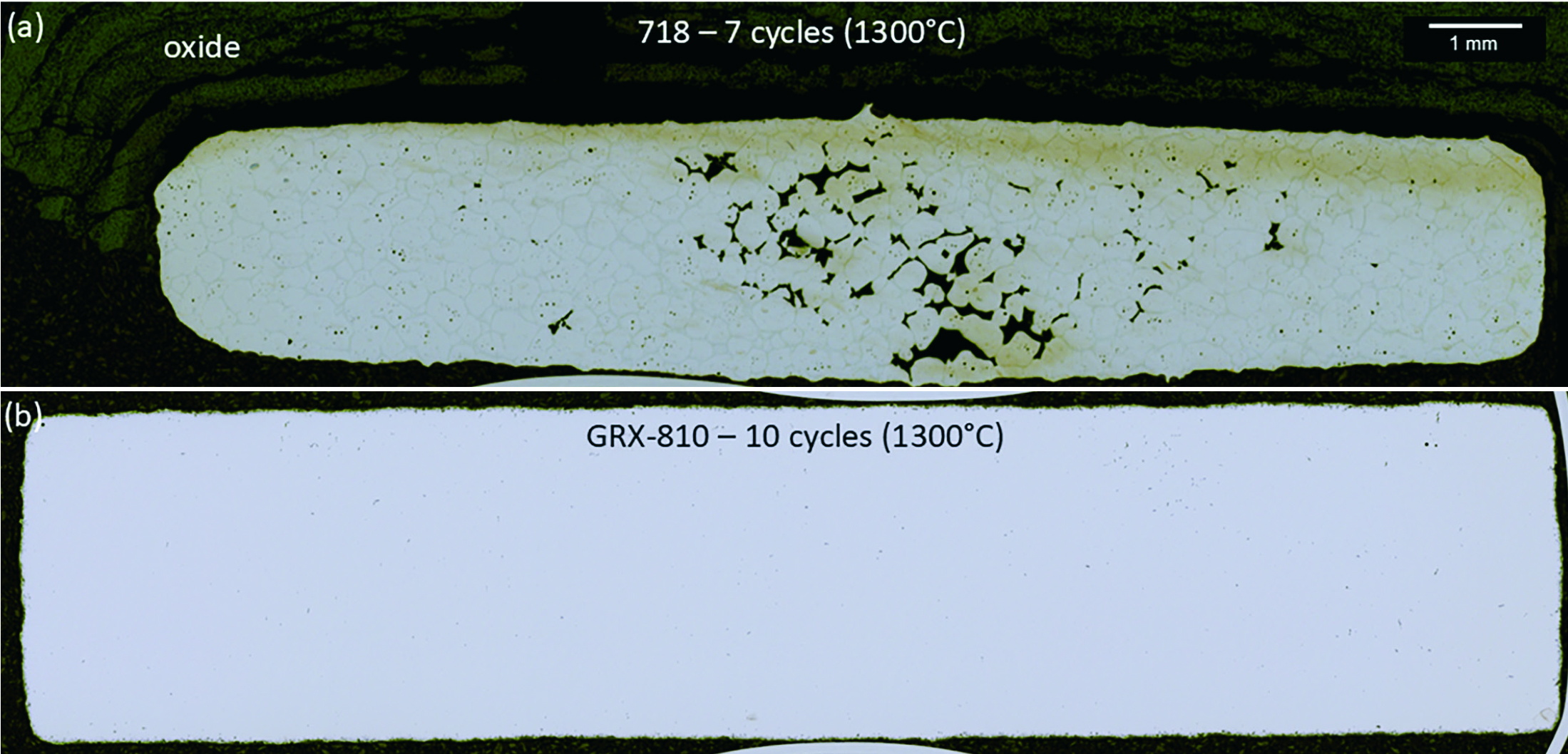
Tests comparing GRX-810 to the old-school materials have been striking. In one example, after heating the new alloy to 1,100 degrees, cooling it, and repeating the cycle 100 times, the GRX-810 was unchanged. For the same test with a common nickel superalloy, “it’s completely falling apart into dust,” Smith says.
In a strength test under continuous heating at 1,100 C, the traditional nickel superalloy breaks apart after five hours, whereas GRX-810 lasts more than six months. NASA researchers don’t precisely know the maximum time yet for GRX-810 on the test. During its first 5,000-hour trial in 2024, the test frame gave out before the alloy sample did.
“That was a good sign: Like, ‘Alright, this really is as good as we’ve been claiming,’” Smith says.
This year’s tests are focusing on the cold-spray method, in which researchers blast powder particles of GRX-810 through a nozzle. In this technique, high-pressure gases propel the particles at supersonic velocities to embed them onto a component surface, coating it without melting. If it works, GRX-810 could be applied to turbine blade tips or other worn-out parts to repair them, or as a heat-shielding coating on other metals to make cheaper parts. Cold spraying could also serve as a way of 3D-printing entire parts from GRX-810.
For all the potential benefits, challenges remain, says Michael Schmitt, CEO and senior research scientist for HAMR Industries, a materials development company in Pennsylvania. GRX-810 was originally designed for laser powder bed fusion, in which thin layers of powder are consecutively melted. This 3D-printing process yields dense, finely detailed parts, but it is also time-intensive, expensive and can’t be used to repair or add onto existing parts. The laser printing can produce a few hundred grams of material per hour, compared to the tens of kilograms per hour possible via cold spray.
“It’s great for certain applications, but it definitely has its limitations,” Schmitt says.
These limitations are partly why NASA is exploring cold spraying, Smith said. The agency last year awarded 12-month contracts of about $150,000 each to HAMR, Elementum 3D of Colorado, and Triton Systems of Massachusetts, with results due by Sept. 30. The overarching goals are to discover the best methods for cold spraying GRX-810 and study whether cold-sprayed parts can be as strong and corrosion-resistant at high temperatures as the ones produced via laser powder bed fusion.
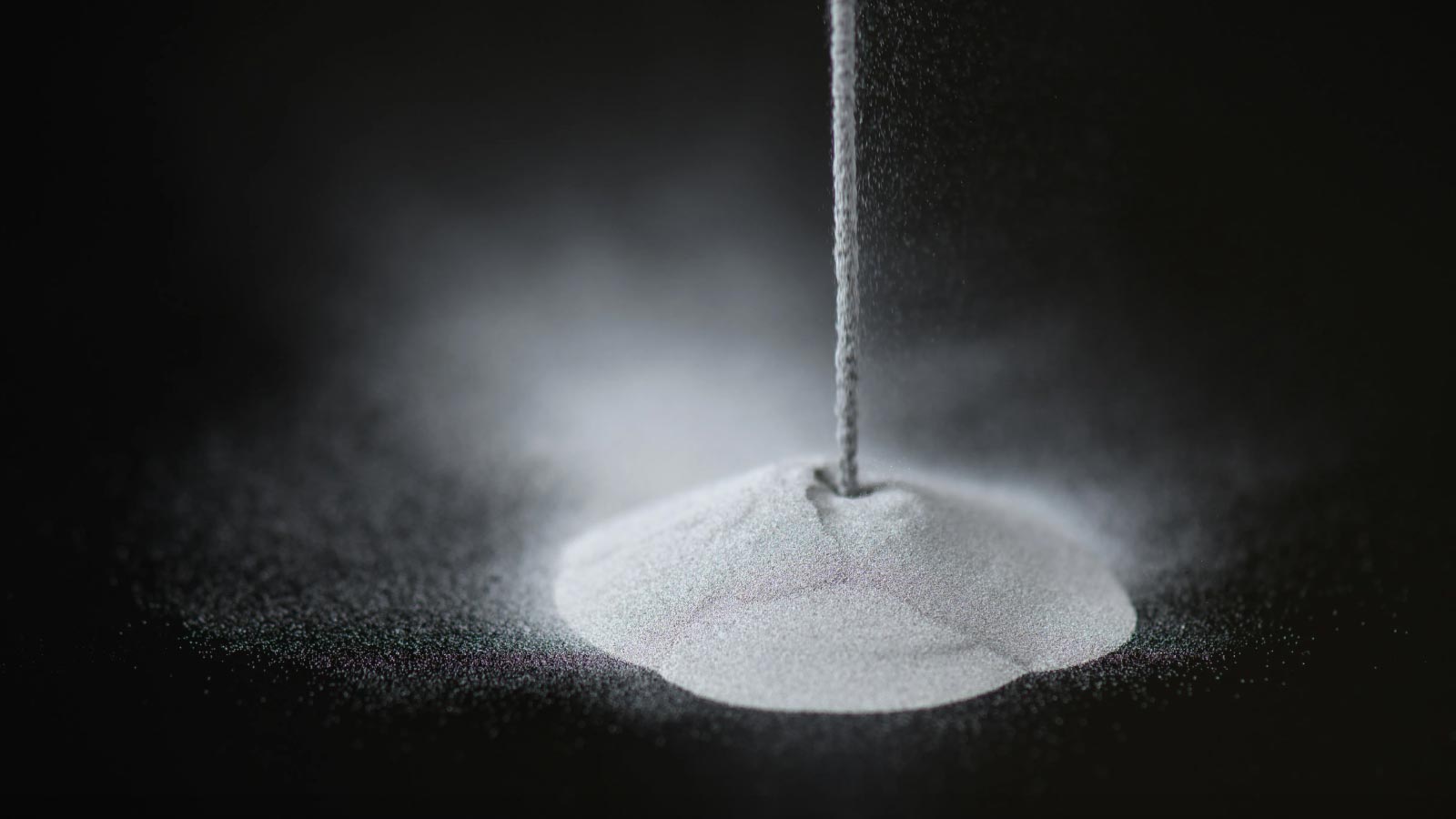
GRX-810’s high-temperature characteristics can be traced in part to the microscopic bits of ceramic embedded in the material’s 3D-printed form. In the powder formulation, each particle is coated with a layer of a ceramic called yttrium oxide, much like powdered sugar clinging to a donut. During the laser printing process, the ceramic bits are evenly disbursed throughout its microstructure.
NASA doesn’t fully understand what gives the 3D- printed material its superpowers, but early research has revealed some clues. In a January paper in Nature Communications, Smith, Kantzos and 15 co-authors showed that the cubic crystals of yttrium oxide in the powdered form are converted into hexagonal crystals in the laser 3D-printing process, providing added strength at high temperatures. Another contributor is the nanocarbide crystals that grow in the microstructure when the printed alloy is heated and remain there even after it cools.
These crystals prevent the microscopic defects that would typically form in a metal as it is heated toward its melting point, Smith says: “When you heat things up, everything wants to move and relax and start to break apart, and the oxides and the carbides here really are just holding everything together.”
A key question for the cold-spray research is whether that method will evenly distribute the yttrium oxide coating throughout the alloy.
To describe the theorized outcomes, the researchers once again reached for baking analogies. Consider the GRX-810 particles like balls of clay coated in flour, says Jeremy Iten, chief technical officer for Elementum. The flour might disperse as the clay balls impact and flatten into pancake shapes on the surface of the component the alloy is being cold sprayed onto. But it’s also possible the flour might fly off upon impact, or form rings around the impacts, or form layers that don’t allow other balls of clay to adhere.
To examine that question, Elementum has subcontracted with the University of Utah to study how individual particles of GRX-810 impact on a surface at different cold-spray velocities, particle sizes, angles, and temperatures with or without coatings.
The tests involve shooting a pulsed laser at what the researchers call “launchpad” sandwiches — a top layer of thin glass, a middle metal layer about two-thousandths as thick as a sheet of paper, and a thin plastic bottom layer with particles of the GRX-810 stuck to the underside. The laser is aimed from above at a single particle, penetrating the glass and striking the metal layer to create an explosion that sounds like a tiny lightning strike. This propels the particle to the target surface a few millimeters below.
The velocity is controlled by adjusting the power of the laser, and the angle of impact is controlled by tilting the target surface, says Suhas Prameela, the University of Utah materials science professor leading the tests.
The velocity of the particle is calculated from a 16-frame movie shot with a $600,000 camera capable of taking a billion images per second. If the particle is too slow, it bounces off the surface; if too fast, it can create violent impact craters and erode the surface.
When the particle’s velocity is just right and it sticks to the target surface, the researchers check the strength of the particle-surface bond under a scanning electron microscope, examining a cross section of the bond. So far, Prameela’s team has conducted thousands of laser shots testing a range of variations for the cold-sprayed particle scenario, he says.
As part of HAMR’s contract, the company is studying how the makeup of the GRX-810 powder might be altered to improve the cold-sprayed alloy. For instance, “Can we change a little bit upfront on how we generate these powders to make them more suitable for cold spray to then, down the line, enhance the properties that we get out of it?” Schmitt says.
Under the same contract, he says, HAMR is also looking beyond GRX-810 to explore how NASA might create its “next latest and greatest alloys” through cold spraying — a potentially faster process that could yield additional cost savings.
“They can just buy commercial off-the-shelf materials, which are cheap, easy to get,” he says. “We can spray these materials together in the right composition and blend ratio, and then we can let them explore new alloys that way, rather than having to go out and custom cut the materials.”