

The U.S. Air Force has awarded millions to a Virginia startup to develop a means of communicating through dense jungles, fortified bases and other environments where radio-based communications are inaccessible. Keith Button explores the concept and the testing ahead.
If you’ve ever lost your cell phone signal in an elevator or while driving through a tunnel, you’re familiar with the problems Igor Smolyaninov and his Virginia startup are trying to solve.
The physicist and his team of engineers are developing wireless communication devices for the U.S. Air Force to reach where typical handheld radios can’t, such as radio-signal dead zones in and around hangars; bunkers and tunnels on air bases; and in areas of dense foliage. The devices transmit via plasmons: electromagnetic waves that can travel along and through metal or concrete structures, bodies of water, the ground and even forest canopies.
“We don’t want to replace anybody’s radios. We just want to augment the conventional radios and antennas with this, so that it makes communication more resilient and reliable,” says Smolyaninov, who co-founded the company, Saltenna, with investor Dendy Young in 2017.
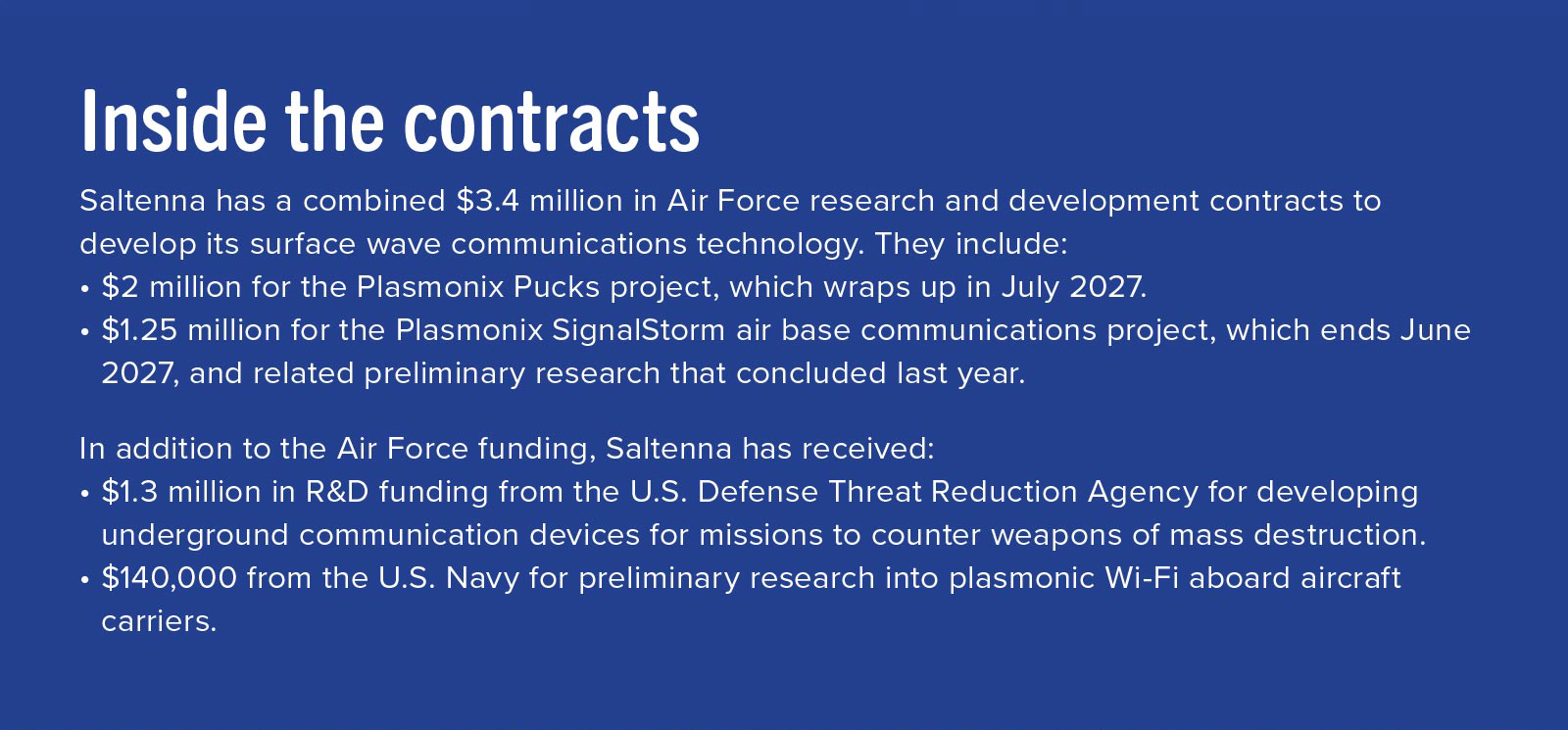
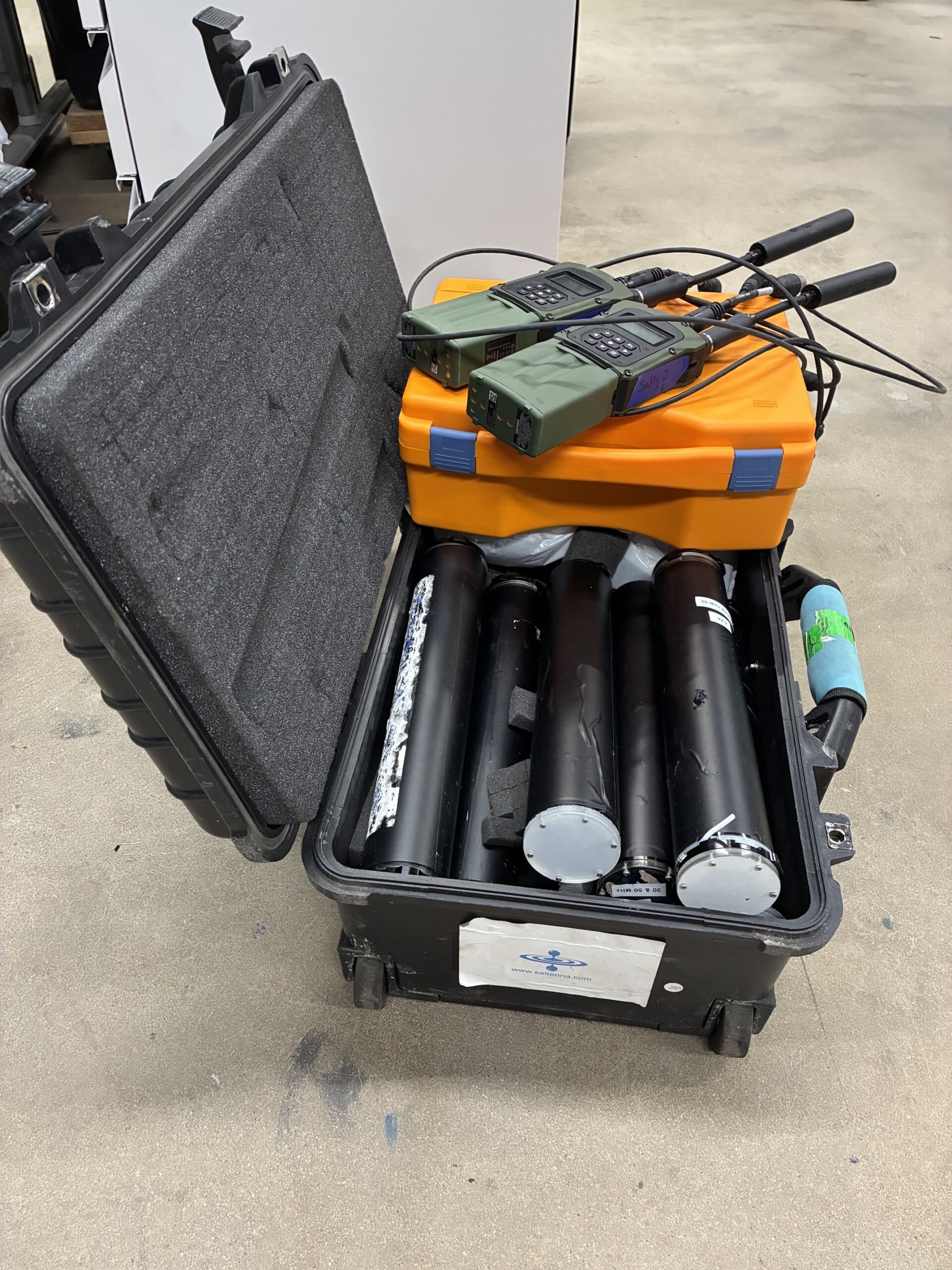
Saltenna has received $3.4 million under two separate Air Force projects to develop radio antennas and hockey-puck-like devices for two slightly different scenarios. The company’s Plasmonix Pucks project is aimed at extending ground-to-ground radio communications in challenging areas for traditional radio signals, like dense jungles or steep valleys. Under the second project, Plasmonix SignalStorm, Saltenna is developing antennas for handheld tactical radios to allow communications into and through radio-obstructed buildings and other structures on air bases.
Plasmonic potential
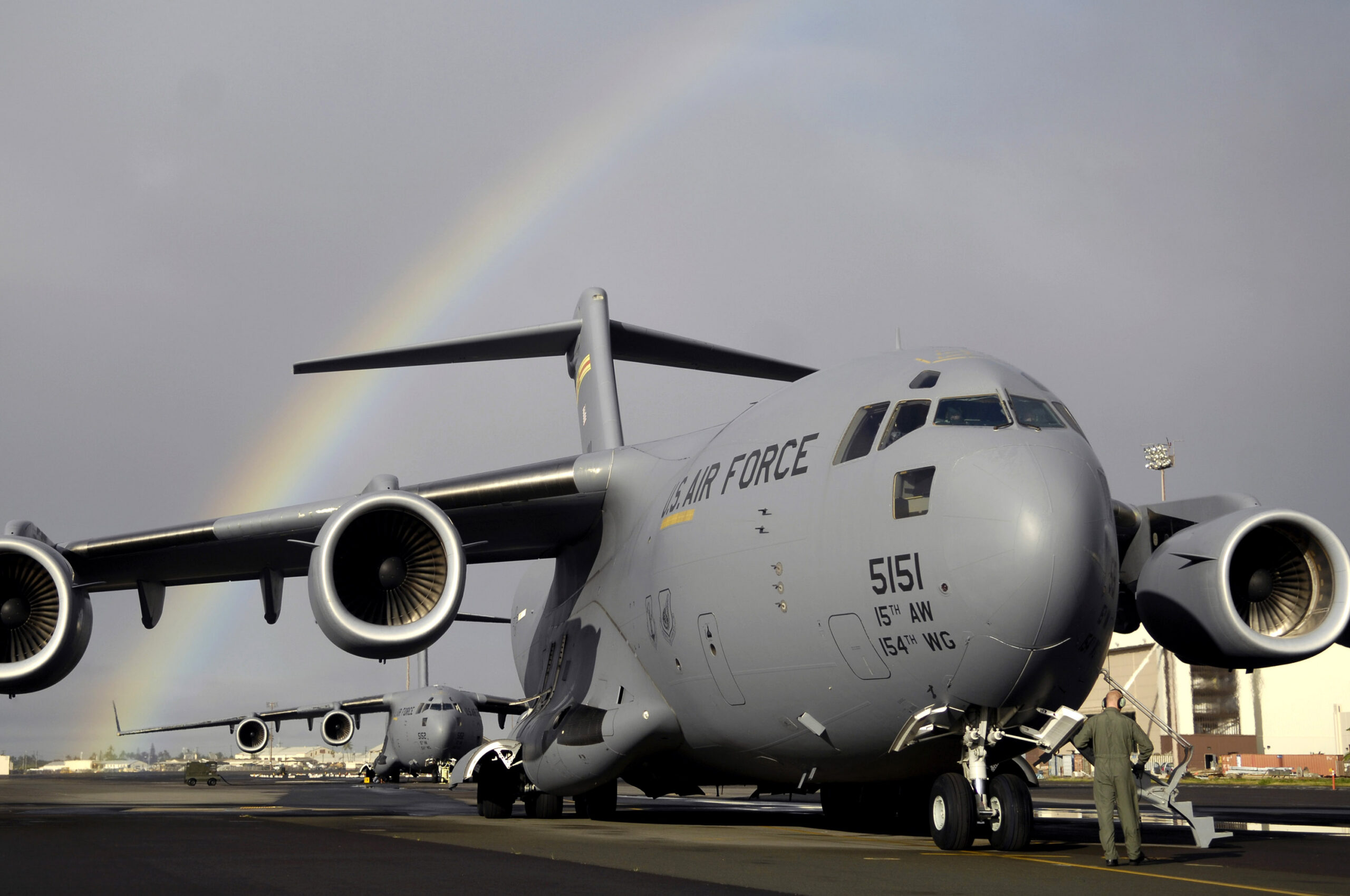
Saltenna introduced its plasmonic technology to Air Force officials during a 2024 demonstration with a parked C-17 cargo plane at Hickam Air Force Base in Hawaii. With conventional handheld tactical radios, a pilot inside the airplane tried to communicate with Saltenna executives on the tarmac, who were playing the roles of ground crew. The ground crew during normal operations would communicate with the cockpit via a cable plugged into their headsets and the fuselage.
The conventional radios didn’t work, says Ashley Johnston, Saltenna’s chief operating officer, because the metal skin of the aircraft acted as a Faraday cage, an enclosure typically made of metal designed to block radio waves. Then they switched out the radios’ antennas for Saltenna’s plasmonic antennas — and the radios worked.
“We had Air Force people out there watching us going: ‘How did you do that, please?’” he says. “Our ability to sit inside a C-17A and communicate clearly to not only just to the outside, to some distance from the aircraft, was eye-opening to the folks that saw us demonstrate that.”
Saltenna showed the radios with the plasmonic antennas could communicate through the skin of the aircraft, past two other aircraft on the tarmac and through a metal warehouse and to the other side, Johnston says. “Our only limitation in that example was the fact that we ran into the edge of the airfield and couldn’t go any further.”
Because the surface waves utilized for plasmonic communication can transmit at higher frequencies than radio waves, they have the potential to carry more information than even cell phone frequencies, says Anatoly Zayats, a physics professor and plasmonic researcher at King’s College London who is not associated with Saltenna.
“The higher frequency, the more information you can encode,” he says. As for the potential limitations, the distance a surface wave’s signal will carry depends on the type of surface, Zayats notes.
Surfaces with greater electric conductivity, such as materials containing conductive metals or water, will perform better.
“Depending on how many electrons there are in the material — the more electrons, the easier it will be to communicate,” he says. For instance, a hard metal pipe surface will have less signal loss than a jungle canopy surface of leaves and branches: “With lower losses, you can communicate over longer distances.”
The testing ahead
For both the Plasmonix Pucks and Plasmonix SignalStorm projects, the goal is to demonstrate how the technology works under a list of scenarios requested by the Air Force, Johnston says. These include tests in dense jungle scenarios, conducted earlier this year in Puerto Rico, and tests slated for later this year at an Air Force base or bases yet to be determined. For those, the aim is to demonstrate the ability of the pucks and antennas to communicate through structural obstructions.
For both scenarios, Saltenna engineers carry tactical radios equipped with plasmonic antennas and evaluate how well they can communicate with other radios with the antennas or via the pucks. The pucks are designed to serve like Wi-Fi extenders for radio communication in environments where tactical radio signals don’t travel far or don’t work at all, Johnston says, such as the ground in a dense forest where vegetation absorbs radio signals in the air.
On a jungle island, for example, “rather than sticking up great big antennas all over the island and making yourself known to people you don’t want to be made known to, you have these little pucks around the place, or you just have radios with our antennas where you don’t need to put up big radio masts.”
Radios with plasmonic antennas can use the vegetation to propagate the signal. “It uses the leaves and the foliage as the transmission medium.” Johnston says.
For plasmonic antenna transmissions through air base structures, the goal is to avoid needing to place a large number of expensive, networked ground antennas around a facility to make sure everyone can get a signal with no dead zones, he says.
“They have hangers that are made of steel; they’re basic Faraday cages. They want a way to make sure that their
tactical radios function no matter where people are,” he says.
The air base tests will be similar to the 2024 Hickam demonstration — but more difficult, Johnston says. For some of the planned scenarios, the Air Force will be looking for certain percentage gains in signal resiliency or signal distance over previous benchmarks.
The Air Force declined to make its managers for the Saltenna projects available for comment, and Saltenna declined to provide further details about testing and development for the projects. But for the dense vegetation and air base scenarios, the general engineering goals are similar: Develop prototypes that are more compact, can transmit farther with less power, and can be tuned quicker, Johnston says.
“How do we squeeze another milliwatt of power out of this antenna and make it go this much further? This is the sort of thing we spend a lot of time doing,” he says.
The engineers are also learning about how certain frequencies of plasmonic waves work better with certain surfaces, Johnston says. Instead of using third-party electronics, they want to build their own software-defined radio. In the future, that may include software that constantly retunes the plasmonics, similar to how current home Wi-Fi systems constantly search the spectrum to identify the best channel.
Saltenna is also developing and considering applications of its plasmonic technology for other environments. Within a few months, it plans to begin marketing devices for divers to communicate with one another while underwater.
Engineers and founder Smolyaninov have also considered plasmonic communication concepts for the surface of the moon and spacecraft reentering Earth’s atmosphere, but so far have not developed those. On the moon, where the absence of an ionosphere makes beyond-the-horizon radio communication difficult, plasmonic communication could be possible if the lunar soil is conductive enough, says Zayats of King College.
“It’ll work,” Johnston says. “But could I write you a quick spec sheet, ‘what will work on the lunar surface’? Don’t hold me to that, please.”
The reentry scenario looks similarly promising, Zayats says. Today, mission controllers lose contact with reentering spacecraft for several minutes because plasma buildup on the vehicle’s exterior blocks conventional radio signals. The challenge for plasmonic communications, he predicts, would be converting the signal at the edge of the plasma to a radio or optical signal to reach the ground, but it could probably be done.
Smolyaninov agrees.
“We haven’t done it yet, but it’s a clear technical possibility,” he says. “Any time you are inside a conductive kind of enclosure, it can be a space vehicle or whatever, whenever you see metal everywhere around, it will help you.”