
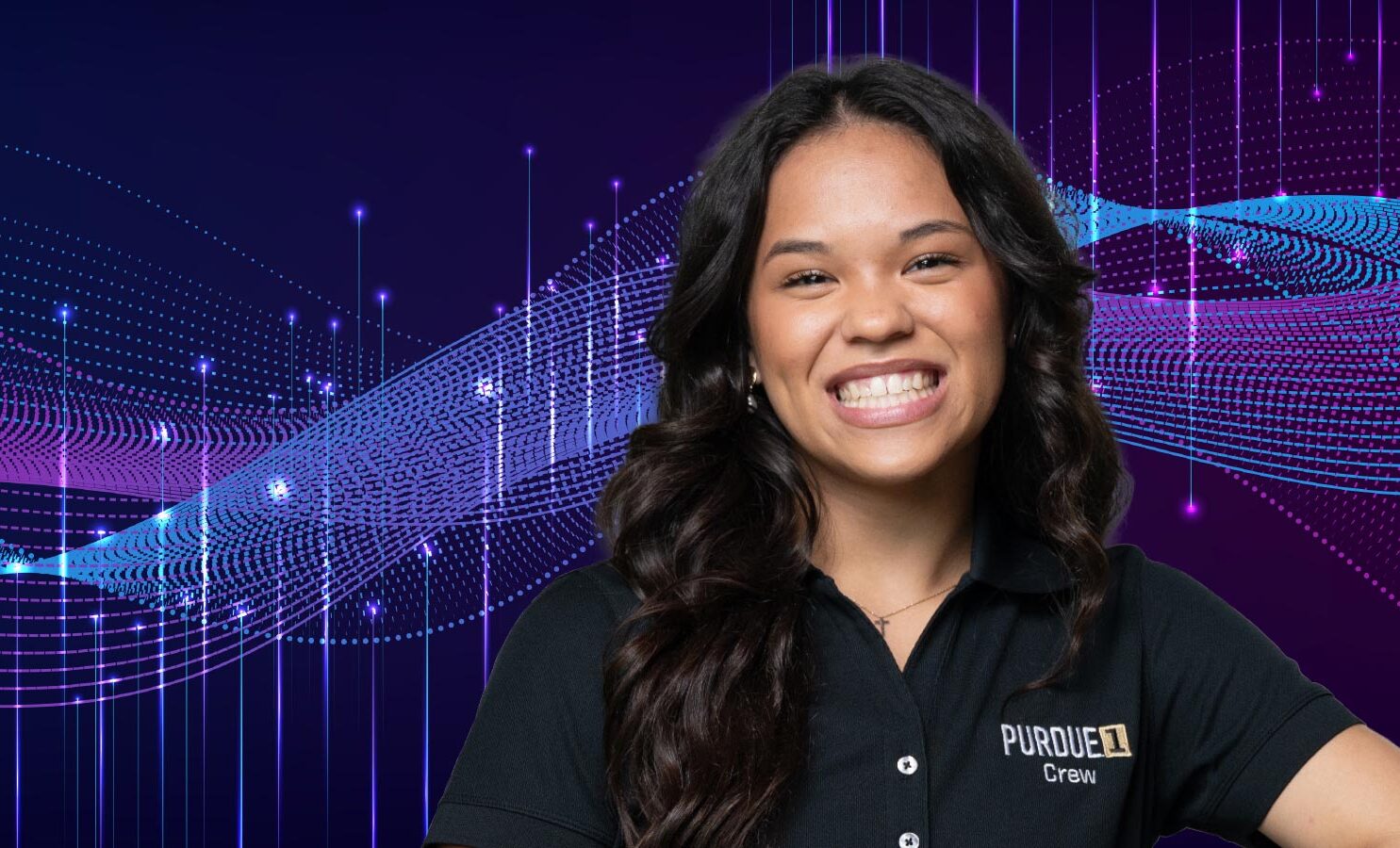
Growing up in the shadow of a bustling airport, Abigail, 23, felt drawn toward aviation at a young age. Continued exposure to aerospace fueled her growing passion for suborbital flight and early conceptual design work. Now, Abigail is preparing for her own flight opportunity in 2027: conducting microgravity experiments on computational fluid dynamics aboard a Virgin Galactic spaceplane.
What’s your aerospace origin story?
I grew up near O’Hare Airport in the Chicago suburbs, and there were just so many airplanes flying overhead. So when I was asked as a little kid what superpower I’d want to have, I would always say, ‘I want to be able to fly.’ That led to me wanting to build airplanes. Then, early in high school, I attended an aerospace summer camp and talked to real engineers. That really began my fascination with aerospace.
Once I got more immersed and started at Purdue University, I learned about what aerospace can really encompass and how spaceflight has changed so much from being not just NASA astronauts but now also having the private spaceflight world. It’s a whole new platform we can do research on, and that’s really exciting.
Favorite thing about your job?
We’re pretty much at the halfway mark for Purdue 1, our Virgin Galactic suborbital flight. What’s exciting is the buildup. I have a team of 10 undergraduate students every semester and summer, and we work together on this experiment. I get to lead them — helping them go through the engineering design cycle, working with hardware and software for the experiment and building out how the experiment will interact with myself, the human controller. It’s been a very fun process of learning how to lead a team and help teach young engineers.
What motivates you?
I like doing something with a purpose. I’ve done some aviation defense work, which was really important to me to support our national security. With this more space-related work, I find a lot of passion in knowing that the data we collect will help improve future missions. That’s what drives me: knowing my work is going to help continue making spaceflight possible and also protecting the lives and people that will be going up into orbit.
Program/tech area outside your field that fascinates you?
Robotics. I went to an artificial intelligence conference recently, and the humanoid robotics there were very interesting. I found it really cool to see how the technology is decreasing the risk for humans in some dangerous scenarios.
What will the world look like in 2050?
My hope is that there’s been more Artemis-level missions, and we’ve continued expanding in that way. I’d also
imagine that suborbital flight would be more prevalent, maybe becoming more like aircraft today — happening more often to where we can continue doing even more research. Today, fewer than 1,000 people have gone to space, so by 2050 we should be way over that number.
MORE ABOUT ABIGAIL
AIAA CONNECTION AIAA’s 2024 co-located ASCEND and AVIATION Forum “was my first technical conference,” she said, “which was perfect, because at that point I was interested in going into graduate school … and I found a lot of great mentors at AIAA.” Looking back, “that conference was a great push for me to go to graduate school.”
EDUCATION Bachelor’s in aeronautical and astronautical engineering from Purdue University, 2025. Master’s in aeronautical and astronautical engineering from Purdue University, expected 2027.
GOING SUBORBITAL As a graduate research assistant for Purdue 1, she will gather data on how fluids move and settle in microgravity, a “very nonlinear” process that is “hard for us to predict,” she said. The experiment consists of a carry-on-suitcase-sized unit with faux propellant tanks filled to four different levels, to simulate the performance of traditional and green propellants. Cameras will record how the liquids move.
CREATIVE ENGINEERING “I also really love art, and I feel like engineering is so creative and has so many artistic parts to it. You have to be creative to make a new technology. Maybe people don’t talk about that as much, but that side of aerospace engineering really blends well with my mind and is very, very fun to me.”