Collision avoidance for the moon
 By Keith Button
 By Keith Button
When it comes to lunar surface exploration, NASA and the space industry frequently tout the potential benefits, such as easy access to minerals and compounds that could be converted into rocket fuel or harvested for use on Earth.
But plans to boost the number of spacecraft traveling to and orbiting the moon in the coming years also increase the risk of debris strikes from potential collisions. That’s because our nearest celestial neighbor has no atmosphere to cushion the descent of any falling objects.
On Earth, “things burn up and slow down. On the moon, it comes in at full speed,” said Jonathan McDowell, an astrophysicist and former researcher at the Harvard-Smithsonian Center for Astrophysics. Falling debris from collisions or deorbiting space junk would be the most likely threats, while meteorite strikes are relatively rare.
Based on the missions launched to date and those projected to by 2030, the number of orbit “conjunctions” where collisions or near misses are possible could increase 100-fold, according to a 2025 paper by the Virginia-based Aerospace Corp. Risks would be highest over the lunar poles, the authors wrote, which are popular pathways for lunar orbits and the regions where the U.S. and China plan to establish surface bases.
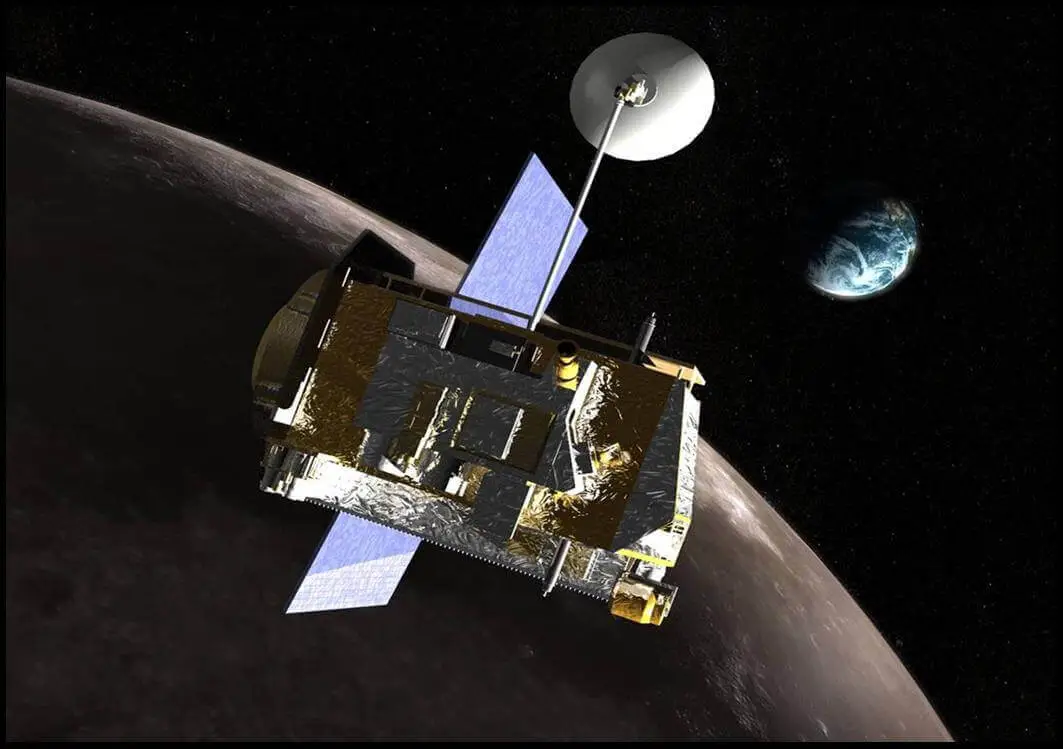
To illustrate the possible impact, the authors created a scenario based on NASA’s Lunar Reconnaissance Orbiter and India’s Chandrayaan-2, two lunar mapping spacecraft have already maneuvered several times to avoid each other. If they were to collide and completely break apart, millions of centimeter-sized and smaller debris fragments would spray into space and toward the moon, impacting the surface at 1-2 kilometers per second — enough energy to penetrate spacesuits and habitats, according to the paper.
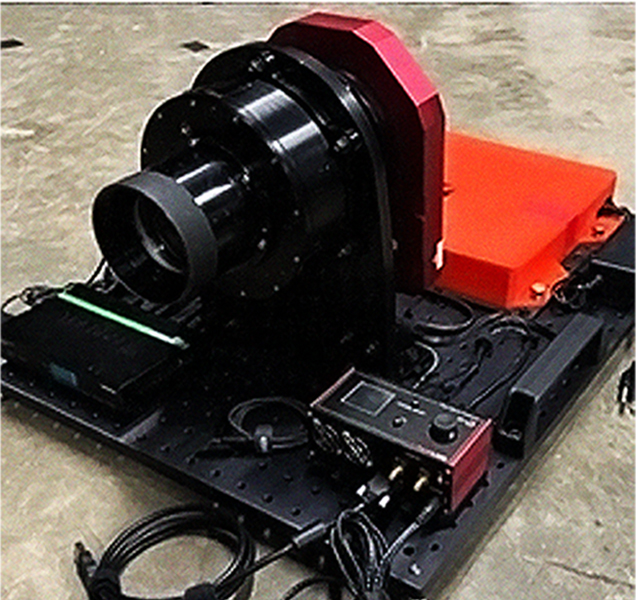
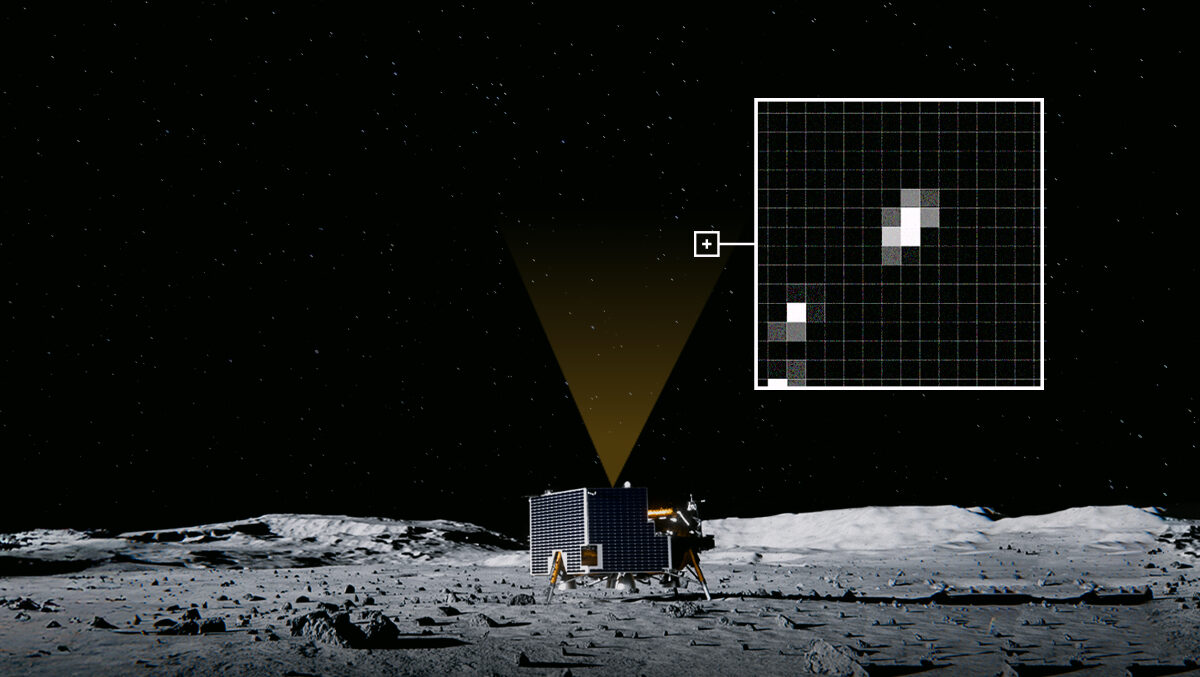
To protect against such a scenario, engineers at Pittsburgh-based Astrobotic are developing a digital telescope called Clavius-S (Cis-Lunar Automated Vision-based Identification of Unknown Satellites-Surface) that could be deployed across the moon’s surface to monitor the lunar skies. Roughly the size of two stacked softballs, the device resembles an aluminum book, with one lens or multiple side-by-side lenses pointed skyward.
Astrobotic proposed Clavius-S last year in response to a NASA request for technology that could detect and track noncommunicating spacecraft in lunar orbit, basing it on technology it started developing in 2022 for another digital telescope.
By March, Astrobotic plans to finish designing Clavius-S, funded by a $150,000 NASA grant. If the agency approves the project for its next phase, Astrobotic will receive an additional $850,000 to build and ground test a prototype. Plans also call for installing that prototype aboard an Earth-orbiting cubesat for an initial on-orbit demonstration.
Astrobotic aims to have a “flight-ready” version that could operate on the moon by 2028 and eventually would also like to install one of the digital telescopes aboard a lunar lander to demonstrate it from the moon’s surface.
Today, tracking for lunar orbits relies on trajectory data provided by the spacecraft and satellite operators. NASA’s Multi-Mission Automated Deep Space Conjunction Assessment Process team then uses that info to predict orbits and their potential conjunctions.
“If you want to know where someone else’s lunar spacecraft is, you have to ask them,” McDowell said. That’s not too arduous, given there are currently only 11 known spacecraft orbiting the moon, but predictions are also complicated by the “lumpiness” of the moon’s mass. “If you go over a dense bit, it pulls you more tightly than if you go over a less-dense bit,” he said.
Astrobotic wants this task to instead be done by a network of Clavius-S telescopes arrayed across the surface. The instruments would record positions, velocities and direction of movement from different angles to accurately project the crafts’ trajectories, said Andrew Horchler, the company’s chief research scientist. With this information, aided by predictive computer models, ground controllers on Earth or an automated alert system could warn of potential collisions or near misses, giving astronauts time to take shelter or cover up equipment.
Such monitoring is best conducted from the moon’s surface, Horchler said, because the brightness of the light reflected off the moon frequently blinds Earth and space-based optical and radio frequency sensors. Even very large telescopes on Earth have difficulty seeing large lunar lander spacecraft from that distance, regardless of the lighting.
“Even if the moon’s dark, that means the sun isn’t shining in that direction, and so we’re also not going to see something because there’s no sun lighting it at that point,” he added.
The Astrobotic engineers based Clavius-S on computer vision hardware and onboard image processing algorithms they developed for its Peregrine and Griffin lunar lander sensors, as well as for spacecraft navigation and docking systems for Pentagon-funded programs, Horchler said.
“They share a lot in common in terms of the underlying computer vision approaches, how we accelerate those algorithms on our computers, and a lot of the underlying physics that go into the problem,” he added. Astrobotic built a Clavius prototype for detecting objects from Earth or lunar orbits for the Air Force Research Lab in 2023.
With both Clavius and Clavius-S, the telescope scans a wide field of view of the sky, collecting stacks of images and trying to determine the orientation, velocity and direction of passing objects, juxtaposed against known stars in the background and from different angles over time, to predict their orbits or pathways.
The original software was tuned for detecting extremely faint, slower-moving objects, but Clavius-S must be able to track bright objects moving rapidly. From the lunar surface, even tiny cubesats look very bright in the lunar sky, Horchler said.
Clavius-S is also to have wider-field optics and smaller optics to give it reduced size, weight and power consumption.
“It’s not a dedicated sniper scope of a sensor like our main Clavius product, but it could still provide useful information in certain contexts,” Horchler said. In addition to scanning the lunar skies, Clavius-S could function like a Ring doorbell camera for a spacecraft in flight, watching for other spacecraft maneuvering within 100 to 1,000 kilometers.
For lunar surface operations, the idea is for the sensors to be small and cheap enough to be mounted on every lunar lander, including those launched by other companies, as well as the larger rovers and nodes of future solar panel arrays that Astrobotic is developing for generating power at the moon’s poles. All of these together would create a comprehensive tracking network.
“That is optimal to get this to be easily accessible for every single lunar lander and asset that’s going to the surface,” Horchler said. “We don’t want this to be a highly bespoke system that every time we build one, it takes a long time and costs a lot of money.”
The main challenge in developing Clavius-S is the limited computer power available to process massive amounts of large images to extract the objects moving across them. The algorithms and computer hardware had to be designed with this problem in mind.
The computer selected for Clavius-S must be capable of processing just-captured images at the same time the sensor is capturing the next frames. It’s also important the computer and software don’t introduce noise during processing that makes objects more difficult to extract, according to Horchler.
To process a digital image, the sensor will first remove the base noise, then detect the brightest stars in the image by comparing them to a digital catalog of known stars. Once those stars are removed from the image, what remains is potentially an object of interest. The computer then assesses to determine where the object appeared and moved to in subsequent images and how quickly it moved and in what trajectory.
“The whole idea is to not have to send whole images — large, full-frame images — all the way to the ground, because the bandwidth from the moon is very limited and that would be just too much,” Horchler said.
“Once we see some things of interest, we can extract that information of their trajectory, maybe of the brightness of the object in the scene relative to the stars around it, and turn that into a telemetry packet, so it’s very, very little data. We could potentially also send some thumbnails of that image, if we wanted to, downstream for further processing or validation.”
From that telemetry data — combined with the location and angle of the sensor, and the location and angles of other sensors viewing that same object — an orbit can be calculated.
The engineers selected the optical lenses for the sensor to build a compact telescope with a wide field of view, good resolution of white light sources and lenses that can focus point sources of light without distortion on the digital camera detector. For the camera detector, they needed to make sure the background noise is low so that the photons from even faint images are detected on the pixels, Horchler said.
On the software side, engineers are developing algorithms and testing them to make sure the sensor can spot objects moving quickly over multiple pixels, while also ensuring the computer processing time doesn’t exceed the image capture time, he said.
Given all of this, it could be several years before there are enough of these telescopes on the moon to provide comprehensive tracking. But in McDowell’s view, it will become a necessity, especially as countries launch spacecraft that they don’t want to share information about.
“If you have two spacecraft in orbit that come close, you can tell one of them to maneuver and avoid the bad thing happening. Or if you see that a rocket stage is in a decaying orbit that is going to potentially crash into the moon, you can send up a robot to lock on to it and change its orbit so that it doesn’t,” he said. “But I’m afraid you can’t do anything until you know what’s going on.”