At DBF, aerospace engineering students explore best uses of AI


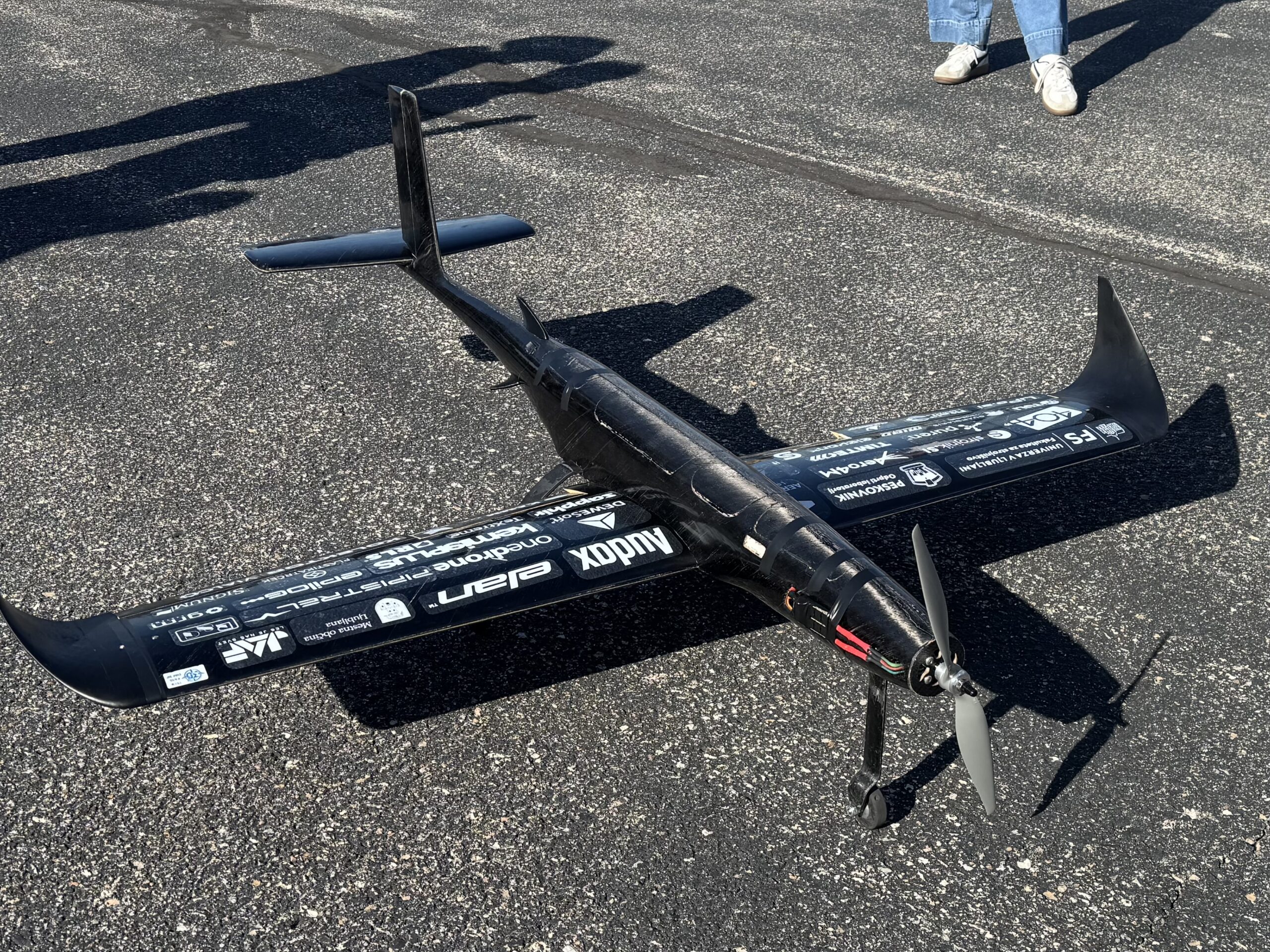
WICHITA, Kan. — The winning airplane in this year’s AIAA Design/Build/Fly collegiate competition, a sleek, carbon-fiber aircraft called BRVINC, seemed to perform flawlessly.
The University of Ljubljana design easily overcame choppy winds while trailing a 4.6-meter banner for seven laps on a blustery day at Textron Aviation’s Employees Flying Club here, even as the winds caused several competitors to crash.
The team said it benefited from artificial intelligence — but primarily in limited early research of its design and strategy, according to team member Brian Kleva, who wrote software to help the team maximize its design for performance.
“I treat AI as a tool, because in my mind, AI is not competitive enough to use reliably yet,” he told me on the sidelines of the fly-off. “For small chunks of data or research, it’s very useful, like to get a quick insight of how AI would consider doing something.”
“But I never copy and paste from AI,” Kleva added
Other student competitors and members of the DBF Organizing Committee told me AI is playing a growing role in all sectors of the aerospace industry, and aircraft design is no exception. But many said there are limits to how it can or should be used, particularly when it comes to final designs.
With 89 teams and 1,179 students from universities around the world participating in this year’s DBF, the annual radio-controlled aircraft competition represents a cross-section of aerospace academia and the industry. This year, a sampling of teams reported they had used AI at some point in the aircraft design process, mostly by turning to large language models (LLMs) such as ChatGPT or Claude to research solutions for specific challenges, rather than to design their plane.
There are no rules against using AI in the competition, but it is prohibited to plagiarize previously published material. Committee members, some of whom are employed by aviation companies like Cirrus and Textron, said they are wary of students using LLMs and related tools, especially to write the initial aircraft design reports that teams are required to submit months before the April fly-off.
“My take is that students and the industry in general still don’t know how to use AI best. Yet, we are starting to get worried that the reports are being written more by AI than they are by students,” said Rob Roedts, a DBF Organizing Committee member and vice president of engineering at Cirrus Aircraft.
He said he doesn’t see AI tools as capable enough on their own to give a team a win in the competition. Judges employ methods to spot AI-generated content in the written reports, and the committee’s safeguards against plagiarism — which entail searching for strings of words that match published material — may also identify the use of AI, he noted.
“In the industry, we are trying to figure out the best way to use AI, and we haven’t seen it make a difference,” Roedts said. “There’s nothing that we’ve seen where AI has presented a unique solution that someone hadn’t already proposed.”
This year’s competition, which took place April 16-19, included three flight missions meant to emulate the operations of a small charter business carrying passengers and towing banners. A ground mission also challenged students to load and unload their aircraft quickly.
If individual student team members used AI, that wouldn’t necessarily be specified in the final design report, said Petr Tupitsyn, captain of the University of Southern California, Los Angeles team, which took third place.
AI was not used by UCLA “as much as I would think,” he said. “Of course, our actual plane is built by our own hands. We would not use any AI for any of the final product. We gave out different sections of the challenges to our team members so, obviously, only they know what they did.”
Similarly, University of Southern California team captain Kathleen Flynn told me “students are using AI, but I feel like it’s not a part of the final design here.” USC took home the prize for best design report.
She added: “We do rely on our in-house optimization software, which we call Plane Tools, to help us look at the equations or challenges that the judges are giving us and then try to figure out how we can optimize our plane to beat the competition.”
Of 10 leading teams I surveyed at the competition, only two said they don’t believe any team members used AI to help research or design their aircraft.
Mark Maughmer, a long-time faculty adviser for Penn State University’s DBF teams, told me he worries about the level of reliance on AI among all undergraduates because he believes it restricts their ability to develop critical thinking skills. Penn State has created policies to govern AI use on its campuses, he noted, but those are still evolving.
“The technology has outpaced us; it’s ahead of us and our policies and education models,” he said.
Committee member Ed Feltrop, manager of the aerodynamics department at Textron Aviation, told me he’s concerned about the use of AI in the competition. However, he acknowledged the industry now requires engineers and other professors to have some familiarity with AI to manage routine tasks.
“Use of AI is a skill that they’re going to need when they graduate, and we’re trying to get them ready for that,” said Feltrop, who is on Textron’s AI Governance Council. “But my belief is that AI cannot come up with something original. It can help you come up with a pretty good design, but you still have to have someone then that’s checking the work.”
Feltrop said industry research has been focused on connecting AI models with computer-aided design, or CAD, technology, but those aren’t yet effective at solving unique or emerging design challenges.
“We’re being challenged from the executive levels all the time to find ways to make ourselves faster, to make ourselves more efficient,” he said.” AI is just another tool that can help us do that, but it can’t do the design work.”