

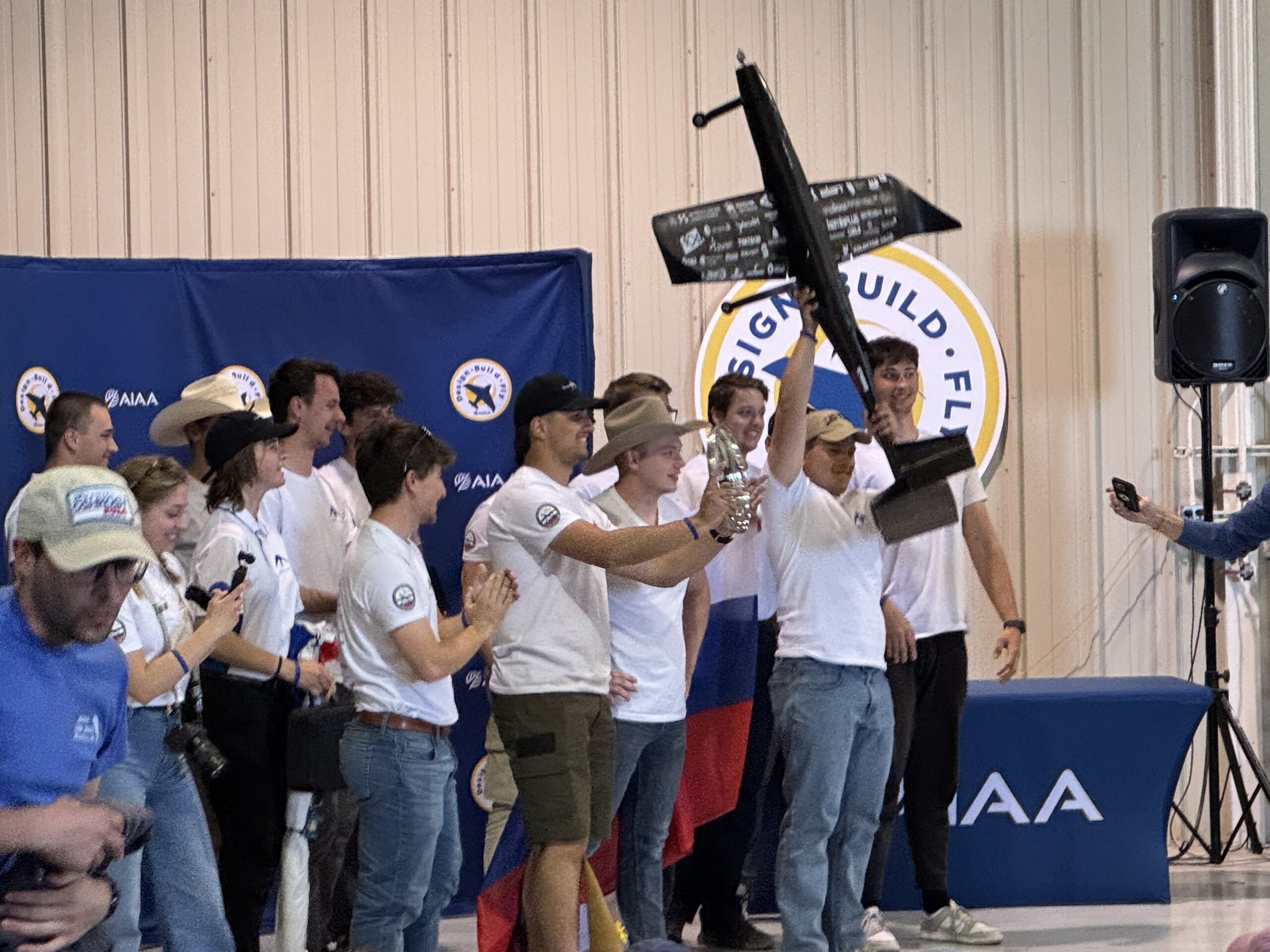
WICHITA, Kan. — Slovenia’s University of Ljubljana took first place at AIAA’s 30th Design/Build/Fly competition yesterday, receiving high marks on three flights that included towing of a banner behind its electric radio-controlled aircraft, the BRVINC.
This year’s fly-off drew 1,179 students from 89 teams in 12 countries, a record for the collegiate event intended to provide students real-world aircraft design experience and an opportunity to practice teamwork.
“It couldn’t be better; we are very happy,” Jakob Erhatič, Ljubljana team captain, told me in an interview. He said the team had run thousands of simulations and wrote its own programs in Python computer code to optimize the design for the competition. “It all went exactly as planned. I can confirm that the simulations we ran were 99.4% accurate.”
Over the course of the competition, held April 17-19 at Textron Aviation’s Employees Flying Club here, teams conducted a variety of flights meant to emulate the operations of a small charter business carrying passengers and towing banners. A ground mission also challenged students to load and unload their aircraft quickly.
A tornado warning forced a break on Friday, the first day of flying, shortening precious flight time. Saturday saw near-perfect flying conditions, but some tricky crosswinds caused a few crashes on Sunday.
For the first of the three missions, the teams flew their planes without any payloads. For the second, they simulated carrying at least three passengers, represented by toy rubber ducks 5.8 centimeters high, and at least one piece of cargo, represented by a hockey puck. Ducks and pucks were restrained to prevent movement during flight.
The third mission profile called for the planes to deploy and release a banner midflight, a first in the history of the competition. Each banner, required to be at least 25.4 centimeters, was released either by the pilot using the controller or by a designated observer crew member with a second transmitter just for that purpose.
This challenge resulted in a colorful scene as the banners, emblazoned with the team’s university name or logo and colors on each side, flapped loudly overhead while the planes flew over the flightline crowds.
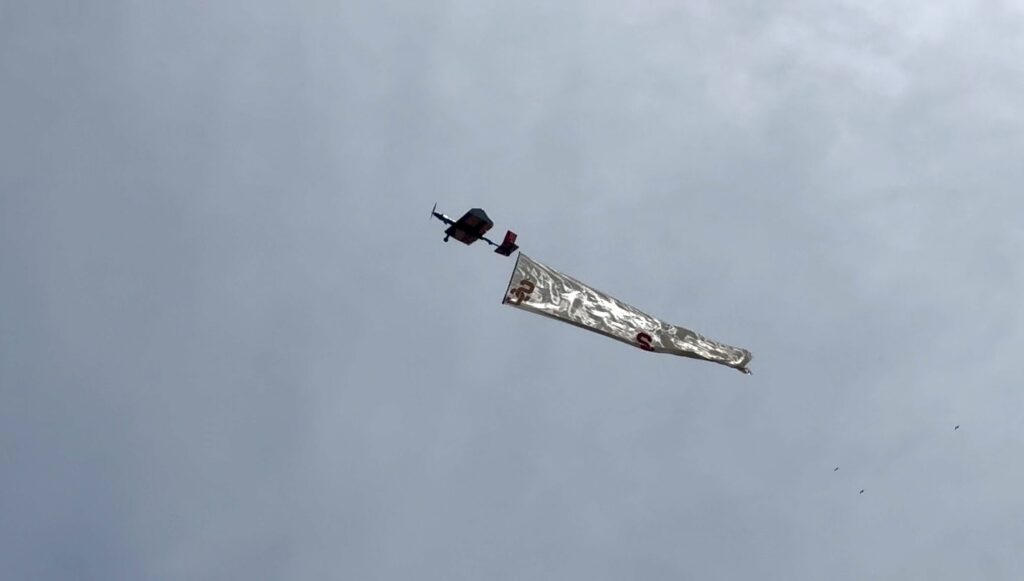
Ljubljana won the $3,000 first-place purse by maximizing its score for the banner length at 4.6 meters, flying it for seven laps and quickly completing the loading and unloading of its rubber duck “passengers,” although it sacrificed some scoring potential by only loading three ducks and one puck.
The University of Washington-Seattle came in second, receiving $2,000, and the University of California, Los Angeles took the $1,500 third-place prize.
A prize of $100 for best design paper submitted prior to the fly-off event went to the University of Southern California. The DBF organizing committee awarded its Stan Powell prize, recognizing the DBF team that showed it had learned the most, to Washington University in St Louis, which rebuilt its plane after a crash.
Petr Tupitsyn, captain of the UCLA team, said he was pleased with his colleagues’ performance under pressure, which he said offered great experience for a career in aerospace.
“The pressure really turned on today because, due to the weather, we only had one shot at our Mission 3 and that was our biggest mission for scoring,” Tupitsyn said. “That’s the one we’ve been testing all year and has caused many sleepless nights.”
CATCH THE RECAP: For the first time, AIAA livestreamed the fly-off. Watch it here.