
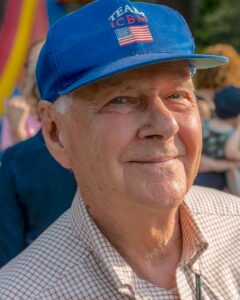
Noel Thyson died on 2 May. He was 87 years old.
Thyson received an M.S. in Aeronautical Engineering while he was a University Fellow and a B.S. with Honors in Aeronautical Engineering from the University of Illinois in 1960.
Thyson worked the summer of 1958 at North American Aviation on the X-15 rocket airplane, and thereafter as a research assistant at the University of Illinois while he completed his Master’s thesis, operating shock tubes and assisting in taking data on the transmission of electromagnetic waves through plasmas created by strong shock waves. After graduation, he accepted a job at Avco Systems Division in 1961 (bought by Textron in 1984), where he worked for 47 years, retiring in 2009.
He held many supervisory positions at Avco/Textron in the fields of aerodynamics, thermodynamics, flight mechanics and materials. Throughout his career, he was involved in the development of Air Force strategic missile systems, tactical weapons systems, space vehicles, and energy conservation technology. Much of Thyson’s research focused on hypersonic inviscid and viscous flow phenomena, nosetip material ablation phenomena, ballistic missile accuracy, internal flows associated with high powered lasers, high velocity impact phenomena, aerodynamic wind tunnel and hyperthermal arc testing, and energy conversion techniques. He authored some 20 papers in the field of aerodynamics over the course of his career.
Thyson began his career assessing the thermal protections systems for the Apollo missions and was part of the team that developed the AVCOAT 5026 technology for the heat shield that has been used in both missions to Mars and most recently NASA’s Artemis II to the moon. Most of his career was associated with Air Force Strategic Missile Forces, both offensive and Missile Penetration Aides (PENAIDS) weapon systems (decoy systems used by ballistic missiles to penetrate defense systems). Under his supervision, Operational and Flight Test Vehicles were designed and flight tested that included the aerodynamic design of the Mark 21 reentry vehicle and ascent shroud on the Peacekeeper (chosen as the payload for the new Air Force Sentinel ICBM in 2022) and the Operational Mark 11 vehicle aboard ICBM systems Minuteman I and II. He was well respected by all who served under his guidance as well as peers across the Air Force ICBM community, colleagues and competitors, alike.
As a long-time AIAA member, Thyson participated in the Missile Systems Technical Committee (1997–2010) and the Applied Aerodynamics Technical Committee (1994–1997). He received a distinguished Alumni Award in Aeronautical Engineering from the University of Illinois.