
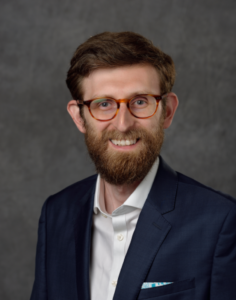
AIAA Member Patton M. Allison, age 38, died on 28 April 2025.
Allison earned both his bachelor’s and master’s degrees in Aerospace Engineering from Georgia Tech, before completing his Ph.D. in Aerospace Engineering at the University of Michigan. His academic journey took him from Ohio State University to the University of Cambridge in the United Kingdom. He was a cherished member of the international scientific and engineering society, The Combustion Institute, and a generous academic with a natural ability to connect people across the institutions he served.
In 2017, Allison joined the faculty of Michigan State University and made the Advanced Diagnostics and Combustion Lab his second home. As an Assistant Professor of Mechanical Engineering at MSU, he led distinguished research in combustion science and propulsion. In addition to being a brilliant researcher, he was a beloved teacher. A two-time recipient of the Withrow Teaching Award, he inspired his students with clarity, compassion, and a deep commitment to their success.
Allison was a member of the AIAA Propellants and Combustion Technical Committee for several years, and he was the AIAA faculty advisor for the MSU Student Branch from 2018 to 2025. He served as a faculty advisor to the Michigan State Rocketry Club and was an active supporter of the Society of Hispanic Professional Engineers. Through these roles, he helped build inclusive, hands-on learning communities and inspired the next generation of engineers to dream bigger and reach higher.
In honor of his many contributions to the college, university, and discipline, the annual Patton Allison Memorial Lecture was established by MSU; the inaugural lecture was held on 15 October 2026. Speaker Jenni Gibbons, Astronaut, Canadian Space Agency, and a former colleague of Allison’s, outlined the process of training for spaceflight to serving as a backup crew member for Artemis II, NASA’s first crewed mission to the moon in over fifty years. The lecture explored what it truly means to contribute to human spaceflight.