Structures in 2025: AI-powered composite analytics, material characterization for hypersonics and novel joint analyses
 By Cat Hofacker
 By Cat Hofacker
With support from AnalySwift and the state of Indiana, Purdue University is developing the AI-powered system CompositesAI to consolidate and deliver expert composites knowledge through the power of large language models. By integrating diverse data sources, including technical publications, material databases, simulation software, and expert insights, CompositesAI constructs a cohesive data ecosystem, and it enables real-time querying, analytics, and knowledge extraction through a chat interface, making sophisticated composites knowledge accessible to all stakeholders.
By mid-2025, CompositesAI was updated to include a user-friendly, multimodal chat interface and an optimized retrieval-augmented generation workflow. Future planned upgrades include an AI agent capable of providing tech support for customers and performing cross-sectional design and analysis using natural language. Once fully developed, CompositesAI will combine the precision of validated engineering software with the insights of world-leading experts.
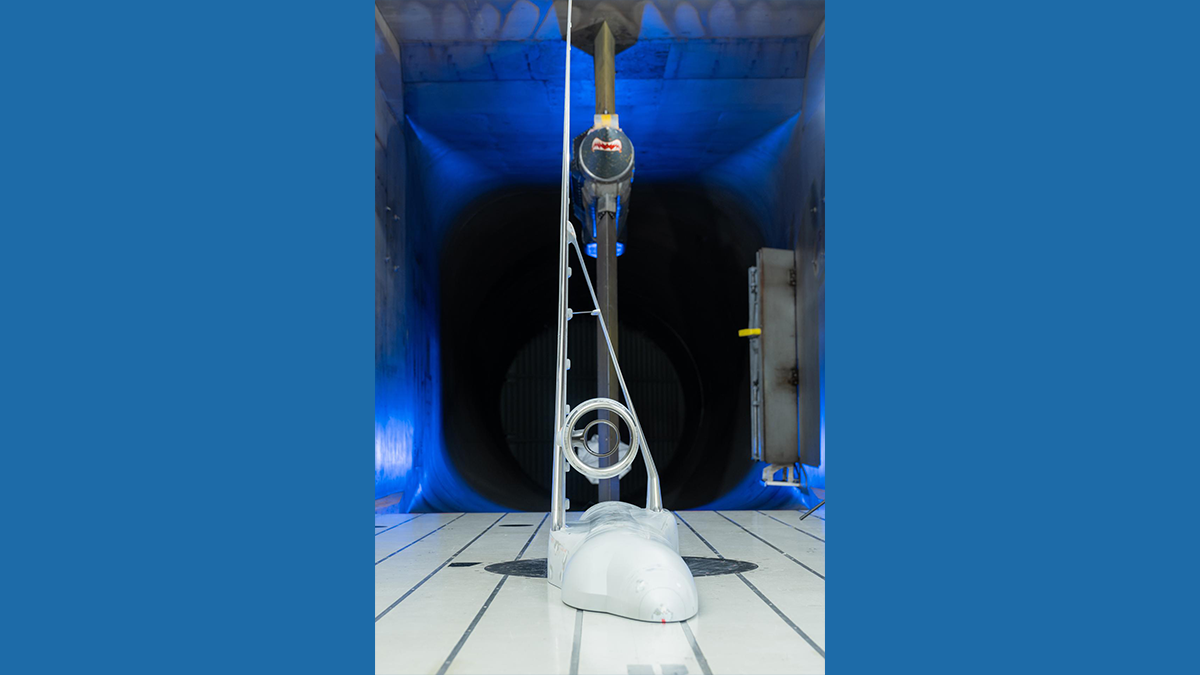
In April, NASA and Boeing decided to pause activities related to the X-66A. This demonstrator announced in 2023 was to be a major step toward demonstrating the fuel-saving potential of the transonic truss-braced wing (TTBW) concept. The new plan is not to conduct flight tests, but continue research on a simpler thin-wing design.
Based on a modified MD-90 aircraft, the TTBW concept was originally developed under NASA’s Sustainable Flight Demonstrator Project. The design integrates extra-long wings stabilized by diagonal struts, enhancing aerodynamic efficiency. In 2024, low-speed and high-speed wind tunnel tests were completed for almost 2-meter wingspan and 3-meter semispan models, respectively. The knowledge gained from the X-66A program and the continued research on thin-wing technology will still inform future aircraft designs of the truss-based configuration.
Lockheed Martin Aeronautics Advanced Development Programs partnered with Dassault Systèmes to introduce stability constraints into topology optimization and generative design. In 2025, developments included a novel approach that incorporates nonlinear analysis methods to constrain stability critical structures, which leads to more appropriately designed structural parts. By September, the team illustrated key differences in the resulting part design with increased performance when compared to linear-based topologies without stability constraints.
Throughout 2025, Texas A&M University Materials for Extreme Environments researchers characterized the thermomechanical response of aerospace composites in extreme environments involving vastly different loading conditions and timescales. Carbon-epoxy composites displayed markedly similar failure mechanisms and damage morphologies when exposed to direct flame exposure, simulated lightning strikes, or hypervelocity impacts. High heat flux, Joule heating, and shock-induced heating all resulted in local composite temperatures greater than 3,000 degrees Celsius as evidenced by pronounced matrix and fiber degradation. Such findings facilitate the development of novel materials and structures for hypersonic applications.
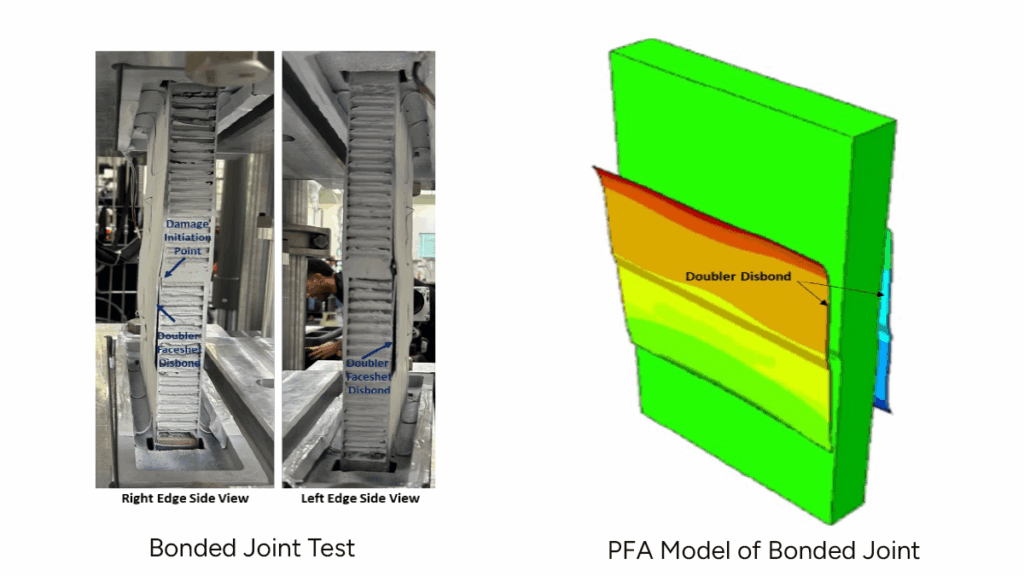
In February, researchers at NASA’s Langley Research Center in Virginia designed, analyzed and tested bonded composite joint samples to demonstrate their damage tolerance and validate a failure model. Samples were made by bonding laminate doublers to sandwich panel halves without using adhesive. A detailed analysis method, called progressive failure analysis (PFA), was implemented in the Abaqus software suite to predict when and how the samples would fail. Bond interface properties were derived from tests and used in the analysis. The failure mode observed in one of the test samples matched the pretest prediction very well, both in terms of how and when the failure occurred. This excellent correlation between the test results and the PFA model proved the model’s accuracy and predictive capability.
Researchers at the University of Michigan, Northrop Grumman and Arizona State University developed a predictive modeling strategy under the U.S. Air Force Research Laboratory FASTBUCS program to analyze the deformation response and failure of un-pinned and z-pinned pi joints. In January, the team accurately reproduced joint responses under different selected loading paths. The computational model is being further refined for efficiency (speed of computation) in relation to fatigue life prediction.
Contributors: Wenbin Yu, Zhenning Hu, Thomas E. Lacy Jr., Bruce Willis, Arunkumar Satyanarayana, Michael Rodrigues, Evan Pineda, Anthony Waas
Opener image: Wind tunnel tests on a Boeing-built X-66A model were completed in 2024 at NASA’s Ames Research Center in California’s Silicon Valley in its 11-foot Transonic Unitary Plan Facility. NASA and Boeing in April 2025 announced they would pause development of the demonstrator. Credit: NASA/Brandon Torres Navarrete