
Birds, wings and sonic booms: researchers adapt shapes to advance flight
 By Cat Hofacker
 By Cat Hofacker
The 2025 achievements included enhanced state-sensing technologies, avian-inspired adaptive capabilities and improved maneuverability and acoustic performance in subsonic and supersonic flight regimes.
Regarding basic research, various new flexible sensors and circuits capable of detecting physical changes in deformable bodies are being designed and developed through novel materials and fabrication techniques. Work at Texas A&M University focused on creating high-strain sensors for solid-state actuators made from shape memory polymers and shape memory alloys (SMAs) using eutectic gallium-indium liquid metal. Testing conducted in May showed that high-strain liquid metal sensors can withstand large local strains, conform to surfaces, and maintain consistent electrical performance over many deformation cycles.
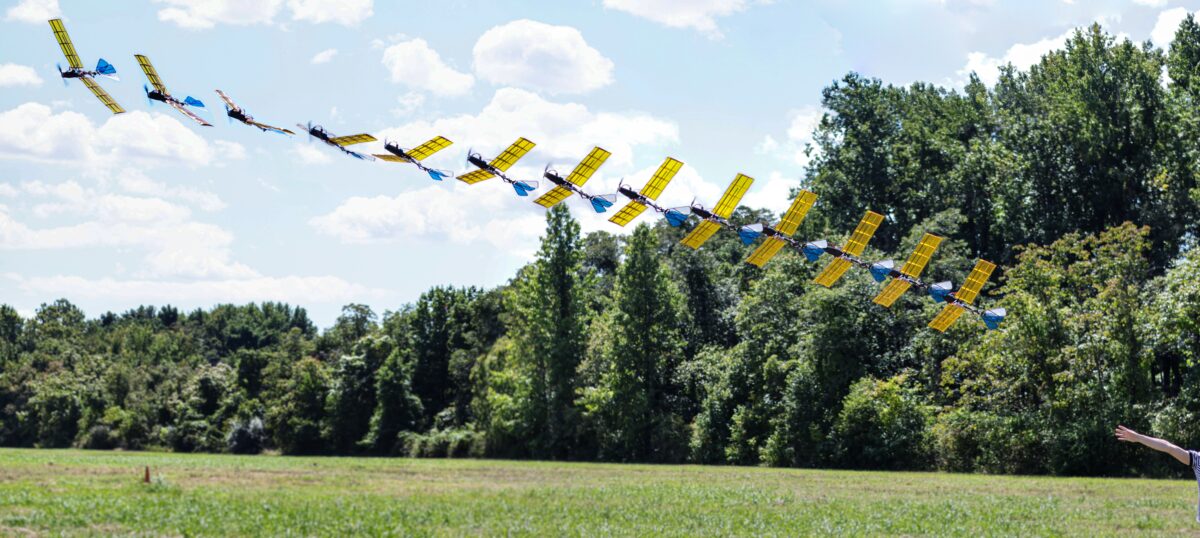
Progress was also made in the future of adaptive aerial vehicles, drawing on inspiration from avian species. From June to August, researchers from the U.S. Army Combat Capabilities Development Command (DEVCOM), Army Research Laboratory and the University of California, Davis demonstrated unpowered perching trajectories on a small uncrewed aerial system equipped with an avian-like morphing tail. Early results showed that the aircraft can rapidly reduce airspeed while preserving longitudinal pitch authority through large elevator deflections and tail area morphing.
In September, the UC Davis Bird Flight Research Center was completed. This unique facility will use state-of-the-art motion capture and 3D photogrammetric reconstruction to study avian and engineered vehicle kinematics and aerodynamics. By rigorously quantifying how birds fly in complex environments, the center aims to advance unsteady aerodynamic understanding and the morphing technologies that result.
Across the Atlantic, the morphAir project executed by the German Aerospace Center (DLR) explored a spanwise-differentiated morphing wing and a conventional reference wing for the PROTEUS technology demonstrator program. The conventional wing completed its first flight in March, followed by the morphing wing in July. Valuable flight data was collected, demonstrating the improved maneuverability of the morphing wing.
Simultaneously, researchers at Delft University of Technology worked on the Smart-X Beta wind tunnel demonstrator to investigate morphing wings as a pathway to sustainable flight. This demonstrator features three camber-twist morphing flaps, enabling spanwise control of lift and drag. The novel design expands the range of attainable morphing shapes to include reflexed airfoils by adding more chordwise flexibility. The wing was tested in February at a Reynolds number of 4 million and a free stream velocity exceeding 70 meters per second. Results demonstrated higher lift-to-drag ratios across all angles of attack and independent control of the aerodynamic pitching moment.
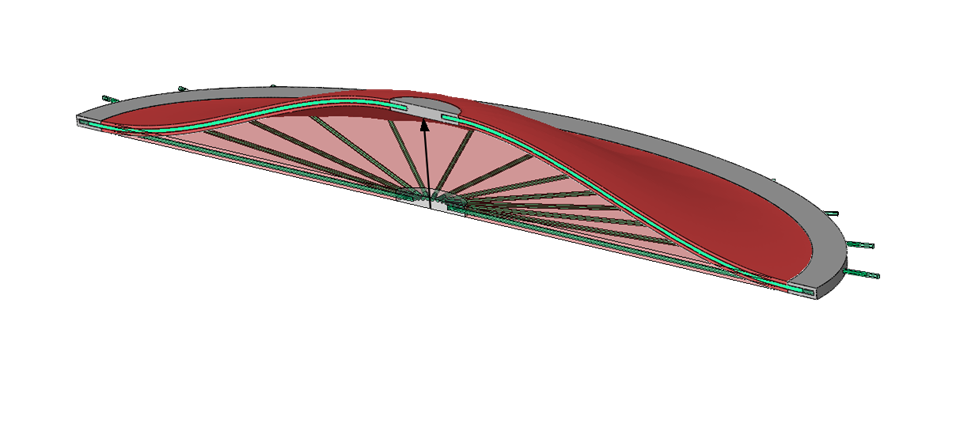
A final active area of research and development within the adaptive structures community centered on mitigating sonic booms to revive commercial supersonic travel. The NASA GoSwift Project (Geometry Optimization and Sensing with Integration and Flight Test) — executed by Texas A&M University, the University of Michigan, and Boeing — is one such effort teaming academic thought leaders with system-minded industrial partners. The goal is to reduce the perceived loudness of sonic booms using adaptive structures, and NASA has challenged the team to prove that such a concept is feasible via flight testing at Mach 1.5.
Following successful completion of a system requirements review in July, the team is continuing on toward a preliminary design review scheduled for late 2026, with a full-scale flight test in their sights. The flight experiment will incorporate an onboard lidar system to drive real-time shape change actuated using SMAs, resulting in the first full-scale supersonic adaptive structures flight test to date.
Opener image: A time lapse photo of flight tests conducted in mid 2025 with an aircraft employing an avian-like morphing tail. Tests tracked the body-tail pose, velocity and position for trials of fixed deflections and actively controlled tail-pitch. Credit: Todd Henry/U.S. Army DEVCOM Army Research Laboratory