Space Force releases two documents focused on 2040 planning


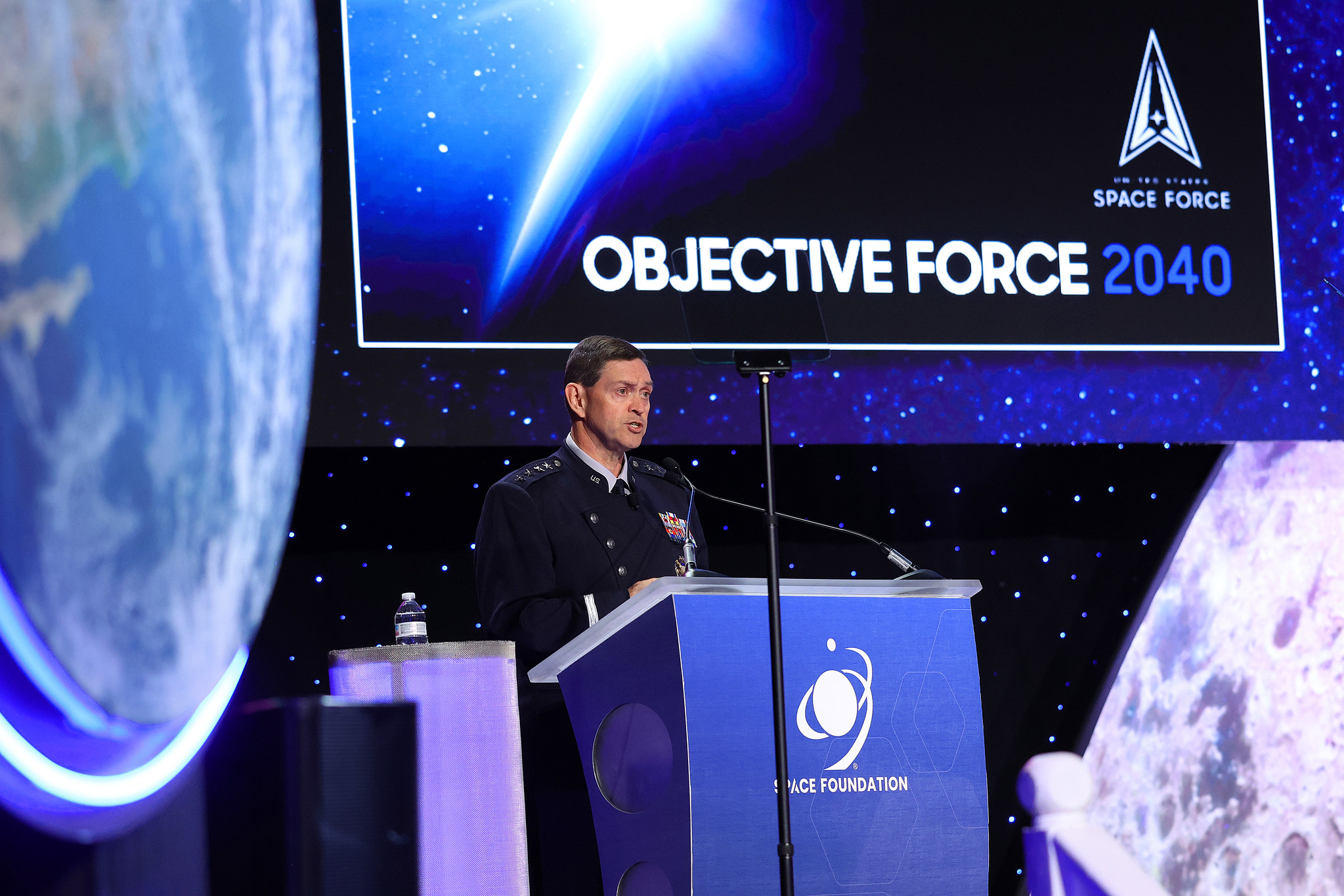
SPACE SYMPOSIUM, COLORADO SPRINGS, Co. — The U.S. Space Force on Wednesday announced the release of two future-focused documents: Future Operating Environment 2040 and Objective Force 2040.
Gen. B. Chance Saltzman, the chief of space operations, announced both before an audience here. He described Future Operating Environment 2040 as “a conceptual view of a future where our space superiority efforts must contend with new technologies, new threats, new missions and new ways of war.”
The document “will serve as a point of departure and a catalyst for the growth and change that the future of space warfighting will demand,” Saltzman added, noting it’s not an intelligence assessment. “Because this approach is visionary and predicting the future is tough, it will certainly get some things wrong. But on the new battlefield it describes, one reality becomes clear: The Space Force we have today is not the Space Force we need to secure the future domain.”
The nearly 70-page document identifies China as the pacing threat for the Space Force.
“The People’s Republic of China (PRC), and to a lesser extent the Russian Federation, are pursuing strategies to transform outer space from a civil commercial frontier into a fully contested battlespace,” the document reads. “Both are developing offensive and dual-use capabilities designed to hold at risk the space-enabled lifelines that Americans and their allies rely on every day — positioning, navigation, and timing (PNT), financial clearing and trading, global communications, and weather and disaster response.”
During a media briefing shortly after his remarks, Saltzman stressed that the document is not meant to draw conclusions, but instead to raise questions. “There is no intent to square this with a strategy because it is not a strategy,” he told reporters. “It is simply one vision, one conceptualization of what the future could be.”
The Space Force also on Wednesday released an unclassified version of its Objective Force 2040 report.
“We’ve analyzed Space Force missions, including navigation warfare, satellite communications, missile warning and many others in great demand by the joint force, and, through our assessment of these vital mission areas, we’ve built a framework for the systems, formations, support structures that we will need for the next 15 years,” Saltzman told the audience here.
He said the document defines the “enduring Space Force objectives” for each mission and details the required capabilities, which current and future capabilities will best integrate into the force and the required timelines and quantities.
“Take navigation warfare, for example. The Space Force faces sweeping threats from jamming to physical attack against our most widely used capability,” Saltzman said. “To protect that capability, the Objective Force calls for diverse allied and commercial navigation and timing systems to augment future GPS, all underpinned by interoperable data systems.”
According to the 100-page document, the Space Force must double its personnel over the next 10 years, realign its organizational structure and modernize its infrastructure.
Calling the document a “starting point,” Saltzman told the audience that “we want it to spark discussion, we want your feedback — but we also need you to use this as a blueprint to align your priorities with ours.”
He told reporters both documents will receive annual updates.