

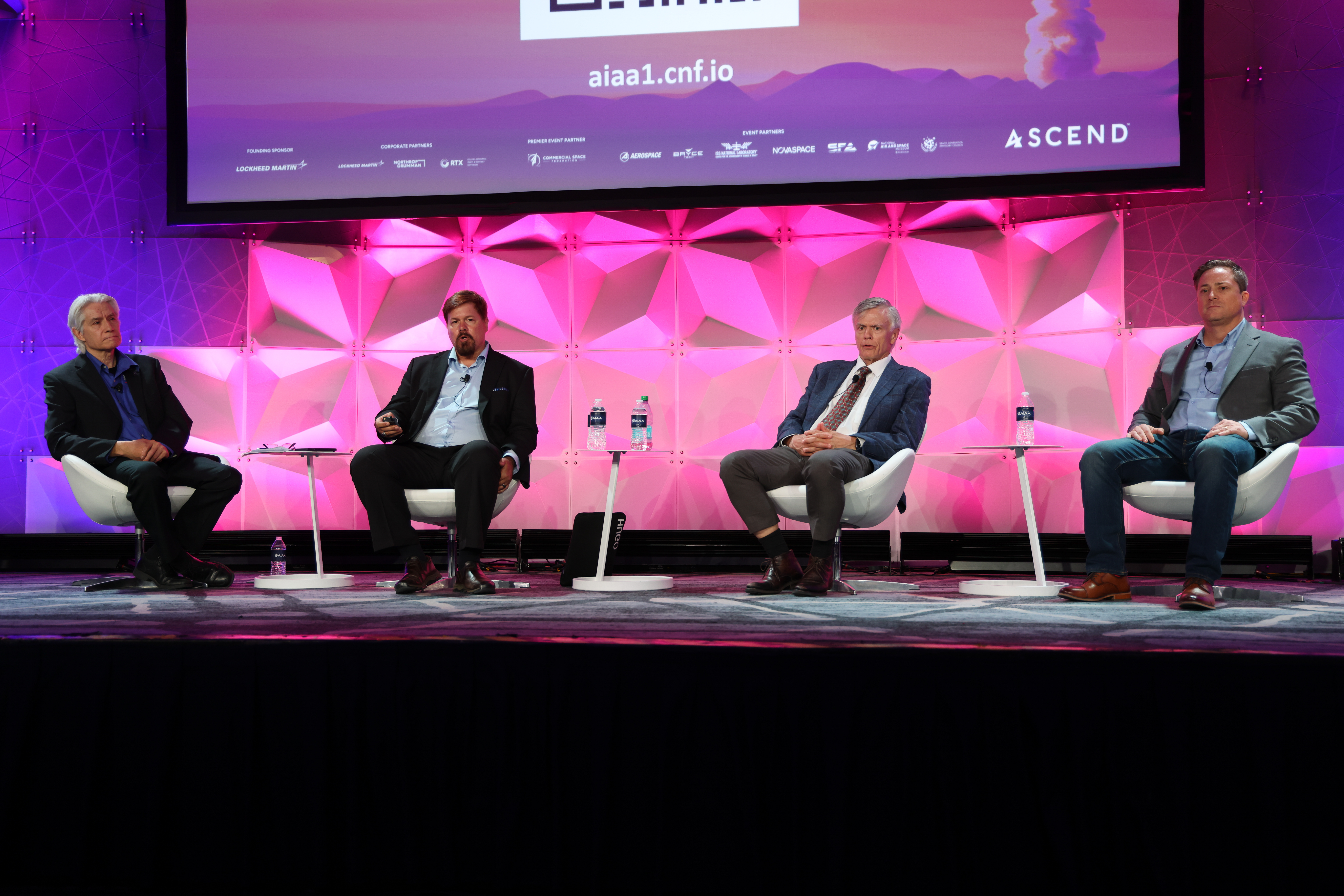
WASHINGTON, D.C. – As the United States confronts its great power competition with China to the moon, NASA and policy and commercial space experts shared current thinking on how to accelerate developing the lunar environment — and why it matters.
“We are in a great power competition with China,” said Peter Garretson, senior fellow and co-director of Space Strategy Initiative, American Foreign Policy Council. He summarized China’s ambition “to build a $10 trillion a year moon‑earth economic zone by 2050 and to industrialize the moon.”
Charles Miller, a longtime space entrepreneur and policy strategist, predicted that whoever dominates commercial space industries and resources will become the preeminent military space power — and thus dominate Earth. He draws an analogy to maritime history, where Britain and then the United States became dominant military powers by first becoming dominant commercial maritime powers.
Miller said the United States should develop the moon the same way people approach a commercial real estate project. This approach de-risks investment and unlocks capital. It also “survives changes in political leadership – like water, electric, airport and port authorities on Earth.”
He used CERN (The European Organization for Nuclear Research) as a model, noting, “Over 20 countries in Europe now are part of CERN… [It is] the largest nuclear research organization in the world, because of stability and trust built over time.”
The goal, he explained, is to create a stable governance framework that can cut through political and regulatory uncertainty, give companies clear mining and usage rights, and unlock private capital to build out lunar infrastructure.
Miller said a shared authority would invite U.S. allies and partners to work together and coordinate long-term development of a scalable industrial hub capable of supporting mining, manufacturing, and permanent human presence.
The discussion then turned to a proposed Lunar Innovation Park, as envisioned by NASA’s Space Technology Mission Directorate and collaborators at NASA Langley Research Center and NASA Glenn Research Center.
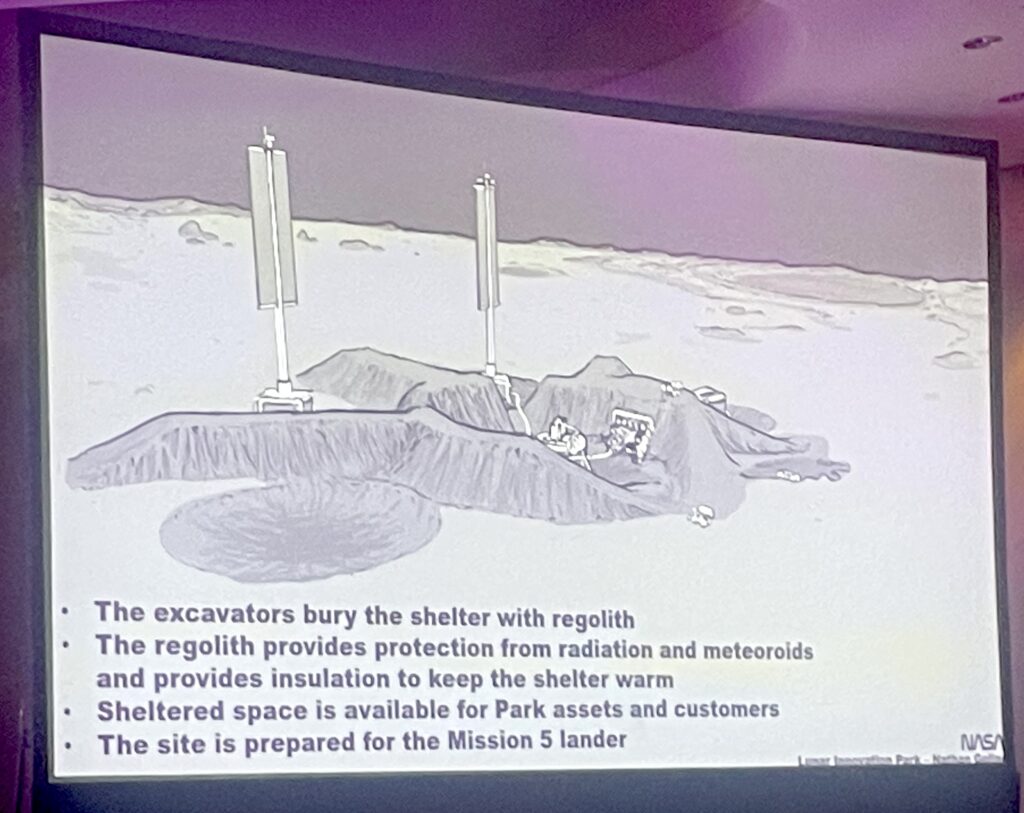
Nathan Gelino, who serves as senior principal investigator – Off Earth Excavation and Construction at NASA Kennedy Space Center, worked on the design. He explained that the park must support tightly co‑located landings — as close as 20 meters apart. A series of CLPS‑class landers would deliver vertical solar arrays, the IPEX and later CPEX excavation platforms, energy storage, and ultimately ARMADAS self‑assembling structures and buried shelters. Over time, excavation robots would build berms and pads, enabling reusable launch/landing sites and a local power grid.
A financial assessment, Gelino said, shows that once “three or four missions” use park services for power, communications, and logistics, the park pays for itself because individual missions no longer need to be fully self‑sufficient.
Success, he added, will depend on clearly communicating to industry NASA’s plans, so companies understand requirements and can contribute their expertise and technology. NASA must also tolerate risk, learning from mistakes as part of the process.
Miller linked that mindset to a broader philosophy where “you get rid of risk by having many shots on goal, mitigating risk by diversification, but you’re maximizing the rate of learning and development.”
Garretson endorsed the Lunar Innovation Park as “much more credible than the overall Artemis moon base as it’s currently conceived.”
The experts agreed that a park — backed by an authority‑style governance model, precision robotics, and a willingness to embrace risk — increases the likelihood that U.S. lunar ambitions succeed.