

ISS programming opens new doors for researchers, entrepreneurs – and inspires a race to preserve its legacy
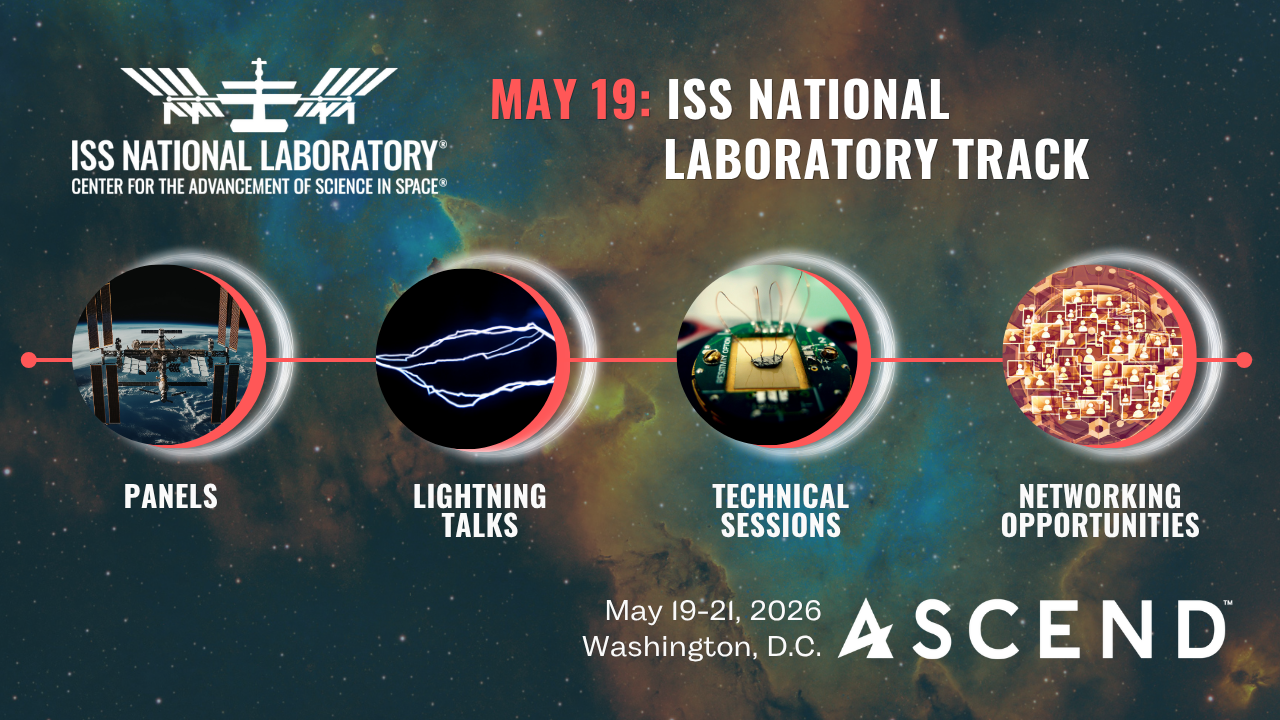
The International Space Station (ISS) National Laboratory will bring a full day of programming to ASCEND 2026 on Tuesday, 19 May, plus nearly 60 technical papers on ISS utilization and space-based research expected to be presented on Wednesday and Thursday, 20–21 May. From microgravity-enabled medical breakthroughs to startup innovation in low Earth orbit (LEO), the ISS National Lab sessions are designed to show how researchers and commercial players alike are using the orbiting laboratory as an engine for science, technology, and a sustainable space economy.
Meanwhile, the Smithsonian’s National Air and Space Museum will use the gathering to rally the space community around a different but equally urgent mission: preserving the station’s legacy before the space station is deorbited.
Amy Elkavich, director of Communications for the ISS National Lab, said the organization’s strategy at ASCEND centers on demonstrating utilization and showcasing space-based results.
“We’re invested in enabling access and opportunity to leverage the ISS,” Elkavich said, noting that the programming is designed to demonstrate how academia, industry, and government are using the ISS for both fundamental and applied research and enabling a space economy in the process.
Managed by the Center for the Advancement of Science and Space (CASIS), the ISS National Lab has helped sustain a continuous human presence in LEO for nearly 26 years. At ASCEND, the organization is focused on expanding the community that benefits from it.
Early-Stage Startups Invited to Apply for Orbital Edge Accelerator by 26 May
A centerpiece of 19 May’s track will be a dedicated session on the 2026 Orbital Edge Accelerator, a one-of-a-kind program that provides early-stage startups with both access to LEO and $500,000–$750,000 in private capital funding per company.
Elkavich explained the accelerator features two tracks: Sentinel, focused on space technologies and dual-use applications, and Disrupt, geared toward in-space manufacturing and space biology opportunities. Participating startups also receive targeted mentorship, business-building support, and the chance to compete for a Boeing-sponsored prize worth up to $1 million in nondilutive funding. For ASCEND attendees just learning about the program, the application window remains open through 26 May to apply.
State of Microgravity Research
Beyond startups, the ISS National Lab will use ASCEND to offer attendees a current look at the state of microgravity research. A morning panel will provide a programmatic update, underscoring how the station has served as the world’s only continuously operating microgravity research platform for more than two decades—enabling advances ranging from cancer therapeutics to bio-printed human tissues.
Elkavich said she’s most looking forward to the “Space Research for a Healthier Future” session, which will spotlight biomedical research teams whose ISS work is shaping the future of human health both in orbit and on Earth. Attendees will hear from Kenneth Mayuga, the founding director of the Space Health Center in the Heart, Vascular, & Thoracic Institute at the Cleveland Clinic. The panel also will feature Kate Rubins, a retired NASA astronaut and the inaugural director of the Trivedi Institute for Space and Global Biomedicine at the University of Pittsburgh, who will discuss her current work and her experiences on station conducting human health-related investigations.
Elkavich believes the ISS National Lab’s presence at ASCEND is ultimately about demonstrating utilization – not just showcasing flagship projects, but helping a broader range of researchers and entrepreneurs understand the opportunities available through the ISS National Lab.
“We hope that attendees will learn more about what’s possible when conducting ISS National Lab-sponsored research and hear about what our partners are doing to advance a sustainable space economy that supports space-based research and development,” she said.
ISS Palooza Trivia Game Returns
Rounding out the day, the ISS National Lab will reprise “ISS Palooza,” a trivia-style game show that puts attendees’ knowledge of ISS research, investigators, and on-orbit achievements to the test – a lighthearted close that reinforces the day’s key themes. A “by the numbers” lightning-talk session will walk attendees through the latest statistics and outcomes from ISS National Lab-sponsored investigations and activities.
Artifacts Needed: Capturing the Heritage of the ISS
Alongside the ISS National Lab programming, the Smithsonian’s National Air and Space Museum is bringing its own mission to ASCEND 2026: rallying the space community around preserving the station’s legacy before it is deorbited.
According to Smithsonian curator Jennifer Levasseur, the museum is organizing a trio of back-to-back ISS Heritage sessions on Thursday, 21 May, that will tackle the “why, what, and how” of ISS preservation – why the legacy of the ISS matters, what artifacts should be saved, and how the story of continuous human presence in LEO can be told through real hardware and lived experience.
“ASCEND this year especially seems to have become the major gathering point for all of the communities we can imagine wanting to reach out to – to start thinking about how to do this in a more strategic way, rather than a very haphazard one,” Levasseur said.
By convening engineers, scientists, companies, universities, and museums under the same roof, the Smithsonian team hopes to surface ISS hardware, stories, and other significant materials that are already on Earth and build it into a shared, global heritage story.
The ASCEND conversations will feed directly into the museum’s new “At Home in Space” exhibit, opening in October, which focuses on what it’s like to live aboard the ISS day to day. Levasseur and her colleagues are particularly interested in artifacts that capture the human side of station life – what she calls the “kitchen table” of the ISS, where crews gather as a community, and symbolic items like the ISS ship’s bell, a military tradition that the ISS crew carries forward to mark changes of command. By identifying and preserving objects like these, alongside cutting-edge experiment hardware, oral histories, documents, and other unique materials, the Smithsonian hopes to give future visitors a tangible sense of the ISS as both a scientific platform and a lived-in home in LEO.
Together, the ISS National Lab and the National Air and Space Museum’s presence at ASCEND 2026 frames the station from two complementary angles: as an active platform driving the next generation of scientific and commercial breakthroughs, and as a historic achievement worth preserving for the generations that will follow.