

At AIAA AVIATION Forum, Penn State aerospace chair warns that today’s autonomy architectures misplace responsibility on humans while asking them to do a job they’re fundamentally bad at: monitoring rare failures.
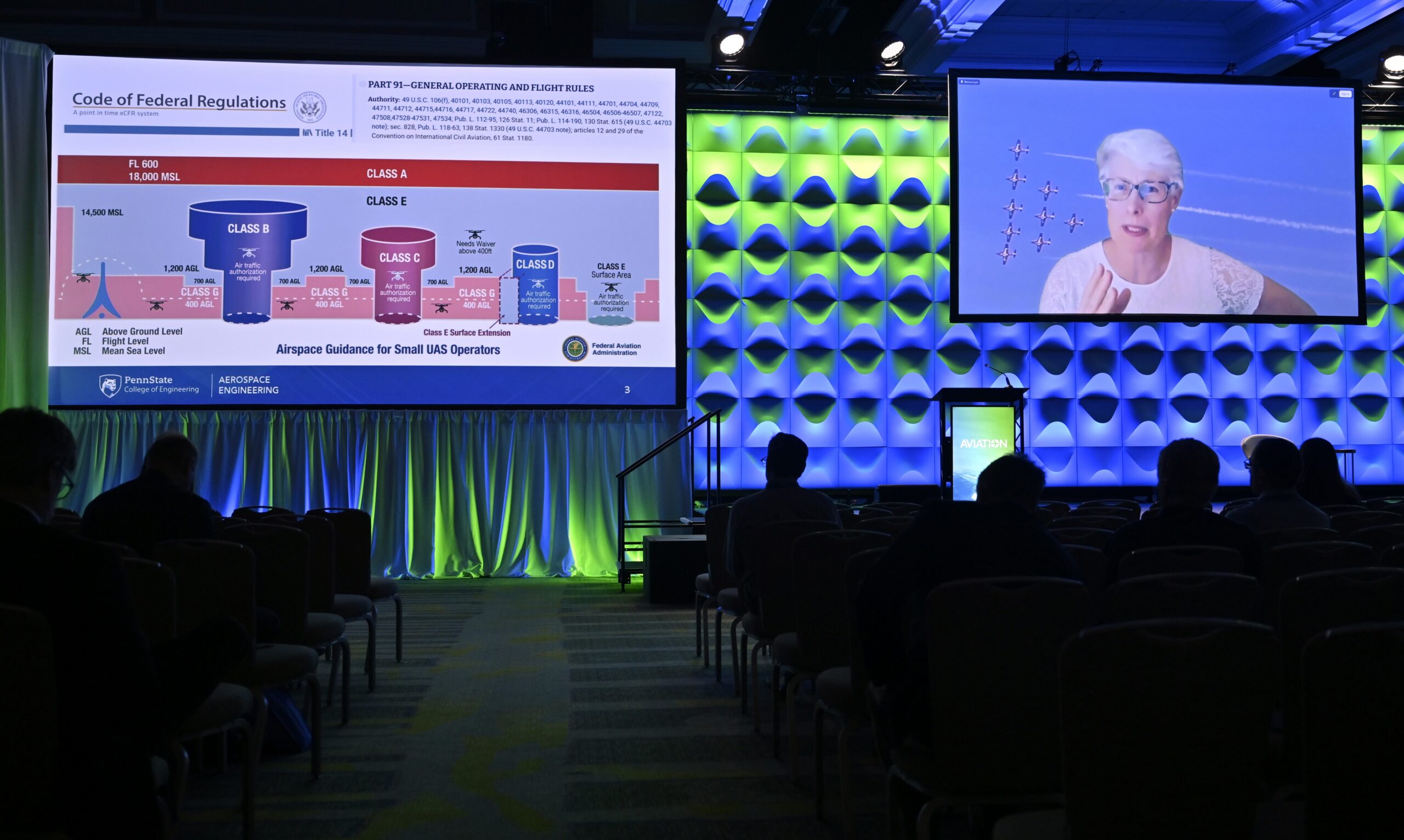
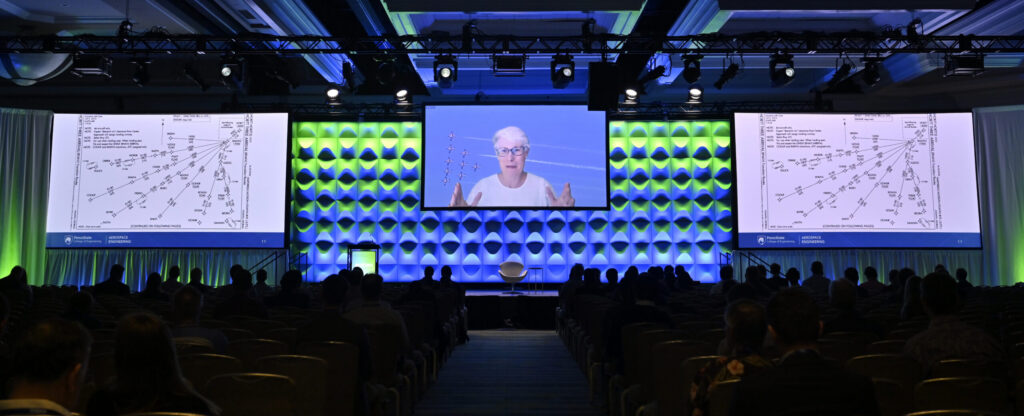
SAN DIEGO – On the final day of AIAA AVIATION Forum 2026, Amy Pritchett, head of the Department of Aerospace Engineering at Penn State University, challenged the aerospace community to rethink how it designs autonomy for the global airspace system – shifting from a focus on “human vs. autonomy” to human-autonomy teams built on interdependence, shared responsibility, and explainable behavior.
The AIAA Fellow argued that aviation still treats autonomy as an independent actor that “grabs the controls” while humans are relegated to passive overseers. That model, she suggested, is fundamentally flawed for a tightly coupled, safety-critical system like global airspace.
“Autonomy implies independent – but is anything fully autonomous? Should it be?” she asked. “Do we clear any aircraft for takeoff saying, ‘Hey, go do whatever you want’? No, we do not.”
Citing U.S. Air Force planning guidance, she noted that even in defense contexts, autonomy is increasingly framed as a team member, not a standalone agent. The real design challenge, she said, is creating interdependent architectures where human and machine roles are explicitly coordinated, not just partitioned function-by-function.
“It is harder to design an interdependent interactive system than to design an independent system,” she said. “But this is the challenge for our age right now in human-autonomy teaming.”
Authority vs. Responsibility: A Misaligned Contract
A central theme of Pritchett’s talk was the legal and ethical gap between authority and responsibility in current aviation regulations. Under FAA rules, including Part 91.3, the pilot in command – even a remote pilot – is legally responsible for the outcome of the flight, regardless of how much automation is in use.
“A human can delegate authority to another agent, like the autonomy,” she explained. “They can revoke it. But the human cannot delegate responsibility for the safe outcome. That’s on them.”
The result, she warned, is an architecture where autonomy is free to “do what it wants, how it wants,” while humans are expected to supervise increasingly complex systems, detect subtle problems in time, and then instantly take over – often in situations they rarely practice.
“Human operators are poor monitors,” Pritchett said, referencing a 1951 National Research Council report that is still, in her view, underappreciated. “It is hard to just sit and stare at this thing. We are humans – we have many superpowers, but that is not one of them.”
She called out a core design failure: most autonomy lacks the ability to recognize its own limits and call for help. Without that, she said, “the supervisor’s job is to sit there and wait for something to happen and make certain that you intervene fast enough to recover the situation,” often with incomplete observability and eroding hands-on skills.
Humans Are Doing Much More Than “Causing Errors”
Pritchett pushed back against the narrative that autonomy is needed primarily to eliminate “pilot error.”
“I’ve often heard that we need more autonomy because pilot error is so common,” she said. “Well, of course they’re involved in accidents – they’re on the airplane trying to fix it. Pilots are involved in 100% of accidents. They’re there.”
Drawing on operational data, she highlighted that technical malfunctions occur in roughly 20% of normal commercial flights, typically handled quietly by pilots as part of routine work. In just over half of accidents, something technical fails and pilots are unable to resolve it – but that statistic ignores the countless times they succeed.
“Normal includes constantly dealing with things that are off and need to be corrected,” she said. “Pilots routinely, frequently mitigate safety and operational risk – because that’s normal.”
She tied this to aviation’s extraordinarily high dispatch reliability. “We get this amazing dispatch rate in large part because the pilots can take over for anything that fails,” she noted.
Designing Autonomy that Works as a Teammate
Looking ahead, Pritchett urged the community to measure autonomy by its teamwork skills, not just its technical performance.
“If you want to say that we have a human-autonomy team, then I want to see all the members of the team behaving healthy and proud,” she said. That means autonomy that:
- Announces what it is doing and why
- Knows when it is reaching its limits and explicitly asks for help
- Adapts to changing goals and conditions
- Explains its strategies in operationally relevant terms that a busy pilot or controller can quickly grasp
“One pilot would say to the other, ‘I’m going to decrease the speed to maneuvering speed if we hit any turbulence,’ and explain their strategy,” she said. “It’s not enough to say we’ll make a learning system that will adapt that way. It also needs to explain what’s going on as part of the team.”
She also suggested reassigning some “boring and dull stuff” to automation – such as routine radio calls and wide system checks – while preserving pilot flying skills and engagement.
“The FAA has already issued a safety alert to promote pilots flying more,” she noted. “That’s a change from our assumptions in engineering, where we assume we want autonomy to do everything.”
Following the session, Rhea Liem, an associate professor of aeronautics at Imperial College London, who helped chair the multidisciplinary design optimization session, said students shouldn’t fear being replaced by autonomy in one of the world’s safest and most complex transportation systems.
“Students worry they’ll be useless because of machines and autonomy, but we just have to outsmart the machine,” Liem said. “We’ll always be useful if we make ourselves useful. As technology evolves, our education has to evolve too.”
She predicted that the human-machine relationship in aviation will keep evolving, but in ways that shift roles rather than erase them, putting pressure on education to prepare students to “control the autonomy instead of being controlled by the machine.”